Bio Korea 2023
Kim Chi-won, Kakao Ventures Partner
"Warnings That Directly Help Patients Will Become Possible"
Ryu Jae-jun, Naver Cloud Director
"Recommendations for Personalized Treatments Will Become Possible"
"If we can collect data before a situation occurs to the patient, it can directly help the patient. If we gather and analyze data well, we can create medical knowledge that allows intervention before a disease develops."
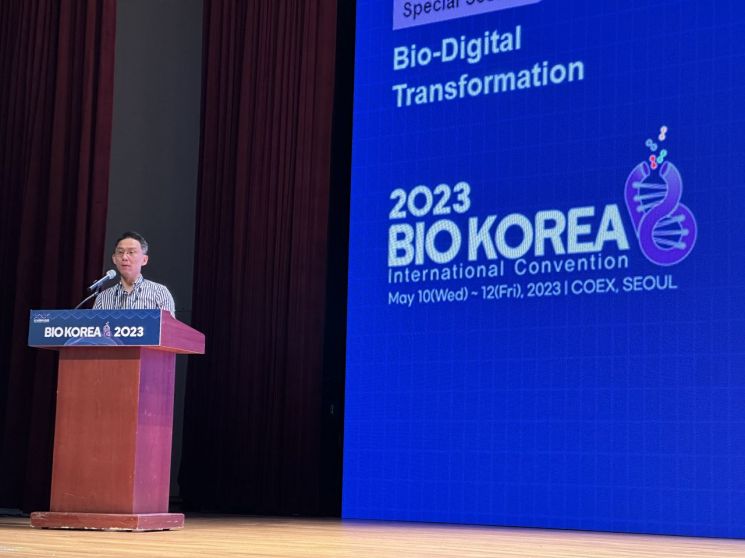 Kim Chi-won, partner at Kakao Ventures, is giving a lecture at 'Bio Korea 2023' held at COEX in Gangnam-gu, Seoul, on the afternoon of the 10th.
 [Photo by Lee Chun-hee]
Kim Chi-won, Partner at Kakao Ventures, defined the main purposes of digital healthcare during his lecture at 'Bio Korea 2023' held on the afternoon of the 10th at COEX in Gangnam-gu, Seoul, as "improving medical accessibility, enhancing the quality of healthcare, reducing costs, and creating new technologies," emphasizing that especially by utilizing data, it is possible to advance to predictive medicine that can forecast disease onset.
As a concrete example of the impact that arises when digital technology meets data, Partner Kim cited blood glucose measurement. He noted, "Previously, patients often did not measure their blood sugar diligently, and even if they did, they did not record it, and even if recorded, they often did not bring the small notebooks to the hospital." However, he pointed out that if blood glucose levels are simply input automatically into a smartphone via Bluetooth, "the moment people realize they forgot their smartphone, they turn back home," and "100% of the data reaches the hospital." Partner Kim further mentioned examples where digital healthcare can be usefully applied, such as a kind of 'artificial pancreas' combining blood glucose measurement with an insulin pump, a device that can easily measure atrial fibrillation for two weeks, and cases enabling polysomnography to be conducted in actual home environments rather than hospitals.
Summarizing these points, Partner Kim explained the significance of digital healthcare by saying, "In the past, everything happened in hospitals, and even if data accumulated, it was rarely used well for the patient," and "Now, if data is measured outside the hospital, analyzed in real time, and then used for therapeutic intervention in a well-functioning cycle, it becomes possible to help people as needed."
Partner Kim also provided an analysis that if digital healthcare development continues and leads to the creation of new technologies, 'predictive medicine' will become possible. He said, "If wearables capable of real-time electrocardiogram measurement without any separate action emerge, not only data after myocardial infarction but also the patient's 'usual data' can be known," adding, "Analyzing this could enable warnings such as a myocardial infarction possibly occurring in five minutes."
However, he also pointed out that there will be many challenges to collecting data at this level. Partner Kim stated, "People want to see what value it has for them immediately," and "When asked 'What's good about it?' after requesting device wear to collect data, the only answer can be 'It might predict myocardial infarction later,' which has its limitations." He emphasized that overcoming this requires efforts such as national support to collect data.
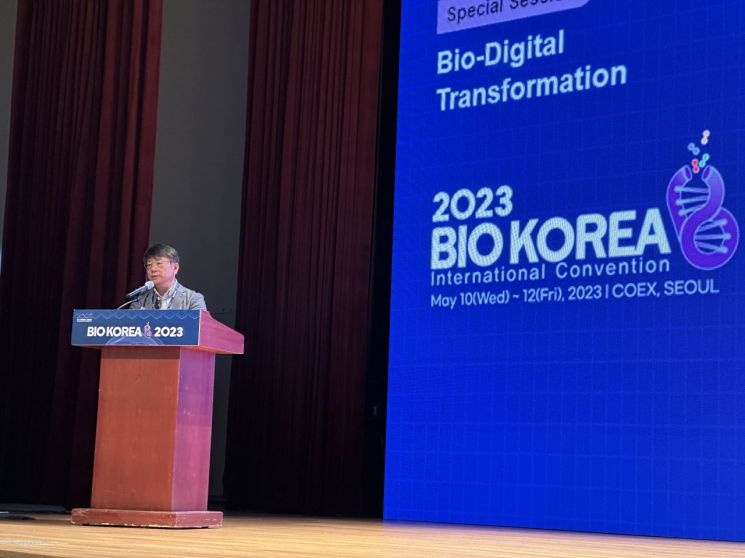 Ryu Jae-jun, General Manager of Naver Cloud, is giving a lecture at 'Bio Korea 2023' held at COEX in Gangnam-gu, Seoul, on the afternoon of the 10th.
 [Photo by Lee Chun-hee]
Earlier in the lecture, Ryu Jae-jun, General Director of Naver Cloud, also stated that data will be the most important keyword in the future of digital healthcare and presented the possibility of precision medicine through it. Using diabetes as an example, Director Ryu said, "Diabetes has many cases due to genetics, onset timing, disease status, and presence or absence of complications, so a lot of data must be collected," adding, "By using data as a reference, it will be possible to predict diabetes onset and recommend treatments that have been effective for people with similar lifestyles."
Director Ryu emphasized the importance of standardization and cloud for such data collection. He said, "Each hospital's electronic medical records (EMR) are all different," and "there is a need to standardize data collection." He added that through government-led projects such as the Ministry of Science and ICT's P-HIS project, the Ministry of Health and Welfare's 'My Healthway' project, and the medical big data platform construction project, various tools usable in medical settings are expected to be developed. Furthermore, "There is a need to build a cloud that securely stores data without allowing external export," and "This allows only results to be taken out, and even then, only with permission from the data owner," he also pointed out.
© The Asia Business Daily(www.asiae.co.kr). All rights reserved.
![User Who Sold Erroneously Deposited Bitcoins to Repay Debt and Fund Entertainment... What Did the Supreme Court Decide in 2021? [Legal Issue Check]](https://cwcontent.asiae.co.kr/asiaresize/183/2026020910431234020_1770601391.png)
















