March Youth Nationwide Apartment Purchase Share 31%
Mapo Reaches 46.7%, Suwon 44.1%
Apartment purchases by young adults aged 20 to 39 are increasing again. The proportion of apartment purchases by this age group, which had fallen below 30% since January last year, recovered to the 30% range for two consecutive months in February and March this year. In particular, in Seoul and Gyeonggi Province, the purchase proportion by young adults exceeded 35%, showing a clear upward trend.
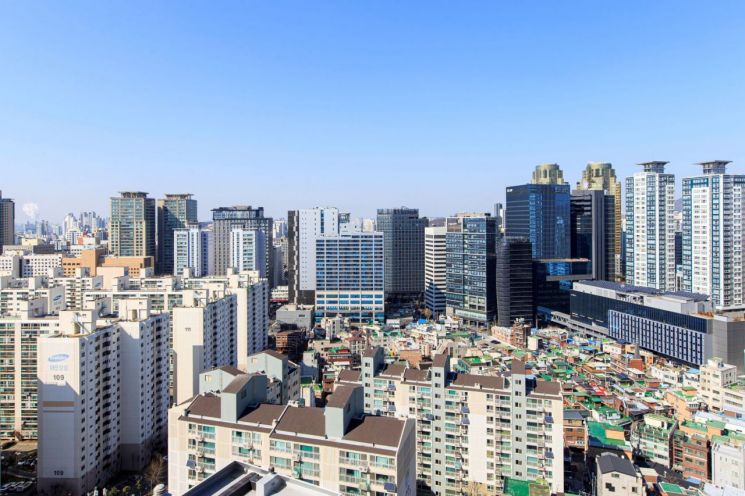 A panoramic view of the Mapo-gu area in Seoul, where the proportion of apartment purchases by young people significantly increased last March.
According to statistics from the Korea Real Estate Board on the 11th, there were a total of 38,926 apartment sales transactions nationwide in March, of which young adults accounted for 31% (12,226 transactions). This marks two consecutive months in the 30% range following February (31%).
Apartment purchases by young adults were actively made in the metropolitan areas such as Seoul and Gyeonggi Province. In Seoul, the proportion had dropped to 24.8% in June last year but recovered to the 30% range in January this year, then sharply increased to 34.7% in February and 35.9% in March. In Gyeonggi Province, the proportion of young buyers, which had fallen to 30.2% in July last year, rose to 36.4% in February and March this year.
Notably, the proportion of apartment purchases by young adults was higher in areas with excellent 'proximity to work.' In March, the proportion of young adult buyers in Mapo-gu, Seoul was 46.7%, and in Suwon during the same period, it was 44.1%. In Seoul, areas with relatively affordable housing prices such as Nowon and Gangseo also saw young adults accounting for 43% and 50% of purchases, respectively.
The increase in apartment purchases by young adults is largely attributed to the launch of the Special Bogeumjari Loan and the relaxation of the loan-to-value ratio (LTV) for first-time homebuyers. The Special Bogeumjari Loan, introduced at the end of January this year, offers fixed-rate loans in the 4% range up to 500 million KRW for homes priced under 900 million KRW regardless of income. Additionally, for first-time homebuyers, the LTV was allowed up to 80% regardless of regulatory areas.
According to the Korea Housing Finance Corporation (HF), during the two months of February and March when the proportion of young adult apartment purchases increased, the number of Special Bogeumjari Loan applications totaled 113,000, amounting to 25.6 trillion KRW.
Meanwhile, some concerns have been raised that the rapidly increasing apartment purchases by young adults could lead to debt repayment burdens, due to high debt relative to assets and income uncertainty.
An official from the financial sector said, "In the era of low interest rates, real estate and stocks have become popular, leading to trends like 'debt investment' (borrowing to invest) and 'Eolgul' (borrowing to the limit) among young adults. As a result, their loans have increased by nearly 30% over the past three years. Especially since the second half of last year when interest rate hikes began, delinquency rates among young adults have been rising. We are closely monitoring the situation as more young adults are acquiring real estate through aggressive borrowing again."
© The Asia Business Daily(www.asiae.co.kr). All rights reserved.
![Clutching a Stolen Dior Bag, Saying "I Hate Being Poor but Real"... The Grotesque Con of a "Human Knockoff" [Slate]](https://cwcontent.asiae.co.kr/asiaresize/183/2026021902243444107_1771435474.jpg)
















