When the trust company managing the land in Osan City owned by former President Jeon Du-hwan's family faced the risk of losing 5.5 billion KRW in auction proceeds due to losing an administrative lawsuit, it raised an objection to the execution of the confiscation itself.
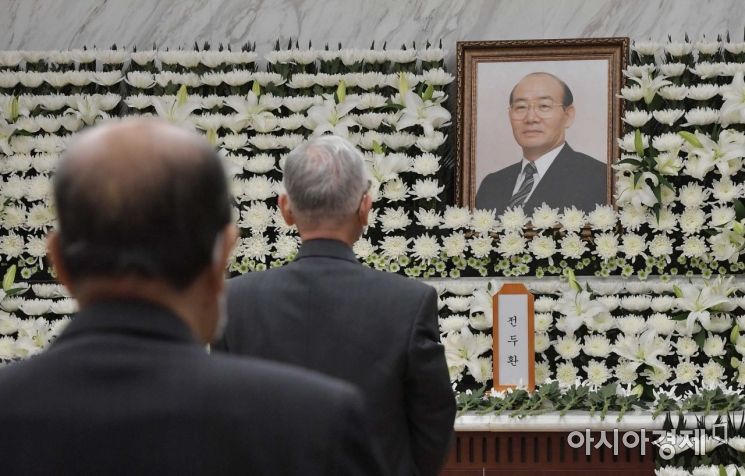 Visitors continue to pay their respects at the funeral hall of former President Jeon Du-hwan, set up at the Yonsei Severance Hospital funeral hall in Sinchon, Seodaemun-gu, Seoul. Photo by Jang Jin-hyung aymsdream@
On the 10th, the Criminal Division 1-3 of the Seoul High Court (Presiding Judges Seo Kyung-hwan, Han Chang-hoon, Kim Woo-jin) held a hearing on the objection to the execution of the trial filed by Trust Company A. Trust Company A raised an objection regarding the timing of the conclusion of the execution procedure for 5.5 billion KRW, which corresponds to the land value of 3 out of 5 forest land parcels in Osan City entrusted by the former president's family.
The prosecution seized five parcels of land in Osan City in 2013 to execute the confiscation order against the former president and auctioned them off in 2017, distributing 7.56 billion KRW as the confiscation proceeds. After litigation that reached the Supreme Court, 2 parcels worth 2.052 billion KRW were forfeited to the national treasury, and last month, the Seoul Administrative Court ruled that the distribution of the confiscation proceeds for the remaining 3 parcels worth 5.5 billion KRW was lawful.
The representative of Trust Company A argued that since the distribution of this 5.5 billion KRW has not yet been paid, the execution has not been completed. Because the former president died before the execution was completed in 2021, they claim the confiscation procedure should be halted and restored to its original state. They emphasized that under the current Criminal Procedure Act, the execution of unpaid confiscation is suspended upon the death of the party involved.
The representative stated, "Although the seizure and distribution of auction proceeds were lawful at the time of disposition, execution cannot continue due to the defendant’s death," and argued, "The execution should be declared impossible and the seizure should be lifted."
However, the prosecution countered that the execution was already completed before the former president’s death and that the 5.5 billion KRW should be forfeited to the national treasury. They pointed out, "The five parcels were sold through auction and ownership was transferred to third parties. Although the applicant raised objections at the distribution hearing, they did not file a cancellation lawsuit against the auction proceeds within one week, so according to relevant laws, the distribution was finalized and the execution procedure concluded."
The court concluded the hearing that day and decided to review additional written opinions before making a final decision.
The 5.5 billion KRW is effectively the last confiscation amount that the state can recover following the former president’s death. Previously, the former president was sentenced to life imprisonment and a confiscation order of 220.5 billion KRW by the Supreme Court in 1997 for charges including rebellion and bribery. So far, 128.22 billion KRW has been recovered, and except for the 5.5 billion KRW currently under litigation, the remaining 86.7 billion KRW cannot be recovered unless retroactive legislation is enacted.
© The Asia Business Daily(www.asiae.co.kr). All rights reserved.

















