5G Optical Cable Materials and Solar Panel Films 'Sold Before Arrival'
Recycled Plastics Sold Before Factory Shoveling
Chemical Industry Targets Market by Developing Eco-Friendly and Next-Generation Materials
"There is no factory yet. Naturally, we haven't been able to produce the goods. But we have already sold everything." At first glance, this might sound like a 'Bong-i Kim Seon-dal-style' scam. However, this is actually happening in major Korean companies. There are products enjoying record-breaking booms amid the recession. A prime example is eco-friendly, high value-added chemical products. These products are sold as soon as they are shipped from the factory, even before the factory is completed. This is becoming a 'way out' for the chemical industry, which had been shrinking due to the global economic downturn.
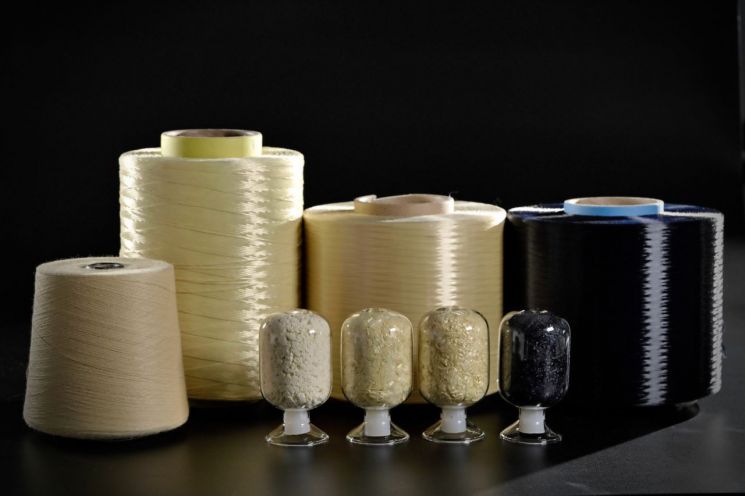
Aramid (product name Heracron), known as a 'super fiber,' is currently playing a key role in supporting Kolon Industries. Aramid can withstand high temperatures of up to 500 degrees Celsius. It is an advanced material that is five times stronger than steel of the same thickness and weight, yet lighter. Its demand is growing steadily as it is used in 5th generation (5G) optical cables, electric vehicle tires, aerospace materials, and more. Recently, as countries have begun expanding their 5G infrastructure, demand has surged to the point where it cannot be met. Kolon Industries ranks first in domestic aramid fiber production and third worldwide.
Kolon Industries' aramid factory located in Gumi, Gyeongbuk, is operating a production line with an annual capacity of 7,500 tons at 100% capacity. A Kolon Industries representative said, "Customers take the products as soon as packaging is finished," adding, "50% of the additional 7,500 tons to be expanded in the second half of this year has already been confirmed for supply." The securities industry estimates that over 60% of the additional expansion volume has been pre-sold. In other words, the factory is still under construction and the products have not yet been made, but more than half of the products to be made in a year have already been sold. Instead of goods, only dust is piling up in the inventory warehouse where products are usually stored after production.
LG Chem's film for solar panels (POE) is also selling like hotcakes due to the expanding demand for renewable energy. POE has high insulation and moisture barrier properties and excellent power generation efficiency, serving to protect solar panels and minimize power loss. Solar companies are competing to purchase LG Chem's POE products ahead of others because of their superior quality. The market for solar encapsulant materials containing POE is expected to grow from $2.26621 billion (about 3 trillion KRW) in 2020 to $5.93002 billion (about 7.8513 trillion KRW) by 2027, with an average annual growth rate of 13.3%. Since 2021, LG Chem has been building a POE production plant with an annual capacity of 100,000 tons at its Daesan plant in Chungcheongnam-do. When the expansion is completed in 2024, the total capacity will reach 380,000 tons, securing the world's second-largest production capacity.
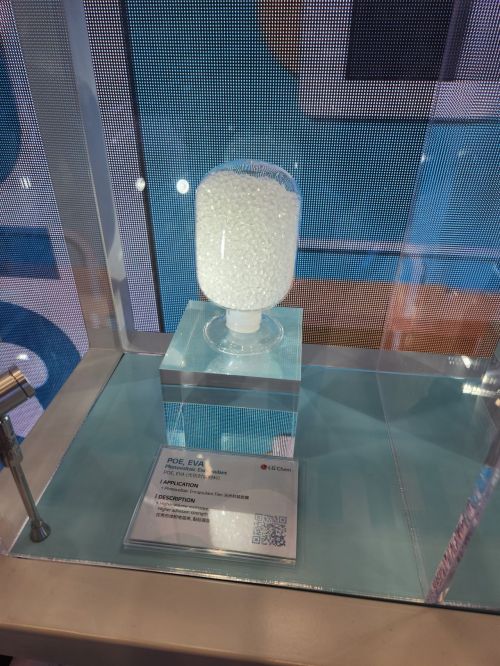 LG Chem showcased its solar panel film 'POE' at the global plastics exhibition 'CHINAPLAS 2023' held last month in Shenzhen, China. Photo by Donghoon Jeong
Plastic recycled chemically from waste plastics that were previously incinerated or landfilled is being sold even before the factory site has been excavated. Chemical plastic recycling technology is an advanced technology compared to existing mechanical recycling, which could not filter out various contaminants. Through chemical decomposition, raw materials such as pyrolysis oil, polypropylene (PP), and polyethylene (PE) are recovered without deterioration in physical properties and with high recyclability. Pyrolysis oil is a raw material converted into liquid form by heating waste resources. After refining, pyrolysis oil is used as recycled fuel or as a substitute for crude oil. Due to its high utility, it is the most popular raw material recovered from waste plastics.
SK Geocentric's pyrolysis oil, scheduled for production in 2025, has already been sold about 30-40% before even breaking ground for the factory construction. SK Geocentric's Ulsan ARC, the world's first comprehensive plastic recycling complex, is set to begin construction this November and be completed in 2025. A leading European food company has made an 'ipdoseonmae' (pre-purchase) agreement.
Lotte Chemical's chemical recycling plastic plant, to be established by 2024, is also receiving a flood of pre-order inquiries. Lotte Chemical is investing about 100 billion KRW to build Korea's first 45,000-ton capacity hydrolysis plant in Ulsan that can process waste PET. Hydrolysis is a technology that chemically treats and melts waste plastics to produce BHET, a recycled raw material. Production facilities that use BHET produced at the hydrolysis plant to make PET with an 110,000-ton capacity are also being built and will be completed by 2024.
© The Asia Business Daily(www.asiae.co.kr). All rights reserved.
![Clutching a Stolen Dior Bag, Saying "I Hate Being Poor but Real"... The Grotesque Con of a "Human Knockoff" [Slate]](https://cwcontent.asiae.co.kr/asiaresize/183/2026021902243444107_1771435474.jpg)

















