Samba, Celt, Hanmi, Daewoong, Dong-A Achieve Record High Performance
Samba Raises Guidance Amid Strong Earnings Expectations
Celt Anticipates Uplima Alongside Remsima SC
COVID-19 Beneficiary Diagnostics and Vaccine Industries Face Earnings Decline
SK Bioscience: "Securing New Growth Engines with 2.4 Trillion Investment"
Major pharmaceutical and bio companies are experiencing a spring breeze, with many breaking quarterly sales records. With favorable factors such as production capacity expansion and new drug development continuing, steady sales growth is expected this year. Meanwhile, companies that rapidly grew due to the COVID-19 boom are facing concerns over significant performance declines this year but are actively seeking new growth engines.
According to the industry on the 10th, among pharmaceutical and bio companies that have disclosed their first-quarter results so far, traditional pharmaceutical companies and bio firms such as Samsung Biologics, Celltrion, Hanmi Pharmaceutical, and Daewoong Pharmaceutical have consecutively posted record-breaking quarterly performances.
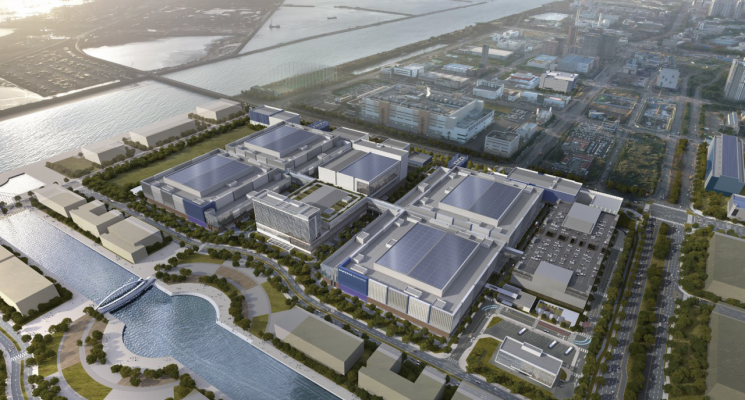
Samsung Biologics and Celltrion are maintaining steady growth by focusing on their core businesses while exploring new growth drivers. Samsung Biologics achieved an industry-first annual sales breakthrough of 3 trillion KRW last year and recorded its highest-ever first-quarter sales with 720.9 billion KRW. Following the full acquisition of Samsung Bioepis in April last year, consolidated sales surged, and Samsung Biologics’ standalone sales also grew by 16%. Particularly, quarterly results are expected to follow a 'lower in the first half, higher in the second half' pattern, with performance anticipated to improve further from the second half when Plant 4 begins full operation. Partial operations started in October last year, and completion is scheduled for June, with contract manufacturing (CMO) agreements already signed with nine clients for 12 products.
Accordingly, Samsung Biologics raised its projected sales growth rate for this year from the initial 10-15% to 15-20%. The company disclosed a midpoint forecast of 3.5265 trillion KRW. Furthermore, the plan for a second bio campus has been actively pursued, starting with the recently announced Plant 5 construction, and next year, the company aims to establish antibody-drug conjugate (ADC) production capabilities, continuing its growth trajectory. Additionally, with Samsung Electronics Chairman Lee Jae-yong visiting the U.S. and expressing his determination to lead the bio industry as the 'second semiconductor miracle,' further momentum is expected in future growth.
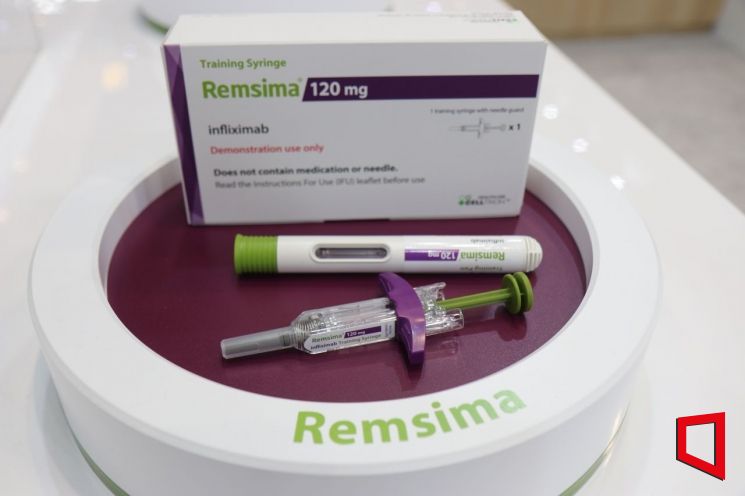
Celltrion also achieved its highest-ever first-quarter sales with 597.5 billion KRW, driven by continued growth in biopharmaceutical sales. Quarterly sales of biosimilars (biopharmaceutical sales) surpassed 400 billion KRW for the first time. It is analyzed that the increase was led by 'Remsima SC' (generic name infliximab), an autoimmune disease treatment developed under the leadership of Chairman Seo Jung-jin.
As the only subcutaneous (SC) formulation among infliximab products, it offers high convenience and is rapidly penetrating the market, with high profitability. It holds a 16% market share in five major European countries, and combined with the existing intravenous (IV) formulation 'Remsima,' the total market share reaches 68%, quickly dominating the market. Moreover, with the U.S. Food and Drug Administration (FDA) currently recommending new drug approval procedures, if approval is granted around October and sales begin next year, profitability is expected to improve further. Additionally, starting July, the U.S. launch of the Humira biosimilar 'Yuflyma' is expected to play a significant role in second-half performance growth.
Hanmi Pharmaceutical also recorded its highest quarterly performance since 2015, supported by the growth of Beijing Hanmi Pharmaceutical. It posted consolidated sales of 361.7 billion KRW (up 12.7%) and operating profit of 60.5 billion KRW (up 47.9%). Excluding 2015, when profits surged briefly due to new drug technology exports, this is the highest quarterly performance ever. This achievement is largely attributed to Beijing Hanmi Pharmaceutical surpassing 100 billion KRW in quarterly sales for the first time with 111 billion KRW. Key products such as the pediatric digestive aid 'Mami Ai,' constipation medicine 'Litong,' and cough and sputum medicine 'Ianping' are rapidly growing in sales.
Daewoong Pharmaceutical also achieved record-high operating profit of 31 billion KRW on a standalone basis in the first quarter, driven by continued sales growth of the gastroesophageal reflux disease new drug 'Pexuclu' and botulinum toxin (BTX) 'Nabota.' Dong-A Socio Holdings turned profitable as Bacchus and over-the-counter (OTC) drugs showed steady growth.
Diagnostics and Vaccines After the COVID-19 Boom... Seeking New Growth Engines
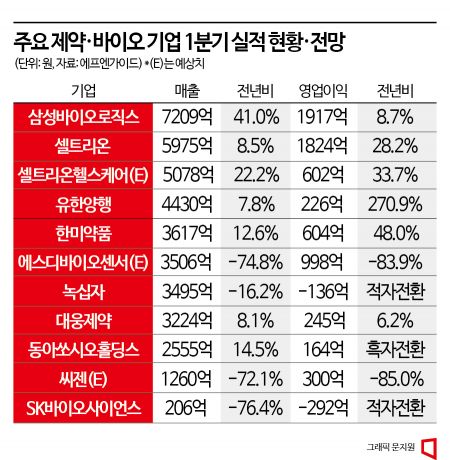
On the other hand, companies related to diagnostics, testing, and vaccines that saw rapid sales growth due to the COVID-19 boom last year are facing concerns over deteriorating performance this year. However, some companies are aggressively investing based on funds secured during the COVID-19 period to overcome this crisis. SD Biosensor, which surpassed 2 trillion KRW in annual sales for the first time in the industry with 2.93 trillion KRW in 2021 and nearly reached 3 trillion KRW for two consecutive years last year with 2.932 trillion KRW, is expected to see a sharp decline in performance. First-quarter sales are projected at 350.6 billion KRW, a 74.8% decrease year-on-year, with annual sales expected to be around 1 trillion KRW. Another diagnostic company, Seegene, is also expected to see a 72.1% sales drop with first-quarter sales forecasted at 126 billion KRW.
Green Cross Corporation (GC) was not spared from this downturn either. GC posted first-quarter sales of 349.5 billion KRW, down 16.2% year-on-year, and recorded an operating loss of 13.6 billion KRW, turning to a deficit. The company explained that the decrease in COVID-19 testing demand due to fewer confirmed cases reduced profits at its consolidated subsidiary GC Cell, along with increased R&D expenses.
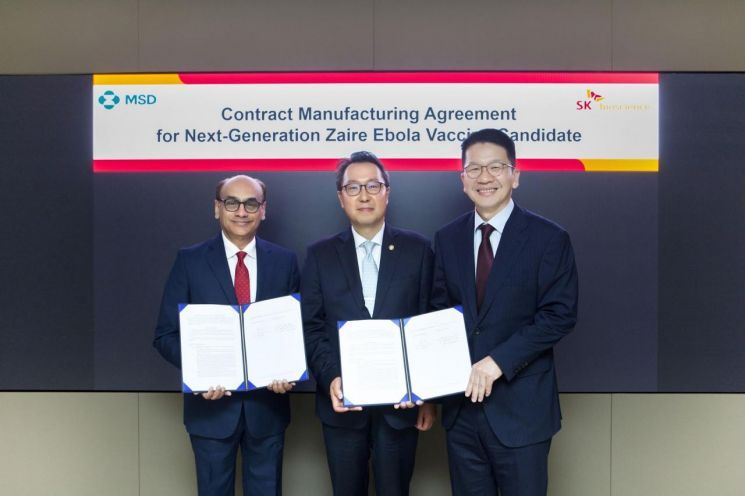 At the contract signing ceremony held on the 4th in Jongno-gu, Seoul, Sanet Chatopadhyay, Senior Vice President of Merck (MSD) USA, Park Min-su, 2nd Vice Minister of Health and Welfare, and Choi Chang-won, Vice Chairman of SK Discovery (from left), are posing for a commemorative photo.
 [Photo by SK Bioscience]
Vaccine company SK Bioscience also recorded an operating loss of 29.2 billion KRW in the first quarter, turning to a deficit. However, SK Bioscience plans to accept losses for the time being and invest heavily?up to 2.4 trillion KRW?to acquire new capabilities, as a new growth strategy is needed post-COVID-19. SK Bioscience President Ahn Jae-yong stated, "We expect losses to continue for about three years due to this investment," but projected that once results materialize, the company will achieve an average annual return of over 14% until 2033. Furthermore, concrete achievements are emerging, such as signing a contract on the 4th with U.S. Merck (MSD) for next-generation Zaire Ebola vaccine contract development and manufacturing organization (CDMO) services.
© The Asia Business Daily(www.asiae.co.kr). All rights reserved.



















