Korea: 'Will conduct independent safety review'
Japan: 'A meeting to hear about construction status'
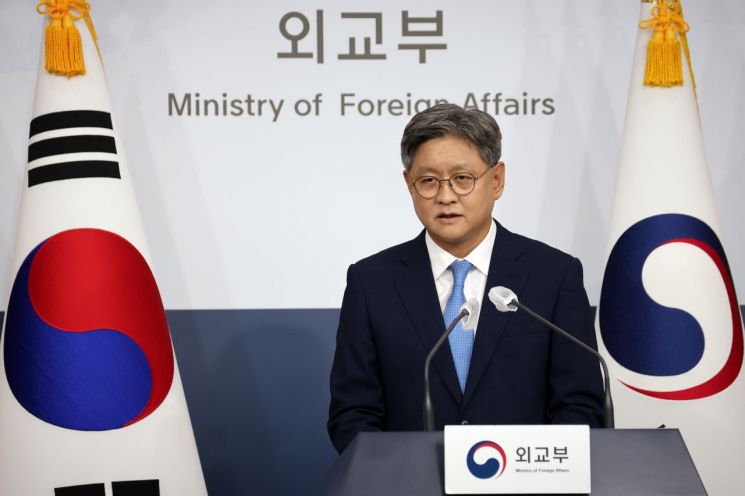
Regarding the scope of the inspection of contaminated water at the Fukushima nuclear power plant, differing positions between our Ministry of Foreign Affairs and the Japanese side are expected to spark controversy. While the Ministry of Foreign Affairs stated that it will "independently review the safety," the Japanese side described it as "an occasion to receive explanations about the construction status."
On the 9th, in a briefing document submitted to the National Assembly's Foreign Affairs and Unification Committee, the Ministry of Foreign Affairs reported that the local inspection team dispatched to Japan on the 23rd to 24th will "inspect facilities related to the disposal of contaminated water and gather information necessary for independent scientific and technical analysis."
However, the Japanese side said that the Korean inspection team will not evaluate the safety of the contaminated water.
At a press conference that day, Economy, Trade and Industry Minister Nishimura Yasutoshi stated that the Korean inspection team would be given explanations about the storage situation of the contaminated water and the status of the discharge facility construction, but they would not evaluate or confirm the safety of the contaminated water, according to Kyodo News.
The differing positions between the two sides are known to be subject to detailed discussions through Korea-Japan director-level talks regarding the scope and nature of the on-site inspection and the activities of experts. Some have pointed out that since it remains only an "inspection" rather than a "verification," it may be difficult to actively request information on contaminated water or conduct scientific reviews. In fact, Taiwan, which visited the site in March for an inspection of Fukushima's contaminated water, only visited as an "observation team" and was unable to conduct an active safety investigation.
In this regard, a Ministry of Foreign Affairs official said, "Our country is already one of the countries participating in the International Atomic Energy Agency (IAEA) monitoring task force composed of international experts, and in addition to IAEA monitoring, we have independently dispatched an inspection team," adding, "It is meaningful that we have secured an opportunity to multilayeredly review the safety of the contaminated water."
Meanwhile, the Ministry of Foreign Affairs cited the full-scale launch of shuttle diplomacy between the leaders and the entry into the main track of normalization and improvement of Korea-Japan relations as major achievements of this Korea-Japan summit.
The Ministry of Foreign Affairs stated, "(Japan) responded to our magnanimous and proactive decision regarding historical issues with Prime Minister Kishida's own message to the victims," and "achievements that the public can feel, such as cooperation in semiconductor supply chains, were created, and cooperation between the two countries on global issues deepened."
The Ministry of Foreign Affairs said it will continue the flow of shuttle diplomacy and normalization of relations through the upcoming Group of Seven (G7) summit to be held in Hiroshima, Japan, from the 19th to the 21st, and the Korea-Japan-China summit planned to be held in Seoul within this year.
© The Asia Business Daily(www.asiae.co.kr). All rights reserved.
![Clutching a Stolen Dior Bag, Saying "I Hate Being Poor but Real"... The Grotesque Con of a "Human Knockoff" [Slate]](https://cwcontent.asiae.co.kr/asiaresize/183/2026021902243444107_1771435474.jpg)
















