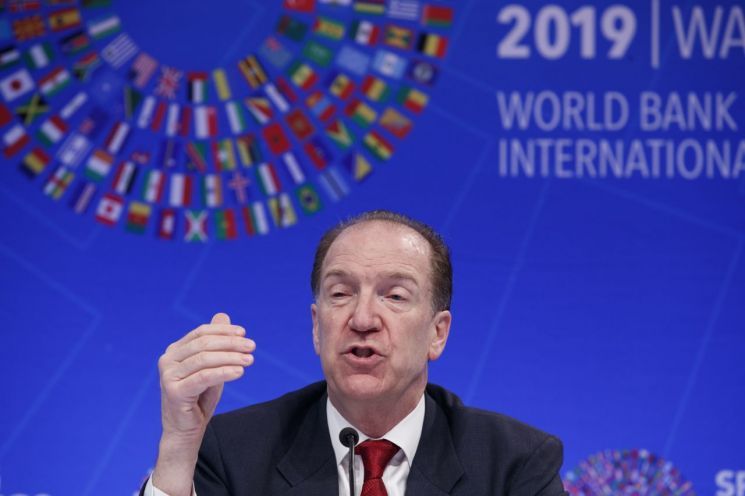
David Malpass, President of the World Bank (WB), who is set to resign next month, pointed out that China's uncooperative attitude is causing setbacks in debt restructuring for developing countries.
On the 8th (local time), Malpass said in an interview with Bloomberg TV, "China is trying to bring all creditors into a restructuring position, but debt adjustment remains at a standstill," adding, "It is unfortunate that there has been no progress."
Earlier last month, China expressed its intention to participate in the 'Common Framework' agreement reached by the finance ministers of the Group of 20 (G20) to restructure the debts of developing and least developed countries.
The international community has focused on China's change in stance, which had been passive toward debt relief. This is because China is one of the largest creditor countries providing loans to developing countries.
China has extended massive loans to developing countries in the process of promoting the overseas infrastructure development project called the 'Belt and Road Initiative' (land and maritime Silk Road). According to Bloomberg, the amount of "China money" distributed to developing countries since 2000 is estimated to be $240 billion (312.48 trillion won). In particular, in the case of Zambia, loans from China account for 75% of the total debt.
However, China has shown an unfriendly attitude toward easing the debt burden of developing countries by not participating in the 'Paris Club,' a debt restructuring group formed by 22 creditor countries.
Although China appeared to shift its stance by expressing its intention to join the Common Framework last month, no progress has been reported so far. This is because China has been reluctant to bear losses from debt restructuring.
President Malpass pointed out, "China, the largest lending channel for the least developed countries, has not yet indicated a willingness to accept losses on debt," adding, "It is necessary to discuss technical issues such as long-term rescheduling of debt repayment with China." He also warned, "Global economic growth is expected to be below 2% this year," and "If countries around the world face a 'dangerous point' where economic growth slows, China's political system could also come under pressure."
© The Asia Business Daily(www.asiae.co.kr). All rights reserved.

















