Bloomberg "Rent Surge Puts Pressure on Ruling Party"
As housing prices and rents in Singapore soar, public sentiment is rapidly deteriorating, especially among the 2030 generation. Unlike the stagnant global real estate market caused by high interest rates, the overheated Singapore housing market has emerged as a major headache for the ruling party, Bloomberg reported on the 8th (local time).
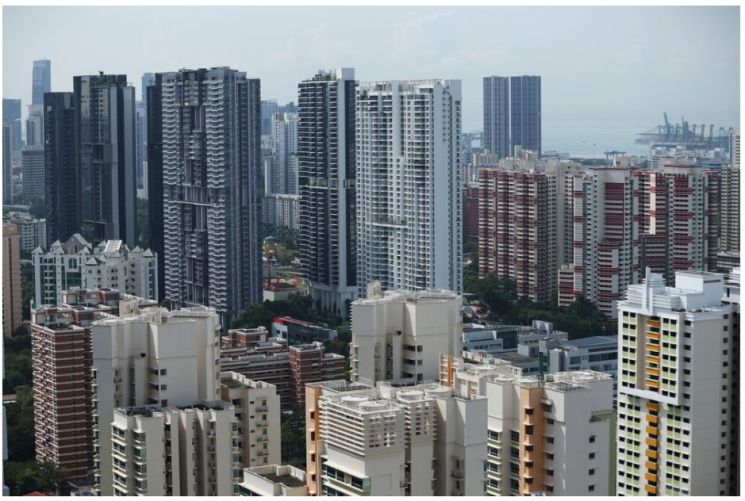
According to Bloomberg, in March this year, rents for private apartments and public housing in Singapore rose by 32% and 27%, respectively, compared to the same period last year.
Earlier, a survey by Knight Frank, a UK real estate information firm, also showed that Singapore's housing rents in the fourth quarter of last year increased by 28.2% compared to a year earlier, surpassing New York (18.6%), London (17.8%), and Toronto (15.0%) to rank first in growth rate.
With Singapore's housing prices rising for 12 consecutive quarters, rents have also surged. Unlike major countries where the real estate market has cooled sharply due to high interest rates, housing prices in Singapore have continued to rise for three years without pause. This is due to Chinese investors shopping for Singapore real estate, coupled with the effects of supply shortages.
Accordingly, the Singapore government has introduced various measures to stabilize housing prices, including significantly raising the foreign buyer's stamp duty from 30% to 60% of the house price and increasing the stamp duty for second-home buyers from 17% to 20%. However, it remains uncertain whether these measures can calm the already heated housing market.
The relative deprivation and dissatisfaction among Singapore's youth are also growing. This is manifesting as opposition to the ruling People's Action Party (PAP), which holds 90% of the parliamentary seats and effectively operates as a one-party dictatorship.
Ms. Sonam, a 33-year-old unmarried woman who has worked at a Singapore tech company, lamented, "I can't understand that they (the ruling party) don't know what is really happening to the millennial generation and what we need to survive in Singapore," and stated she would support the opposition in the next election. She moved to Thailand after her landlord raised the rent by about 70%.
Ms. Sonam argued that the Singapore government should relax the conditions for purchasing public apartments supplied by the Housing Development Board (HDB) so that young unmarried households can also buy homes. In Singapore, buying public apartments subsidized by the HDB is the relatively affordable way to own a home, but eligibility is restricted to couples aged 21 and above and unmarried individuals aged 35 and above, leading to high dissatisfaction as even this is not easy. Currently, the Workers' Party, Singapore's only opposition party, has proposed easing the requirements to allow unmarried individuals aged 28 and above to purchase HDB public apartments.
Bloomberg analyzed that the sharp rise in rents is emerging as a political issue, putting pressure on the ruling party ahead of Singapore's presidential election. In particular, a new prime minister is expected to be elected around September, which is anticipated to serve as a litmus test of public sentiment ahead of the general election in November 2025.
Bloomberg noted, "While the PAP is very unlikely to lose power in the election, the party is sensitive to public sentiment on bread-and-butter issues (livelihood matters)," adding, "For a government relying on seemingly impregnable support, even a slight drop in approval ratings can be perceived as a weakness."
© The Asia Business Daily(www.asiae.co.kr). All rights reserved.
![User Who Sold Erroneously Deposited Bitcoins to Repay Debt and Fund Entertainment... What Did the Supreme Court Decide in 2021? [Legal Issue Check]](https://cwcontent.asiae.co.kr/asiaresize/183/2026020910431234020_1770601391.png)















