Various Advice on Korean Economy at ADB Annual Meeting
Optimistic About Korean Economy but Concerns Over Aging Population Grow
Emphasis on Immigration Expansion, Debt Management, and Structural Reform Needed
Amid growing concerns surrounding the South Korean economy due to the global economic downturn and sluggish exports, international organizations and scholars have explained that South Korea's economy remains robust compared to other advanced countries and some developing nations. However, numerous risk factors were also mentioned, including the rapidly progressing aging population, low birth rates, resulting deterioration in fiscal soundness, and persistently high inflation rates. The consensus was that South Korea needs to respond and innovate during this period of global structural change.
At the Asian Development Bank (ADB) Annual Meeting, which concluded on the 5th after a four-day schedule, various opinions on the economies of Asian countries, including South Korea, were expressed through seminars, press conferences, and interviews. This annual meeting, held in South Korea (Incheon) for the first time in 19 years since 2004 (Jeju), gathered ADB and International Monetary Fund (IMF) officials, as well as world-renowned scholars such as Michael Kremer, a Nobel laureate and professor at the University of Chicago, who also made numerous remarks about the host country’s economy.
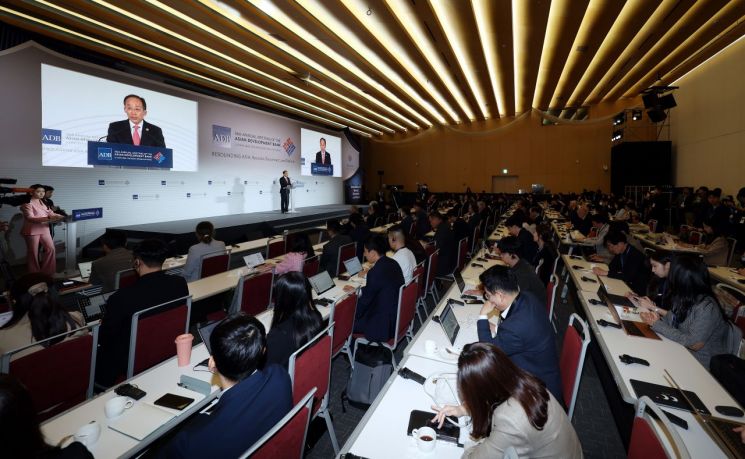 Deputy Prime Minister and Minister of Economy and Finance Choo Kyung-ho delivers the opening remarks at the '56th Asian Development Bank (ADB) Annual Meeting Korea Seminar Day' held on the morning of the 2nd at Songdo Convensia in Yeonsu-gu, Incheon. [Image source=Yonhap News]
"South Korean Economy Very Robust... No Foreign Exchange Crisis Expected"
They generally described the South Korean economy as still "robust." Masatsugu Asakawa, President of the ADB, said at a press conference, "I am very optimistic about the South Korean economy. With inflation under control, it will maintain a solid growth trend," adding, "The likelihood of South Korea experiencing foreign exchange shortages or liquidity problems is very low." Although there are growing concerns about South Korea’s recent trade deficit and slowing growth rate, it is not at a level that threatens the economic foundation in the immediate term.
Krishna Srinivasan, Director of the IMF Asia and Pacific Department, who attended the ADB Annual Meeting for a press conference related to the IMF’s economic outlook report, also said, "South Korea’s exports have been sluggish due to the slowdown in growth among trading partners and the global semiconductor market downturn over recent quarters," but added, "The structure of the South Korean economy is very robust." Regarding the IMF’s downward revision of South Korea’s growth forecast to 1.5% this year, he explained, "This is higher than the global advanced countries’ average of 1.3%."
Professor Kremer also gave positive evaluations during the 'South Korea Seminar Day' in a dialogue with Cho Dong-chul, President of the Korea Development Institute (KDI), stating that "South Korea is the most effective development model for developing countries," "Other countries need to learn from South Korea’s quarantine measures," and "South Korea’s high level of learning is one perspective that demonstrates success."
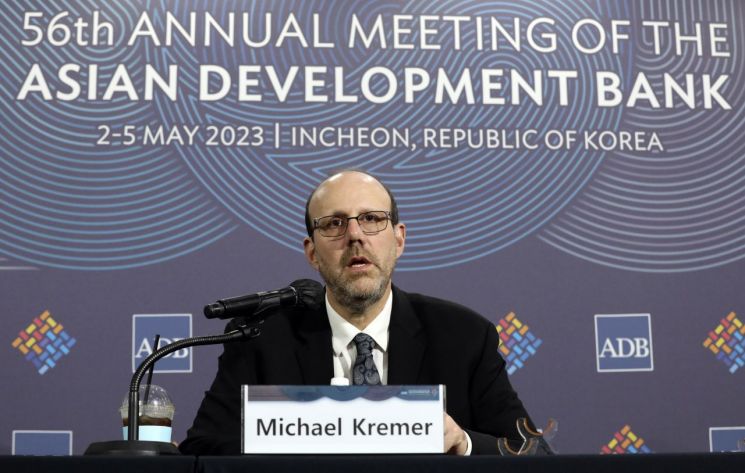 Michael Kremer, professor at the University of Chicago and winner of the 2019 Nobel Prize in Economics, is attending a press conference on the afternoon of the 2nd at Songdo Convensia in Yeonsu-gu, Incheon, during the 56th Annual Meeting of the Asian Development Bank (ADB). [Image source=Yonhap News]
Aging Population, Low Birth Rates, Fiscal Soundness... Numerous Risk Factors
However, a closer look at the various seminars and press conferences held during the Annual Meeting reveals many structural problems in the South Korean economy. A representative issue is the aging population and low birth rates. Yasuyuki Sawada, a professor at the University of Tokyo, Japan, said in his presentation on 'South Korea Seminar Day,' "South Korea’s birth rate is even lower than Japan’s," adding, "Aging is a really big problem, and Asian countries are unprepared. Significant issues may arise in pension insurance and other areas in the future."
Professor Kremer, who viewed South Korea relatively positively, also pointed out the aging issue, saying, "South Korea faces low birth rates and low female labor participation, which are major challenges for the South Korean economy," emphasizing, "Since this is a politically sensitive and delicate issue, if a full immigration expansion policy is difficult to implement, partial immigration should be allowed in areas such as child and elderly care, similar to Israel and the Middle East."
Concerns about South Korea’s massive national debt and fiscal soundness were also expressed. Hyun-ah Kim, Head of the Fiscal Policy Research Office at the Korea Institute of Public Finance, pointed out, "South Korea is rapidly aging due to increased life expectancy and low birth rates," adding, "This leads to economic slowdown and increases public debt by raising social security expenditures such as pensions and health insurance." She also mentioned income polarization, saying, "South Korea’s ranking will rise further," warning that "this could become a serious social problem."
Paulo Medas, Director of the IMF Fiscal Affairs Department, distinguished South Korea from some developing countries facing debt default issues, but advised, "If fiscal expansion was implemented during the (COVID-19) crisis, deficits must be eliminated after the crisis is resolved," and "It is necessary to establish a reasonable and stable medium-term fiscal plan and have sufficient safety nets." Director Srinivasan also said regarding fiscal issues, "South Korea should strive for fiscal soundness."
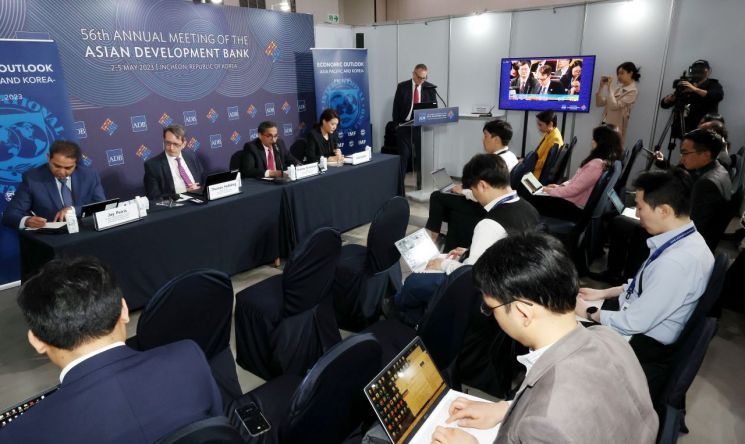 Krishna Srinivasan, Director of the Asia and Pacific Department at the International Monetary Fund (IMF), is holding a press conference on the morning of the 4th at Songdo Convensia in Yeonsu-gu, Incheon, during the 56th Annual Meeting of the Asian Development Bank (ADB). [Image source=Yonhap News]
Growth Hampered in South Korea... "Support Corporate Innovation"
There were also concerns about South Korea’s economic growth. The IMF predicted that South Korea would gradually recover growth from the second half of the year, supported by China and the semiconductor market recovery, but pointed out that the currently faced high interest rates, high inflation, and sluggish housing market could hold back growth.
In particular, the IMF emphasized the need to maintain a monetary tightening stance due to South Korea’s high core inflation rate. Since Lee Chang-yong, Governor of the Bank of Korea, and Choo Kyung-ho, Deputy Prime Minister and Minister of Economy and Finance, expressed the same view during the Annual Meeting, it is unlikely that economic recovery through interest rate cuts will be expected in the near term.
Thomas Helbling, IMF Deputy Director for Asia and the Pacific, stressed that South Korea must respond with structural reforms to the significant shocks caused by the downturn in China and the semiconductor sector, which have been growth engines. He said, "For South Korea to find another growth engine, companies must maintain resilience and adaptability, and the key to this is innovation, research and development, and education," adding, "It is the nation’s role to ensure these three areas are well activated."
He continued, "It is important to create an environment where companies can operate well and to develop a labor market that produces flexible talent," adding, "At the same time, efforts should be made to establish macroeconomic fundamentals, maintain a strong fiscal policy framework, and uphold a flexible and resilient exchange rate system."
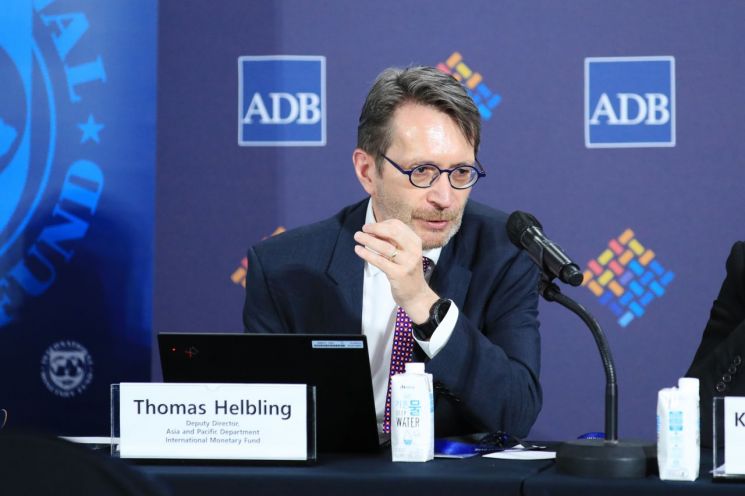 Thomas Helbling, Deputy Director of the Asia and Pacific Department at the International Monetary Fund (IMF), is holding a press conference on the morning of the 4th at Songdo Convensia in Yeonsu-gu, Incheon, during the 56th Annual Meeting of the Asian Development Bank (ADB).
© The Asia Business Daily(www.asiae.co.kr). All rights reserved.



















