The drone operations command, which the military has been preparing to establish, has finally been unveiled, drawing attention to anti-drone technology.
On the 26th of last month, the Ministry of National Defense announced, "In response to the increased threats of North Korean unmanned aerial vehicle (UAV) intrusions and various provocations, as well as changes in the security environment such as the expanded use of drone weapon systems in modern and future warfare, the draft ordinance for the establishment of the Drone Operations Command has been publicly notified."
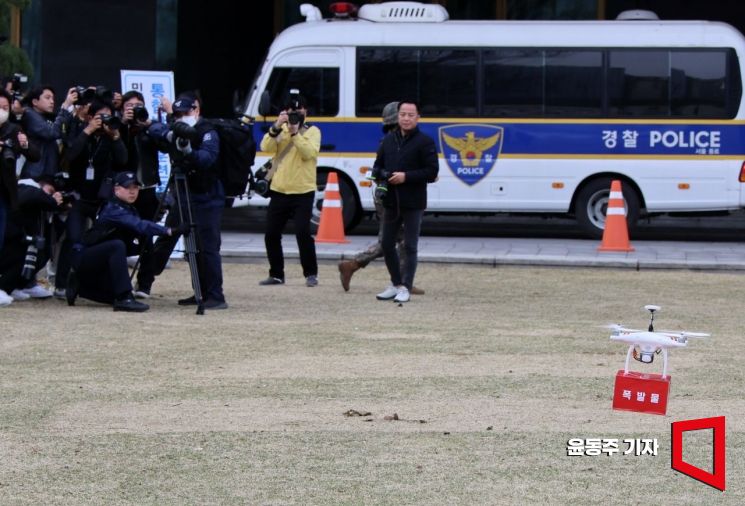 On the 16th, at the Government Seoul Complex in Jongno-gu, Seoul, an integrated protection drill involving government, military, police, and fire departments was conducted, including training for suppressing illegal drones and handling explosives. Photo by Dongju Yoon doso7@
According to the draft ordinance, the Drone Operations Command will be established under the Minister of National Defense and commanded by a general officer. The establishment is expected to take place in the second half of this year.
The mission of the Drone Command is defined as "strategic and operational-level surveillance, reconnaissance, strike, psychological warfare, electronic warfare using drone forces, combat development tasks of drone forces, and matters related to peacetime and wartime command and control of units attached or assigned to the command." It is known that, following President Yoon Seok-yeol's intention to more actively deter North Korean provocations and respond offensively, the command has been assigned strike missions in addition to surveillance and reconnaissance.
Accordingly, the Drone Command will be equipped with weapon systems under development by the Agency for Defense Development (ADD), such as 'drone killer drones' with strike capabilities and stealth unmanned aerial vehicles, which are targeted for production within this year.
Anti-drone technology is a system that detects and neutralizes unidentified drones invading airspace. A complete anti-drone solution involves precise detection of small flying objects using technologies such as radar, radio wave detection, acoustic detection, and image recognition, followed by neutralization.
Neutralization technologies are broadly divided into hard-kill (physical) methods that directly destroy or capture drones, and soft-kill (electromagnetic) methods that disable drones through radio interference.
At first glance, the method of destroying drones by equipping airburst munitions might seem most effective, but physical destruction can cause secondary damage due to explosives or fragments carried by the drone. Additionally, the soft-kill method of jamming (radio interference) attacks has limitations as it can affect civilian aircraft using GPS, friendly forces' equipment, and surrounding electronic devices.
In response, Hanwha Systems has introduced a 'net capture' drone defense system that is highly stable and capable of recovering target drones intact. They developed an anti-drone system by combining their proprietary electro-optical and infrared drone-specific sensor technology with the net capture drone defense system from the U.S. company Fortem Technologies.
Fortem Technologies employs a safe capture method that leverages the advantages of both hard-kill and soft-kill. Their anti-drone defense system detects illegal drones using a proprietary radar equipped with artificial intelligence (AI) software, then deploys autonomous drones to capture and neutralize the target drones with nets. Since the drones are captured intact rather than destroyed, secondary damage is prevented and post-analysis is possible.
Fortem Technologies' technology has been utilized by the U.S. Department of Defense, defense industries, international events such as the 2022 Qatar World Cup and the Davos Forum, and recently in the Russia-Ukraine war.
In fact, drones equipped with strike capabilities currently in use in the ongoing Russia-Ukraine war are evaluated to have had a significant impact, enough to change the course of the conflict. Both sides effectively use drones to guide artillery fire or modify civilian drones to carry grenades to attack soldiers in trenches.
A military official stated, "Drones have proven effective weapons in the Ukraine war, and operating drone units is a global trend," adding, "The establishment of a joint unit was pursued to effectively respond to enemy provocations at a strategic level."
Meanwhile, according to related ministries in January, the global drone market size is projected to reach 125.5 trillion KRW by 2030, with the domestic market estimated at 2.22 trillion KRW. As a result, voices calling for deregulation and strengthening competitiveness domestically are growing, highlighting drones as a key global competitive industry.
© The Asia Business Daily(www.asiae.co.kr). All rights reserved.

















