Government Considers Strengthening Fare Discount Benefits for Vulnerable Groups
It has been revealed that people with disabilities, low-income groups (basic livelihood security recipients, near-poverty class, basic pension recipients), and national merit recipients received a total of 1.2 trillion won in telecommunications fee discounts last year. This amount corresponds to one-third of the combined operating profits (3.5389 trillion won) of the three major mobile carriers: SK Telecom, KT, and LG Uplus. The government is currently discussing plans to expand welfare benefits for socially vulnerable groups from telecommunications fee discounts to include digital device and service usage fees.
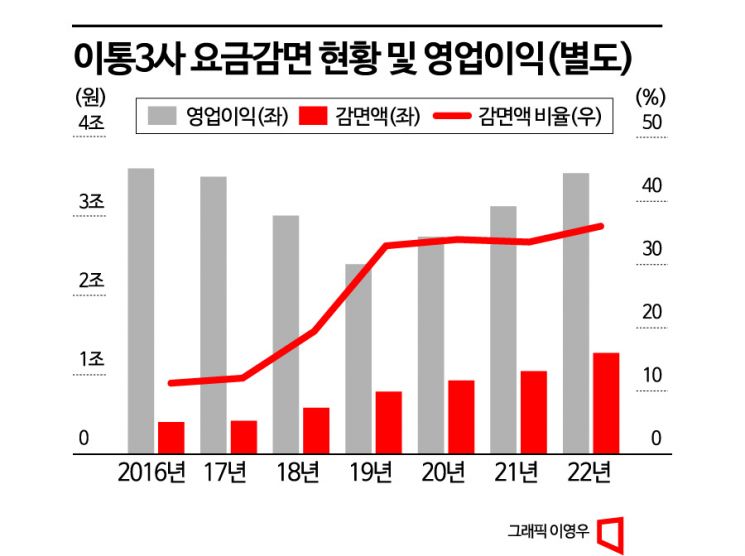
According to data from the National Assembly Legislative Research Office on the 4th, the total annual telecommunications fee discount amount from the three mobile carriers is on the rise. The discount amount, which was 583.9 billion won in 2018, more than doubled to 1.2749 trillion won last year. The "telecommunications fee discount system" is a program under the Telecommunications Business Act that reduces telecommunications fees by 30-50% for vulnerable groups. It has been in effect since 2000. For landline phones, people with disabilities and national merit recipients receive a 50% discount on monthly call charges, while basic livelihood security recipients are exempt from subscription and basic fees. For mobile phones, people with disabilities and national merit recipients receive a 35% discount on basic and call charges without any discount limit. Basic livelihood security recipients receive discounts up to 33,500 won per month, and basic pension recipients receive up to 11,000 won per month. High-speed internet fees are discounted by 30% of the monthly usage fee.
The government is considering strengthening discount benefits for vulnerable groups. This is based on the judgment that a welfare paradigm shift is needed from the existing "provision of telecommunications access rights" to "guaranteeing digital service access rights." As technology advances and lifestyles change, digital platform services have become commonplace. According to the 2022 Digital Divide Survey Report, a significant portion of the population used online platforms for daily life services such as obtaining information (80.8%), shopping and reservations (69.4%), and banking and securities transactions (68.2%).
Banks and securities firms offer preferential interest rates and reduced fees to customers using non-face-to-face services. Vulnerable groups risk being excluded from the "digital transformation" era due to economic reasons, which could further exacerbate economic disparities. After the COVID-19 pandemic, the experience rate of vulnerable groups with digital services (delivery/subscription) was only 46-57% compared to the general population. Various bills regarding the "reform of the discount system for vulnerable groups" have already been proposed in the National Assembly. The government plans to launch a pilot project for a "universal voucher" from the second half of this year, which can be used not only for fee payments but also for digital content and application services.
There are also calls to provide income tax deductions for telecommunications and digital service fees for vulnerable groups. The Ministry of Culture, Sports and Tourism has begun reviewing policies to allow income deductions for online video service (OTT) subscription fees. Professor Shin Minsu of Hanyang University explained, "Taxes apply to the general majority, so there could be issues of tax discrimination," adding, "I understand the government is considering establishing a fund as a solution." However, it is uncertain whether overseas big tech companies such as Google will participate in the fund. Simply put, there is a possibility that only Korean companies will have to pay quasi-tax type contributions.
Discussions on the obligation of platform companies to contribute to universal service funds (USF) are also active overseas. In the United States, there have been calls to require platform companies that have used telecommunications infrastructure for free to pay their fair share by contributing to the universal service fund. The U.S. Congress has introduced a bill to impose universal service fund contributions on platform companies. The European Union has enacted a new Telecommunications Act (EECC) that includes OTT services as telecommunications services and allows universal service fund contributions from the relevant operators. A Ministry of Science and ICT official stated, "After the results of the task force team for 'promoting competition in the telecommunications market' are released, we will comprehensively evaluate and amend the Telecommunications Business Act to implement measures beneficial to the public."
© The Asia Business Daily(www.asiae.co.kr). All rights reserved.

















