Heavy rain and strong winds continue in Jeju Island and the Gwangju-Jeonnam region, causing a series of damages. Over 800mm of rain fell in the Halla Mountain area over two days.
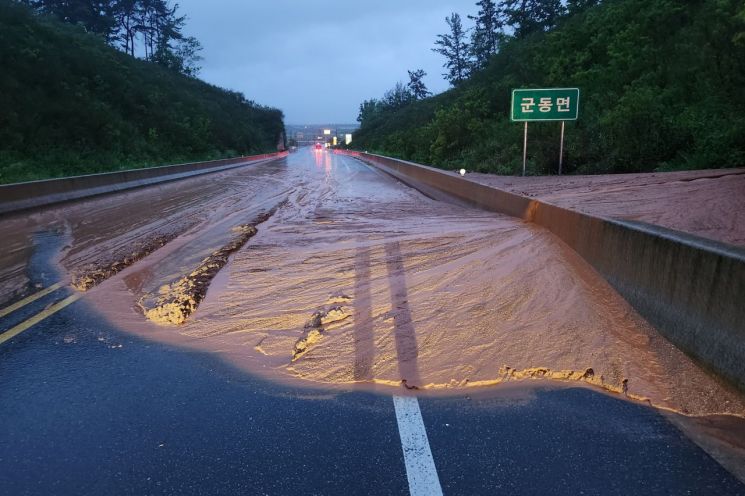
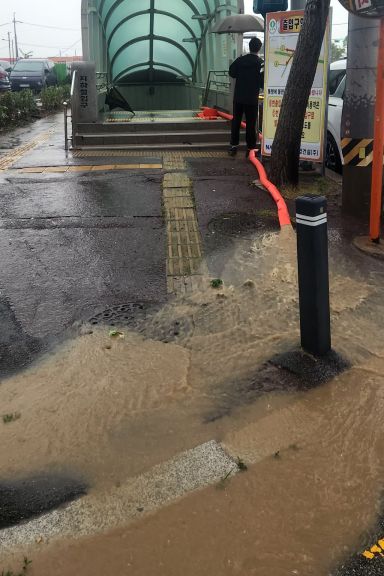 On the 5th, the interior of Gwangju Subway Line 1 Gonghang Station was flooded due to heavy rain, and work is underway to pump out the muddy water outside the station. [Image source=Yonhap News]
According to the Korea Meteorological Administration on the 5th, cumulative rainfall from the previous day until 6 p.m. on the same day was recorded as follows: Jangheung Gwansan 318.5mm, Haenam Bukil 317.5mm, Goheung Narodo 305mm, Boseong 251.8mm, Gangjin 212.5mm, Wando 208mm, Jangheung 182.1mm, Yeosu 180.8mm, Haenam 180.1mm, Mokpo 105.3mm, and Gwangju 109.8mm.
In the mountainous areas of Jeju, more than 800mm of rain fell. From the 3rd until 12 p.m. on the same day, rainfall was recorded as follows: Halla Mountain Samgakbong 803.5mm, Jindallaebat 671mm, Seongpanak 598.5mm, Seogwipo 365.6mm, Jeju Gasiri 327mm, Seongsan 238.2mm, Gosan 180.7mm, and Jeju 142.3mm.
Many damages caused by heavy rain are occurring. At Gwangju Subway Line 1 Gonghang Station concourse, muddy water poured in, causing trains to pass through without stopping for about 1 hour and 10 minutes from 4:42 p.m. The site was cleaned up with drainage support from the fire department. In the Gwangsan district city area, complaints were reported that rainwater accumulated to ankle height on the low-lying roads of Singadong, prompting an emergency inspection of drainage channels blocked by foreign substances.
In the Jeonnam region, agricultural damage continues. About 175 hectares of rice paddies that had completed rice planting were flooded in Podu-myeon and Namyang-myeon of Goheung County, Maryang-myeon of Gangjin County, and Ungchi-myeon of Boseong County. About 525 hectares of fields and paddies in Daedeok-eup of Jangheung County, Joseong-myeon and Deukryang-myeon of Boseong County, and Sinjeon-myeon and Doam-myeon of Gangjin County showed signs of crop lodging.
 Due to severe weather conditions such as strong winds and heavy rain, most departure flights are canceled as indicated on the electronic display board at Jeju International Airport on the afternoon of the 4th. [Image source=Yonhap News]
In Jeju, many flights were canceled. Since the previous afternoon, flight operations were canceled, with a total of 243 flights (118 departures, 125 arrivals) not taking off. Some flights at Jeju Airport resumed operation around 10:10 a.m. with Korean Air KE1045 from Seoul Gimpo arriving in Jeju. However, flight schedules remain flexible depending on weather conditions. Among 11 passenger ships on 8 routes connecting Jeju and other regions, operations of 4 ships on 3 routes are also suspended.
Strong winds in Jeju led to flight cancellations. As of 12 p.m. on the same day, the maximum instantaneous wind speeds (m/s) were recorded as follows: Halla Mountain Samgakbong 28.4m, Eorimok 27m, Jeju Airport 22.7m, Daehul 22.1m, Oedo 21.7m, Gosan 19.1m, and Odeung 19.2m. According to the Jeju Fire Safety Headquarters, there were 27 reports related to weather warnings in Jeju from the previous day until 12 p.m. due to strong rain and wind.
Meanwhile, as heavy rain damages continue, the Ministry of the Interior and Safety activated Level 1 of the Central Disaster and Safety Countermeasure Headquarters (CDSCH) and issued a crisis alert at the 'Caution' level. Heavy rain is expected to continue mainly in the central region, southern coast, areas near Jirisan, and Jeju Island until the next day.
© The Asia Business Daily(www.asiae.co.kr). All rights reserved.



















