Qualcomm, a semiconductor chip design and supply company for smartphones, is experiencing a sharp decline in after-hours trading amid forecasts that the smartphone market downturn will persist.
On the 3rd (local time), Qualcomm announced in its earnings report that its net profit for the first quarter (Q2 of the company's fiscal year 2023) was $1.704 billion, a 42% decrease compared to $2.934 billion in the same period last year.
During the same period, revenue was $9.275 billion, down 17% from $11.164 billion in the previous year.
Qualcomm's deteriorating performance was attributed to weak smartphone demand. According to research firm Canalys, global smartphone shipments in the first quarter fell 13% year-over-year.
Christiano Amon, Qualcomm's Chief Executive Officer (CEO), stated in a press release, "We will focus more on the factors within our control during this market downturn," adding, "We will continue to diversify and invest in businesses such as automotive, networking, and wearable devices with a long-term perspective."
The company expects that it will take longer than anticipated to absorb the oversupply in the smartphone market and forecasts that second-quarter revenue and profits will fall short of Wall Street estimates.
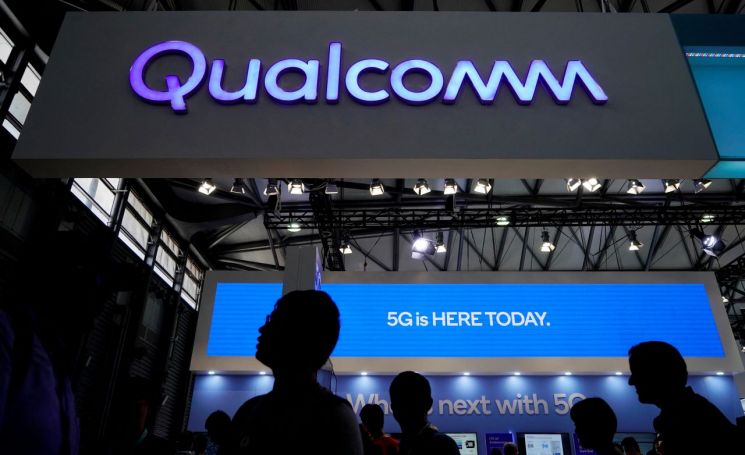
Qualcomm set its second-quarter revenue target at $8.1 billion to $8.9 billion, significantly below Wall Street's consensus estimate of $9.14 billion compiled by financial information provider Refinitiv. Earnings per share were also projected at $1.70 to $1.90, lower than the Wall Street estimate of $2.16.
Shares of Qualcomm, listed on the U.S. Nasdaq market, were down 6.67% in after-hours trading as of 5:27 p.m. local time on the day of the earnings disappointment. Qualcomm's stock price has risen only 2% this year, underperforming the Nasdaq index, which gained 14.89% during the same period.
Meanwhile, U.S. semiconductor company Intel, which announced its earnings on the 27th of last month, reported a record net loss of $2.76 billion (approximately 3.7 trillion KRW) for the first quarter, nearing 4 trillion KRW in losses.
Due to declining demand for its core business of personal computer (PC) chips and accumulating inventory, sales plummeted to the lowest level in 13 years.
The Wall Street Journal (WSJ) reported that smartphone and PC sales, which had surged temporarily during the COVID-19 pandemic due to remote work and the spread of non-face-to-face culture, are worsening as we enter the endemic era.
© The Asia Business Daily(www.asiae.co.kr). All rights reserved.
![Clutching a Stolen Dior Bag, Saying "I Hate Being Poor but Real"... The Grotesque Con of a "Human Knockoff" [Slate]](https://cwcontent.asiae.co.kr/asiaresize/183/2026021902243444107_1771435474.jpg)
















