Stationery Stores Close 500 Annually
"Daiso Seriously Infringes on Local Markets"
Application for Designation as Suitable Livelihood Business
Daiso Begins Review of Win-Win Cooperation
Within a 1.6 km radius around Madu Station in Ilsan, Goyang-si, Gyeonggi Province, six Daiso stores specializing in household goods distribution have opened over the past decade. Centered around Daiso Ilsan Madu Branch, identical stores have sprung up like mushrooms, ranging from three city bus stops away to just a 10-minute walk. During this period, six nearby stationery stores have closed down. A stationery industry insider said, "This is a typical case of Daiso infringing on local commercial districts," adding, "If Daiso continues to expand its business like this, stationery stores will inevitably be pushed out of the market."

Neighborhood stationery stores are disappearing. According to the industry on the 3rd, the number of stationery retail stores nationwide, which was 13,496 in 2013, is estimated to have decreased to about 8,000 as of May this year. Considering that the last count by Statistics Korea was 9,468 in 2019, nearly 500 stationery stores have closed each year over the past four years.
The direct causes of the disappearance of stationery stores include a decline in the school-age population and the introduction of a school supplies system. Recently, stationery consumption trends have shifted to large e-commerce platforms due to the impact of COVID-19. In this context, industry insiders explain that in areas like near Madu Station in Ilsan, where Daiso stores have appeared one after another across the street, stationery stores have no chance to survive.
The Korea Stationery Distribution Cooperative has pulled out the card of applying for designation as a "Livelihood-Suitable Industry" as part of efforts to strengthen the competitiveness of stationery retail businesses that are at a crossroads between survival and extinction. The Livelihood-Suitable Industry system restricts large and medium-sized companies from entering certain industries to protect small-scale merchants. Essentially, it aims to block Daiso, which has about 1,450 stores nationwide, from entering the market.
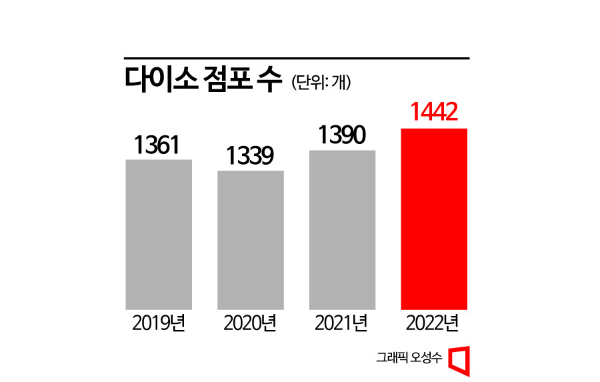
Previously, stationery retail was designated as a Small and Medium Enterprise (SME) Suitable Industry in 2015. Following recommendations from the Win-Win Growth Committee, Daiso has sold 18 elementary school stationery items with characters only in bundled units. However, some bundles included items such as ▲two oil-based markers ▲two name pens ▲five erasers, which were ineffective in practice.
When the SME Suitable Industry designation expired in July last year, the cooperative applied for Livelihood-Suitable Industry designation with some modifications to the existing terms. While details are still being negotiated, a likely plan under consideration is to expand the target items from elementary school stationery to all school stationery and to significantly increase the bundle units.
If stationery retail is designated as a Livelihood-Suitable Industry according to the cooperative's review, Daiso will be required to sell all school stationery in units that individuals cannot use alone. Additionally, the acquisition, commencement, or expansion of stationery retail businesses will be prohibited, and violations will result in imprisonment of up to two years or fines up to 150 million KRW, along with enforcement penalties. This regulation will be maintained for five years after the Livelihood-Suitable Industry designation.
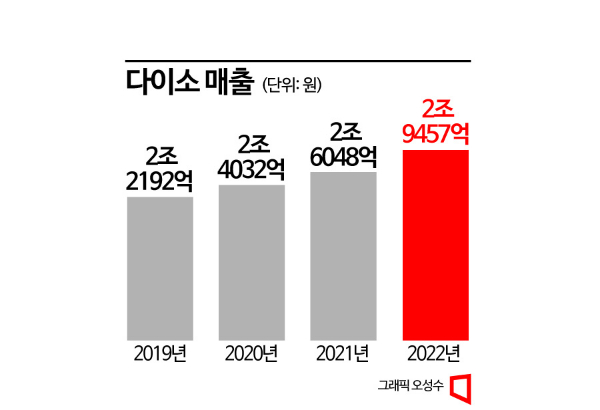
Upon the push for Livelihood-Suitable Industry designation for stationery retail, Daiso is reportedly engaged in internal discussions regarding win-win cooperation. If the cooperative accepts the win-win cooperation proposal, the application for Livelihood-Suitable Industry designation will be withdrawn. However, the Small and Medium Venture Business Department's review committee, which will make the final decision on the designation, is scheduled for October, leaving limited time.
A cooperative official said, "Although we have applied for Livelihood-Suitable Industry designation, if better conditions than now are offered for our retail stores, we are open to win-win cooperation," but added, "We have not met yet, and if opinions do not align, we will have no choice but to proceed with the Livelihood-Suitable Industry designation application." A Daiso representative said, "Discussions on specific win-win cooperation plans have just begun internally," adding, "We will also exchange opinions with large marts and strive to establish win-win cooperation with stationery retail stores."
© The Asia Business Daily(www.asiae.co.kr). All rights reserved.
![User Who Sold Erroneously Deposited Bitcoins to Repay Debt and Fund Entertainment... What Did the Supreme Court Decide in 2021? [Legal Issue Check]](https://cwcontent.asiae.co.kr/asiaresize/183/2026020910431234020_1770601391.png)


















