Low Possibility of Apology for Historical Issues
Professor Hosaka: "What Japan Wants Is Fukushima"
"Ahead of G7, Likely to Seek Positive Response from President Yoon"
Japanese Prime Minister Fumio Kishida is scheduled to make a working visit to South Korea on the 7th and 8th, amid keen interest in whether Japan will show sincere responsiveness to the South Korean government's solution on forced labor, which is a matter of utmost concern.
Initially, Kishida's visit to South Korea was expected to take place around summer after the G7 summit from the 19th to 21st of this month, but the schedule has been significantly moved up. This is analyzed as a sign that Japan is also showing willingness to improve Korea-Japan relations amid efforts to strengthen trilateral cooperation among South Korea, the U.S., and Japan.
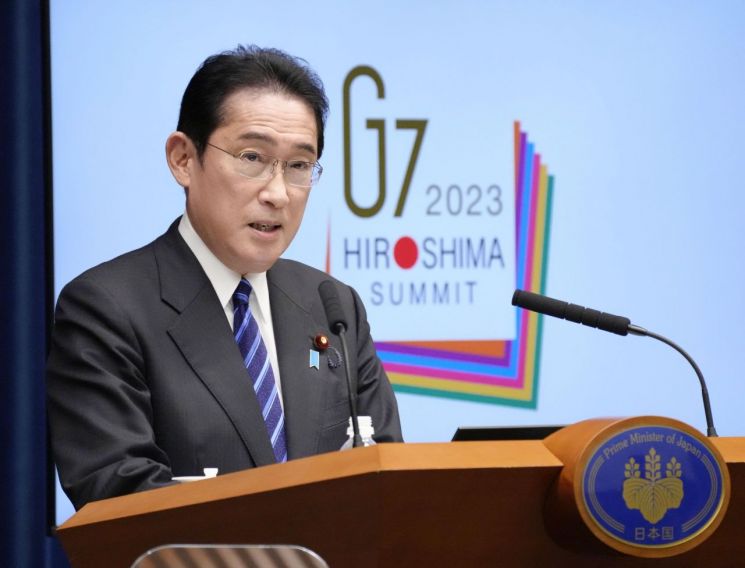 Japanese Prime Minister Fumio Kishida is holding a press conference on February 24 at the Prime Minister's Official Residence in Tokyo to mark the one-year anniversary of Russia's invasion of Ukraine. [Image source=Yonhap News]
The Presidential Office stated in a press release on the 2nd, "President Yoon Suk-yeol invited Prime Minister Kishida to visit Seoul during his March visit to Japan, and through this visit by Prime Minister Kishida, shuttle diplomacy between the two leaders will be fully activated."
It added, "Prime Minister Kishida's visit to South Korea is the first bilateral visit by a Japanese prime minister in 12 years since Prime Minister Yoshihiko Noda's visit to Seoul in October 2011." Mrs. Kishida Yuko will also accompany him on this visit.
The most notable aspect of Prime Minister Kishida's visit is whether there will be any mention of apology or reflection related to the government's solution on compensation for forced labor.
Cho Tae-yong, Director of the National Security Office, said in an interview with YTN on the 1st regarding the necessity of an apology from Prime Minister Kishida for historical issues, "It does not seem appropriate to state it bluntly. There are past issues, but there are also present and future matters, so it is important to maintain an overall balance," but he also mentioned, "Now Japan should do things that help South Korea's interests."
However, considering Japan's attitude after the announcement of the government's solution on forced labor, many view it as unlikely that an apology or reflection message will be expected. Rather, some see Kishida's early return visit as a move considering Japan's practical interests.
Professor Hosaka Yuji of Sejong University explained, "From Japan's perspective, there is one unresolved issue ahead of the G7 Hiroshima summit, which is the Fukushima contaminated water issue," and "Japan did not gain support from G7 countries, and especially Germany strongly opposed it."
He continued, "In this situation, although South Korea is not a G7 country, it is a closely related country to Japan, so South Korea's position is important. In particular, Prime Minister Kishida likely wants to obtain a positive response from President Yoon regarding the Fukushima contaminated water and seafood import restrictions through this visit ahead of the G7."
Regarding historical issues, Professor Hosaka said, "The Japanese government's consistent position is that there was no forced labor, and since Prime Minister Kishida inherits the previous cabinet, it is expected that there will be no direct expression of apology. This is not a matter that can be decided by Kishida's personal opinion."
© The Asia Business Daily(www.asiae.co.kr). All rights reserved.

















