LG Uplus is developing urban environment management services such as road cleaning, fine dust purification, and epidemic prevention using autonomous vehicles that operate 24 hours a day.
LG Uplus announced on the 30th that it has completed an agreement as the lead research institution for the “Research and Development of Autonomous Driving-Based Urban Environment Management Services” project under the “Autonomous Driving Technology Development Innovation Project” led by the Ministry of Land, Infrastructure and Transport.
The Autonomous Driving Technology Development Innovation Project is a research and development initiative aimed at completing the commercialization foundation of converged Level 4+ autonomous vehicles by 2027. Converged Level 4+ autonomous vehicles are capable of driving in a wide range of environments including urban roads, dedicated roads, and specific routes, incorporating infrastructure convergence (vehicle-cloud-road traffic) and social convergence technologies. The project is led by four ministries: the Ministry of Land, Infrastructure and Transport, the Ministry of Science and ICT, the Ministry of Trade, Industry and Energy, and the National Police Agency.
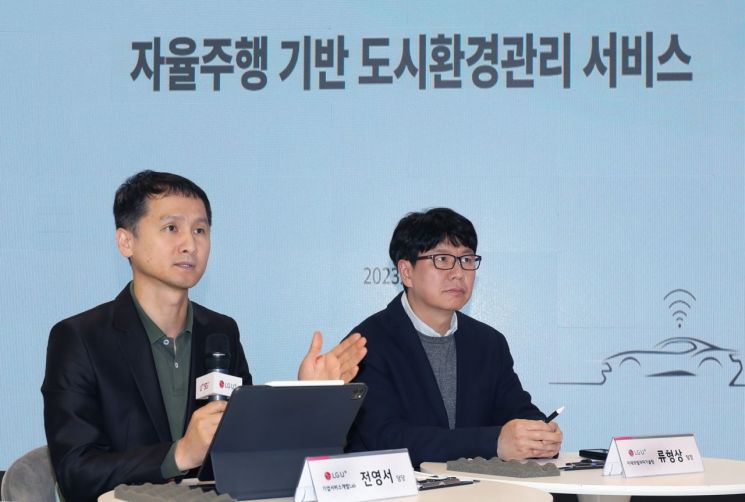 At the 'Autonomous Driving Technology Briefing' held on the 28th, Jeon Young-seo, head of LG Uplus Enterprise Service Development Lab (left), and Ryu Hyung-sang, head of LG Uplus Future Mobility Technology Team, are answering reporters' questions.
 [Photo by LG Uplus]
LG Uplus has additionally secured a project to develop urban environment management service technologies that perform road surface cleaning, fine dust and air purification, and epidemic prevention and disinfection through autonomous vehicles capable of 24-hour operation. As the lead research institution for about five years until 2027, LG Uplus will actively engage in related technology research and development.
According to a survey by the Korea Environment Corporation, simply cleaning roads thoroughly can reduce fine dust in the air by 37%. However, according to the Ministry of Environment, there have been 746 reported fatal accidents involving sanitation workers over the past five years, indicating high risks. Through this research and development project, LG Uplus aims to prevent accidents occurring during urban environment management and reduce secondary air pollution caused by diesel vehicle operation. The company plans to secure a new business foundation including autonomous driving service technology and operational know-how to enter the autonomous driving market. For this demonstration, LG Uplus formed a consortium with eight organizations including GS Construction.
To carry out this demonstration project, LG Uplus will research and develop ▲5G and vehicle-to-everything (V2X) communication-based vehicle data collection, processing, and transmission technologies ▲a 3D control system based on high-precision maps optimized for urban environment management services ▲and a user mobile app, aiming to demonstrate services over more than 40,000 km in a living lab (urban-scale demonstration space). Ryu Hyung-sang, team leader at LG Uplus, said, “We believe stability can be secured if the vehicle operates steadily for about six hours a day over two years.”
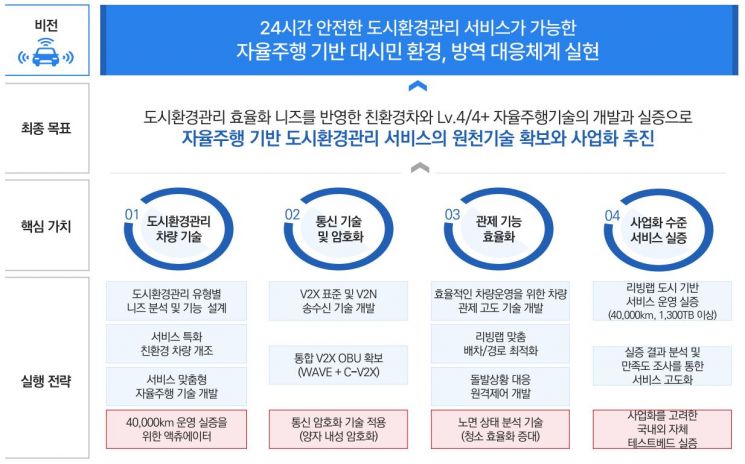 LG Uplus Autonomous Driving-Based Environment and Quarantine Response System Vision.
 [Photo by LG Uplus]
LG Uplus plans to develop a real-time integrated service monitoring solution based on vehicle and road situation video and 3D high-precision maps, which will detect and assess vehicle abnormalities and unexpected road situations, thereby enhancing the ease of autonomous driving-based service management. They also plan to develop and link a mobile app to improve user convenience. In particular, they will significantly strengthen vehicle security by applying a post-quantum cryptography algorithm, which is difficult to decode even with quantum computers that have computational power far superior to supercomputers.
LG Uplus plans to complete service technology design and development by 2024 and verify performance by demonstrating service operation based on the living lab urban environment until 2027.
Lee Sang-yeop, CTO (Executive Vice President) of LG Uplus, said, “It is meaningful to be selected as the lead research institution for the urban environment management service technology development project that can contribute to improving citizens’ quality of life,” adding, “Urban environment management is mainly conducted during late-night hours when many fatal accidents occur, and we expect this research and development to help resolve such issues.”
© The Asia Business Daily(www.asiae.co.kr). All rights reserved.
![Clutching a Stolen Dior Bag, Saying "I Hate Being Poor but Real"... The Grotesque Con of a "Human Knockoff" [Slate]](https://cwcontent.asiae.co.kr/asiaresize/183/2026021902243444107_1771435474.jpg)












