Concerns over damage to the fisheries industry are growing due to the discharge of contaminated water from the Fukushima nuclear power plant in Japan, and criticisms have been raised about the inadequacy of countermeasures.
Choi Seon-guk, Chair of the Health, Welfare, and Environment Committee of the Jeonnam Provincial Council (Democratic Party of Korea, Mokpo 1), demanded measures to address the contaminated water from the Japanese nuclear power plant at a food radiation safety management countermeasure meeting held on the 26th.
The meeting was organized to prepare safety management measures and establish organic cooperation among related agencies in response to the imminent discharge of contaminated water from the Fukushima nuclear power plant.
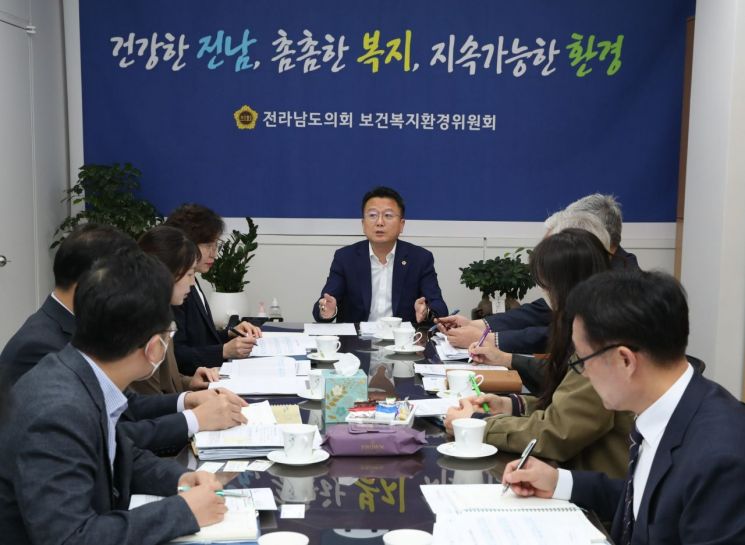 Jeon Sang-guk, a member of the Jeonnam Provincial Assembly, demanded measures to address the contaminated water from the Japanese nuclear power plant at a meeting on food radiation safety management. Photo by Jeonnam Provincial Assembly
The meeting was attended by about 10 officials, including Chair Choi Seon-guk, Kim Byung-sung, Director of the Food and Drug Division of Jeonnam Province, Yang Ho-cheol, Director of the Pharmaceutical Chemistry Division at the Jeonnam Health and Environment Research Institute, Park In-tae, Head of the Seafood Safety Management Team at the Jeonnam Marine Fisheries Science Institute, and Lee Gwi-rye, Head of the School Meal Education Team at the Jeonnam Provincial Office of Education.
They discussed response measures for radiation safety management of production and distribution foods, such as supporting sampling analysis among analytical institutions and conducting radiation inspections before distribution for school meal suppliers above a certain scale.
Chair Choi stated, “The fear among residents regarding the discharge of contaminated water from the Fukushima nuclear power plant is increasing, so it is necessary to increase the frequency of food radiation inspections and expand the range of items tested,” and pointed out, “Jeonnam Province’s preparations for analyzing tritium, which has recently become an issue, are insufficient.”
He continued, “Radiation safety management must not be overlooked for school meal ingredients supplied to children vulnerable to food radiation risks,” and demanded, “We must ensure that no children are exposed to risks in blind spots.”
He also emphasized, “An organic cooperation system among agencies must be established as soon as possible to thoroughly respond to food radiation safety management,” and added, “Monitoring should be strengthened and sufficient information provided to protect the health and safety of residents.”
Park In-bae, team leader at the Marine Fisheries Science Institute, responded, “Jeonnam accounts for more than half of domestic seafood production,” and said, “To enable rapid and accurate radiation inspections at the production stage, we plan to acquire two additional gamma nuclide (cesium, iodine) analysis devices by September, which will triple the maximum daily analysis capacity.”
Other officials stated, “There is difficulty in purchasing and deploying inspection equipment because national standards and testing methods for tritium in food have not been clearly established,” and added, “We will monitor the trends of the Ministry of Oceans and Fisheries and the Ministry of Food and Drug Safety to equip tritium analysis devices.”
© The Asia Business Daily(www.asiae.co.kr). All rights reserved.
![From Hostess to Organ Seller to High Society... The Grotesque Scam of a "Human Counterfeit" Shaking the Korean Psyche [Slate]](https://cwcontent.asiae.co.kr/asiaresize/183/2026021902243444107_1771435474.jpg)
















