Nursing Act and Medical Act Passed Without Ruling Party Attendance
Prevention of Jeonse Fraud and Other Livelihood Laws Processed
Extension of Activity Period for Political Reform and Pension Special Committees
On the 27th, the National Assembly passed the designation of the special investigation law for the Daejang-dong 5 billion club and Mrs. Kim Geon-hee as a fast-track agenda item. The Nursing Act and Medical Service Act, which had significant disagreements between the ruling and opposition parties, also passed the plenary session led by the opposition. The Jeonse fraud victim support law and the multiple voting rights law for venture companies also passed the plenary session.
On that day, the National Assembly held a plenary session and proceeded with the voting procedure on the designation of the dual special investigation law as a fast-track agenda. While all members of the People Power Party left the chamber, the dual special investigation fast-track agenda was approved amid cheers and applause from the opposition. Except for one dissenting vote against the Kim Geon-hee special investigation law, all 183 opposition members who participated in the vote supported the designation of both special investigation laws as fast-track.
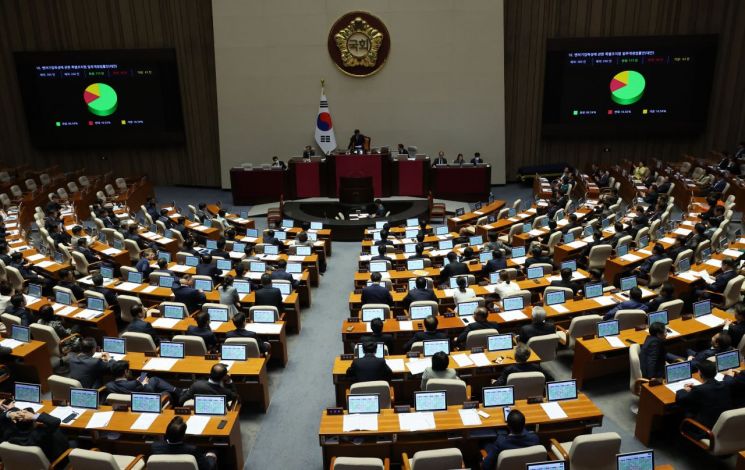
Before the vote, the ruling and opposition parties clashed head-on, shouting at each other when the opposing party’s members made explanatory remarks. During Justice Party lawmaker Jang Hye-young’s speaking time, People Power Party members protested by saying "It is regrettable" and "It is shameful," and when People Power Party lawmaker Jeon Ju-hye spoke, Democratic Party members responded with "Don’t say nonsense." After People Power Party lawmaker Park Hyung-soo finished his explanatory remarks, all People Power Party members eventually left the voting hall after protesting loudly.
On the 25th, 182 opposition lawmakers from the Democratic Party, Justice Party, and others submitted a request to the National Assembly for the designation of the 5 billion club and Kim Geon-hee special investigation as fast-track. Both parties agreed that the 5 billion club special investigation would be based on the bill proposed by lawmaker Kang Eun-mi, and if the Judiciary Committee’s plenary session does not pass it within 180 days, the alternative approved by the Judiciary Committee’s first subcommittee would be adopted as a plenary session amendment. Regarding the Kim Geon-hee special investigation bill, the proposal by Justice Party floor leader Lee Eun-joo would be the basis, but if the Judiciary Committee’s plenary session does not pass it within 180 days, further discussions on the investigation targets and special investigation recommendation methods would be held to prepare a plenary session amendment. The Democratic Party intended to expand the scope of the special investigation related to Mrs. Kim.
The Medical Service Act amendment and the Nursing Act enactment bill, which were directly submitted by the opposition alone, also passed the plenary session.
In the plenary session held that afternoon, the vote on the Nursing Act enactment bill resulted in 179 votes in favor and 2 abstentions out of 181 members present, passing the bill. The Medical Service Act amendment passed with 154 votes in favor, 1 against, and 22 abstentions out of 117 members present. People Power Party members left the chamber as the vote began and did not participate.
The Nursing Act clarifies the scope of nurses’ duties and strengthens the treatment of nursing personnel. The Medical Service Act amendment includes provisions to revoke medical licenses and prohibit reissuance for 10 years if a medical professional is sentenced to imprisonment or higher. The National Assembly’s Health and Welfare Committee directly submitted a total of six bills, including the Medical Service Act amendment and the Nursing Act enactment bill, to the plenary session in February. The Medical Service Act was postponed by bipartisan agreement just before the plenary session on the 23rd of last month.
The ruling party plans to request the president’s veto power regarding the Nursing Act, which was processed solely by the opposition. People Power Party floor leader Yoon Jae-ok said at the morning Supreme Council meeting, "If they ultimately push through contentious bills like the Nursing Act, we will have no choice but to recommend the president exercise the veto power."
Regarding the Medical Service Act, they currently do not intend to recommend the veto power. People Power Party deputy floor leader Lee Yang-su told reporters at the National Assembly in the afternoon, "While we can criticize the Democratic Party for handling the Medical Service Act too unilaterally, it seems difficult to consider recommending a veto."
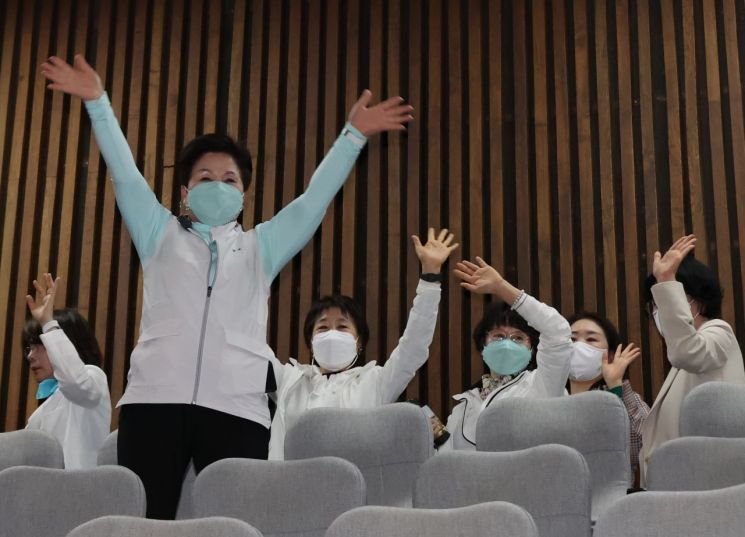
The bill introducing multiple voting rights shares, a long-standing wish of the venture industry, passed the National Assembly plenary session that day. This allows founders of unlisted venture and startup companies to issue shares with up to 10 voting rights per share.
The partial amendment to the Special Measures for the Promotion of Venture Businesses Act, which implements the multiple voting rights share system, was approved with 173 votes in favor, 44 against, and 43 abstentions out of 260 members present.
The amendment was initiated by the Ministry of SMEs and Startups in 2020 and the introduction process began in earnest, but it was stalled in the National Assembly for over two years due to opposition from some lawmakers. Reasons included that the multiple voting rights share system violates the Commercial Act, which stipulates one voting right per share, and concerns that it could be abused for illegal succession by large corporations.
Before the vote on the amendment, eight lawmakers from both ruling and opposition parties engaged in an unusual debate and discussion.
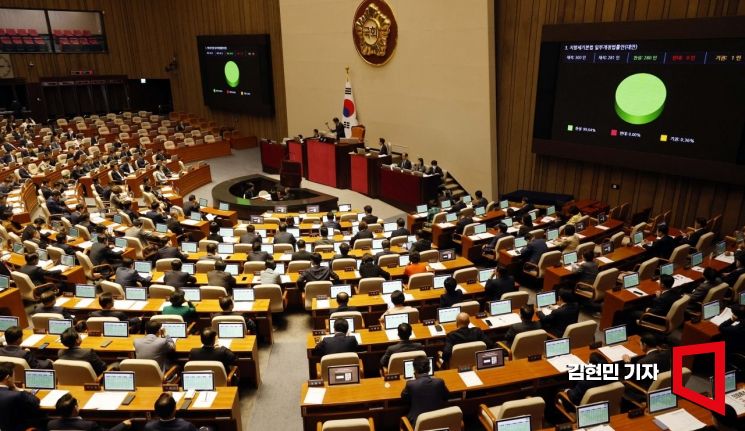 On the 27th, the partial amendment bill of the Local Tax Basic Act was passed at the plenary session held at the National Assembly. Photo by Hyunmin Kim kimhyun81@
Bills related to measures against Jeonse fraud also passed the plenary session.
The amendment to the Local Tax Basic Act passed that day stipulates that when a tenant’s Jeonse house is transferred through auction or public sale, the tenant’s Jeonse deposit should be repaid preferentially over local taxes imposed on the house. The purpose is to protect Jeonse fraud victims by prioritizing the repayment of deposits to tenants with confirmed registration dates over unpaid local taxes.
Along with this, the partial amendment to the Act on Appraisal and Appraisers also passed. The amendment cancels the qualifications of appraisers sentenced to imprisonment or higher for real estate-related crimes such as Jeonse fraud and allows appropriate disciplinary actions for violations of laws. After disqualification, appraisal firms cannot employ such appraisers as office staff for five years, thereby strengthening sanctions to prevent appraisers involved in real estate crimes from engaging in appraisal work.
The bill concerning support for Jeonse fraud victims, which attracted attention, will be actively discussed starting on the 28th at the National Assembly Land, Infrastructure and Transport Committee following the government proposal by People Power Party lawmaker Kim Jeong-jae. The ruling and opposition parties aim to pass support measures in early May, discussing proposals by Democratic Party lawmaker Jo Oh-seop and Justice Party lawmaker Shim Sang-jung along with the government plan.
The National Assembly also passed the amendment to the Framework Act on Disaster and Safety Management, which allows the use of base station information in case of concerns about mass crowd accidents. This is one of the measures proposed to prevent recurrence after the Itaewon Halloween tragedy last year.
The three broadcasting-related bills, including the Broadcasting Act amendment, were directly submitted to the plenary session. The Broadcasting Act amendment includes provisions to increase the number of directors of the Korean Broadcasting System and expand the authority to recommend directors to broadcasting and media-related academic societies and viewer committees.
Meanwhile, the plenary session extended the activity period of the Political Reform Special Committee (Jeonggae Special Committee) and the Pension Reform Special Committee (Pension Special Committee), whose deadlines are at the end of this month, by six months. With the passage of the extension bill, the activity period of both committees has been extended until the end of October.
© The Asia Business Daily(www.asiae.co.kr). All rights reserved.
!["The Woman Who Threw Herself into the Water Clutching a Stolen Dior Bag"...A Grotesque Success Story That Shakes the Korean Psyche [Slate]](https://cwcontent.asiae.co.kr/asiaresize/183/2026021902243444107_1771435474.jpg)


















