"Showcasing Characteristics of 18th Century Buddhist Temple Architectural Decorations"
The Daeungbojeon Hall of Baengnyeonsa Temple in Gangjin, adorned with multiple dragons and phoenixes, is designated as a treasure. The Cultural Heritage Administration announced on the 27th that it will review opinions from various sectors for a month and finalize the designation through the Cultural Heritage Committee's deliberation.
Baengnyeonsa Temple in Gangjin was the site of the Buddhist reform movement led by Wonmyo Guksa Yose (1163?1245) at the end of the Goryeo Dynasty. Many monks continued to visit and practice there during the Joseon Dynasty. Yose led the Baengnyeon Seolsa movement at Baengnyeonsa, completing the theoretical aspects of the faith-based reform movement.
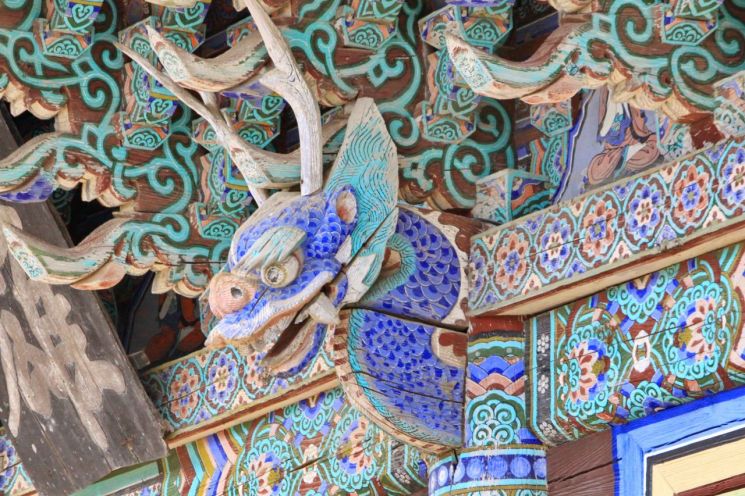
The main Buddhist hall, Daeungbojeon, is a single-story building with a hipped-and-gabled roof, three bays wide and three bays deep. It was rebuilt in 1762 after a fire in 1760. Notable features include dragon head carvings atop the columns and dragon head decorations on the ceiling, expressed with humor and delicacy.
The Cultural Heritage Administration explained, "The detailed techniques such as the style of the bracket system and the fine carvings on architectural components are also elaborate," adding, "It shows the characteristic ornamental architecture of Buddhist halls in the 18th century." They further noted, "The restoration background and the lineage and exchanges of the artisans involved in the Buddhist construction can be confirmed through the restoration record 'Mandeoksan Baengnyeonsa Daebeopdang Jungsugi' and the temple record 'Mandeoksaji.'"
© The Asia Business Daily(www.asiae.co.kr). All rights reserved.

















