Daegu City Council Temporary Session Written Inquiry
Criticism of Gyeongbuk Provincial Office Relocation Site Development
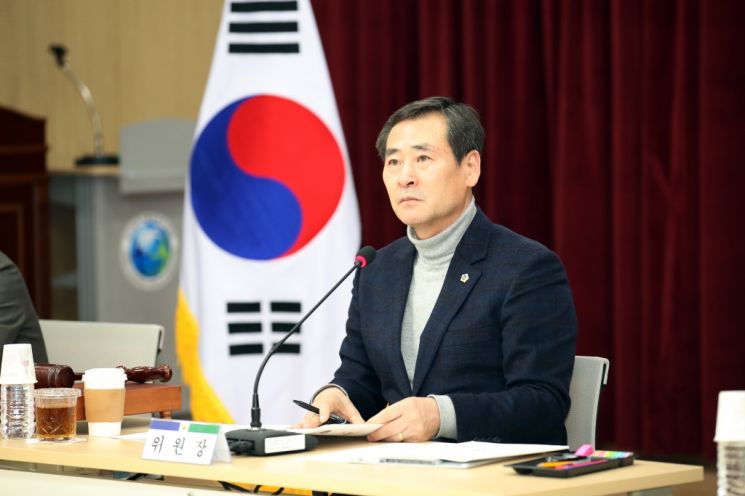
Daegu City Council member Lee Dong-wook (People Power Party, Buk-gu 5) pointed out during the 300th extraordinary session held on the 26th through a written inquiry that “there is distrust in Daegu’s spatial policies such as the development of the former provincial government site and the relocation of the Maecheon-dong agricultural and marine products wholesale market, and residents of Buk-gu are continuing intense protests,” and asked Daegu Mayor Hong Joon-pyo for countermeasures to resolve the residents’ complaints and demands.
In his written inquiry, Councilor Lee stated, “Recently, despite the joyful events that citizens are cheering for, such as the passage of the Daegu-Gyeongbuk Integrated New Airport Special Act in the National Assembly plenary session, which lays the foundation for reestablishing Daegu’s status, and the subsequent announcement of the Daegu development blueprint, residents of Buk-gu have been continuing daily head-shaving protests and visits to the government for several days,” and suggested that “Mayor Hong Joon-pyo, as a ‘great elder of Daegu,’ should embrace the local residents” and proposed solutions.
As the first inquiry, he requested a response regarding whether there was any indication from the President, or agreement and communication with related ministries, about the Ministry of Culture, Sports and Tourism’s plan to relocate the cultural and arts hub project?which includes the National Museum of Modern and Contemporary Art and the National Musical Complex?from the former provincial government site to the Daegu Prison relocation site in Hwawon, Dalseong-gun, which is a campaign promise of President Yoon Seok-yeol, and whether the original plan will be pursued.
Second, pointing out contradictions in the relocation of the second public institution within the urban convergence special zone announced by Mayor Hong as part of the Daegu development blueprint following the construction of the Daegu-Gyeongbuk New Airport, he also requested a response regarding measures to mediate conflicts between other autonomous districts and counties such as Dong-gu.
Councilor Lee claimed, “The reason the development of the former provincial government site has shown confusion is the provisional suspension of the Daegu City new city hall construction project,” and urged the resumption of the new city hall construction project, stating, “The development of the former provincial government site must be preceded by the prompt completion of the new city hall construction.”
He also argued, “If the Ministry of Culture, Sports and Tourism’s cultural and arts hub is built according to the original plan under the current circumstances, there is no need to wait until the completion of the Daegu City new city hall,” and proposed, “The National Museum of Modern and Contemporary Art and others could be built on a certain area such as the right-side parking lot site of the former provincial government site, and the remaining land could be developed sequentially depending on situations such as the passage of the Urban Convergence Special Zone Special Act.”
In the third inquiry, regarding the feasibility study on the relocation of the Maecheon-dong agricultural and marine products wholesale market, he compared the evaluation and results of candidate relocation sites from the 2015 and 2022 studies and pointed out, “It seems like a ‘tailored study’ that tentatively decided the relocation site as the Dopyeong district in Dalseong-gun and created the evaluation criteria accordingly,” and criticized issues such as “the establishment of new economic support by local governments, whether the road condition improvement plan around Dopyeong district and the expansion plan of the access road are reflected in the mid-term local finance plan, overlapping bonus points given for similar evaluation criteria in economic conditions, and exclusion of evaluation scores through surveys.”
As the fourth inquiry, regarding the ‘Chilgok 200,000-pyeong Airport Front City Development’ announced by Mayor Hong as the Daegu development blueprint following the promotion of the Daegu-Gyeongbuk New Airport project, he pointed out the necessity of developing an airport complex city, stating, “Recently, airport functions have expanded from simple transportation functions for passenger and cargo movement to various services and industrial activities that create high added value,” and requested a response on “what the planned airport-based urban development site and main introduced functions are in the Chilgok area of Buk-gu, the gateway region entering the new airport, with a scale of 200,000 pyeong.”
In particular, Councilor Lee emphasized that essential infrastructure for an airport complex city is highways and railroads directly connected to the airport, and proposed “the Chilgok Airport Front City must have an airport railway line passing underground connecting Seodaegu Station to the new airport, and the railway station must be built in the city’s internal center for it to succeed” as a prerequisite for urban development.
Councilor Lee concluded with a brief comment, saying, “Residents are not asking for something extraordinary from Daegu City, but want democratic procedures and communication such as sufficiently listening to residents’ opinions when promoting local issue policies and seeking directions and countermeasures together,” and left a message to Mayor Hong and related officials, “Let’s communicate more.”
© The Asia Business Daily(www.asiae.co.kr). All rights reserved.
![Clutching a Stolen Dior Bag, Saying "I Hate Being Poor but Real"... The Grotesque Con of a "Human Knockoff" [Slate]](https://cwcontent.asiae.co.kr/asiaresize/183/2026021902243444107_1771435474.jpg)
















