Tokyo Electric Power Company to Begin Discharge as Early as July
Research Institute: "Full Inflow into Our Waters in 4-5 Years"
"Typhoons May Carry Contaminated Water and Cause Rainfall"
With the completion of the undersea tunnel excavation, the discharge of contaminated water from the Fukushima nuclear power plant in Japan is entering the final countdown, raising concerns among fishermen. The estimated time for the discharged contaminated water to reach our coastal waters varies from as soon as 7 months to as long as 5 years.
The undersea tunnel construction, which began in August last year, was completed on the 25th. This facility is for discharging contaminated water from the Fukushima Daiichi Nuclear Power Plant into the sea. Tokyo Electric Power Company (TEPCO) has set a goal to complete the construction of facilities related to contaminated water discharge, including equipment within the nuclear power plant site, by the end of June. As this construction enters its final stage, the possibility of discharge starting as early as July has increased.
The Korea Institute of Ocean Science and Technology and the Korea Atomic Energy Research Institute estimate that it will take 4 to 5 years after the discharge for the contaminated water to fully flow into our waters. The amount of tritium entering domestic waters 10 years later is expected to be about 0.001 Bq (becquerel, the international unit for measuring radioactivity) per cubic meter, which is one hundred-thousandth of the average tritium concentration in domestic waters.
However, fishermen's concerns remain. Even if the government or the International Atomic Energy Agency (IAEA) releases investigation results stating there is no harmful effect on human health, consumers are inevitably sensitive to food safety issues on their tables, leading to a decline in seafood consumption sentiment, reduced consumption volume, and inevitable price crashes. The National Assembly Research Service also released a study showing that 81% of consumers reduced seafood consumption after the Fukushima nuclear accident.
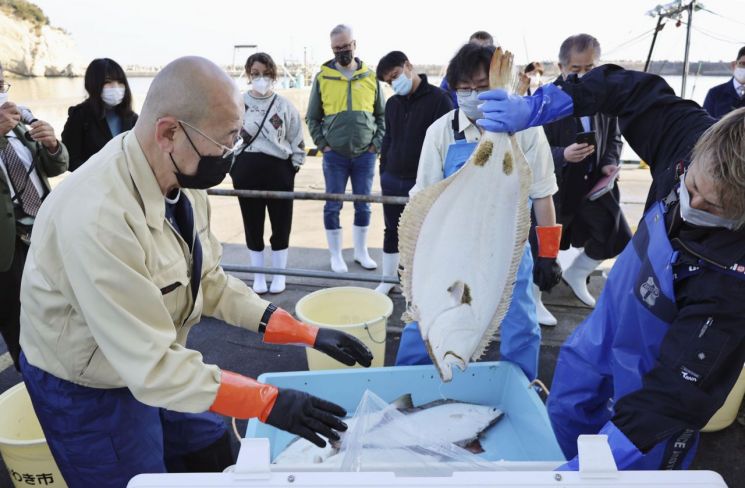 The International Atomic Energy Agency (IAEA) inspection team is observing the transfer of fish samples collected from the port of Iwaki City, Fukushima Prefecture, on November 10 last year.
 [Image source=Yonhap News]
There is also a prediction that the discharged contaminated water could return to our coastal waters within as soon as 7 months. In this case, fishermen's damages could begin as early as this winter.
On the 7th, Professor Seo Gyun-ryeol, Emeritus Professor of Nuclear Engineering at Seoul National University, stated on YTN's 'News Rider' that the upper and lower layers of the ocean should be viewed differently, pointing out that the lower layer water could reach our coastal waters much faster than previously expected.
According to Professor Seo's explanation, the upper layer, or surface water, flows into the North Pacific after meeting the Kuroshio Current and Oyashio Current, then returns to our country via the North Equatorial Current near California, taking about 4 to 5 years as previously predicted. However, water located 200 to 500 meters below the sea surface flows through the East China Sea and the Taiwan Strait into the Korea Strait, potentially reaching our coastal waters within 7 months to 1 year.
Professor Seo particularly highlighted typhoons as a variable. When a typhoon occurs, the sea churns, causing the lower water to rise to the surface, and this water can fall on the Korean Peninsula in the form of rain. About 20 to 30 typhoons occur annually, with an average of 3.1 affecting Korea each year. Professor Seo emphasized the need for contaminated water discharge simulations assuming typhoons pass through the Korean Peninsula.
Meanwhile, the Ministry of Oceans and Fisheries is promoting radiation inspections to dispel public concerns about contaminated water discharge, aiming to conduct over 8,000 tests on all domestic seafood species produced this year. This is an increase of more than 47% compared to the previous year (5,441 tests).
Additionally, the ministry plans to operate a 'Public Application Seafood Radiation Inspection Board' allowing citizens to request radiation tests on desired seafood. Ten items with the most requests will be selected weekly for radiation testing, and the results will be disclosed. After a one-month pilot operation, the service will officially launch next month.
© The Asia Business Daily(www.asiae.co.kr). All rights reserved.

















