Results of the Job-Centered Compensation System Reform Performance Review
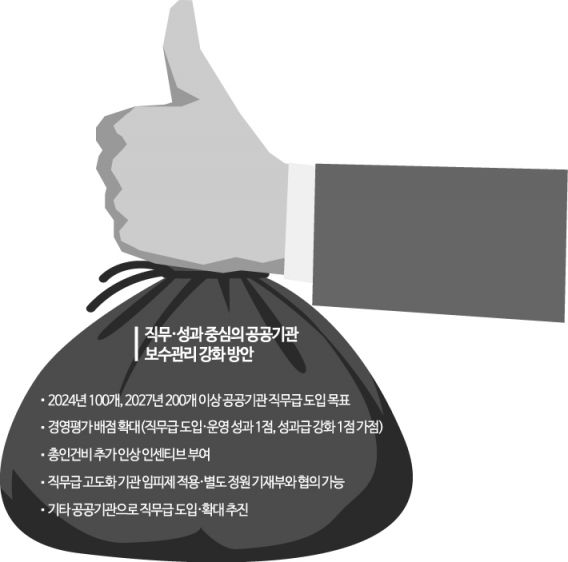
Last year, the number of public institutions operating with a job-based pay system reached 55. Although this is an increase from 35 the previous year, there is still a long way to go to meet the government’s target of 100 institutions by next year. In particular, there are concerns that the strong opposition from labor unions to the job-based pay system will hinder its wider adoption.
On the 26th, the Ministry of Economy and Finance announced the “2022 Job-Centered Compensation System Reform Performance Review.” The review covered 130 public enterprises and quasi-governmental institutions, of which 42% had introduced the job-based pay system. The ministry stated, “Most institutions have completed preliminary procedures such as job analysis for the introduction of job-based pay,” and evaluated that “public institutions recognize the necessity of adopting job-based pay and are making efforts to implement it.”
The government plans to increase the number of public institutions adopting the job-based pay system to 100 by next year and over 200 by 2027. In January, Deputy Prime Minister and Minister of Economy and Finance Choo Kyung-ho held a Public Institution Management Committee meeting and said, “We plan to expand the proportion and differentiation of performance-based pay within public institution compensation to strengthen performance-centered pay management,” and added, “We will promote a shift from the existing seniority-based system to a job-centered personnel management system based on expertise and efficiency.”
The problem lies in the intense opposition from labor unions. Public sector unions under both the Korean Confederation of Trade Unions (KCTU) and the Federation of Korean Trade Unions (FKTU) reject the government’s introduction of the job-based pay system and insist that no labor-management agreements should be made at individual workplaces. Since job-based pay relates to wages, labor-management agreement is essential. If unions refuse to adopt the job-based pay system, there is no way to proceed. As public sector unions are responding by holding a Joint Countermeasure Committee (Gongdaeui), the pace of job-based pay adoption in public institutions is inevitably slowing down.
Another issue to be resolved is the varying levels of job-based pay system sophistication across institutions. Some institutions conduct systematic job analyses and link them to their compensation structures. For example, the Korea Trade Insurance Corporation has a job-based pay proportion of 32% relative to total compensation, and the Korea Water Resources Corporation shows a difference of over 500,000 KRW per month in job-based pay within the same rank. On the other hand, some institutions have a negligible proportion of job-based pay in their compensation or insufficient differentiation of pay according to job difficulty. Some institutions nominally introduced job-based pay but operate it like a fixed allowance or provide job-based pay only to certain ranks.
The government plans to reflect the review results in the public institution management evaluation by delivering them to the Public Institution Management Evaluation Group to promote the expansion of the job-based pay system. Institutions with excellent adoption and operation performance will receive an additional 0.1 percentage point incentive on total personnel expenses, which can be used as job-based pay funds for the next year. From next year’s performance review, this incentive will also be given to institutions newly adopting the system.
Additionally, starting next month, the Ministry of Economy and Finance will hold briefing sessions for public institution compensation officers by visiting major innovation cities by region. Underperforming institutions will receive customized consulting. In particular, for other public institutions, the relevant ministries will oversee the review of job-based pay adoption and operation status. To support this, the ministry will share policy directions on job-based pay with the relevant ministries and provide basic education on the job-based pay system to other public institutions.
© The Asia Business Daily(www.asiae.co.kr). All rights reserved.

















