The Bank of Korea Holds Labor Market Seminar
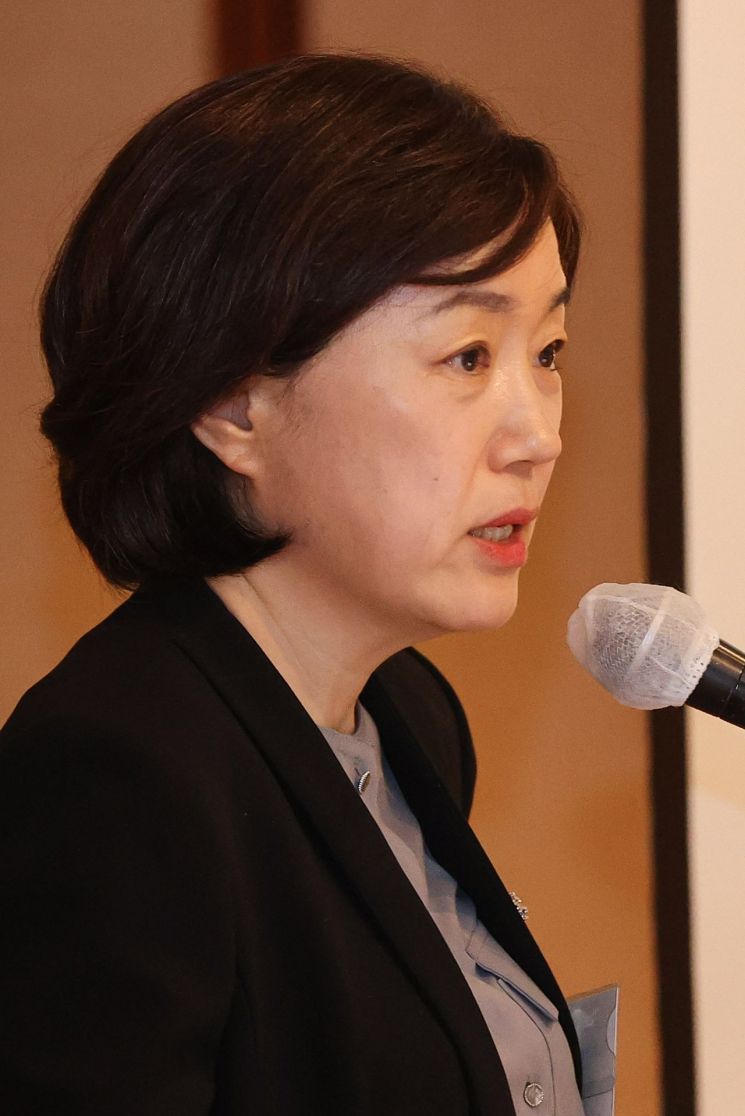
Seo Young-kyung, a member of the Financial Monetary Policy Committee, recently explained that although the employment situation in South Korea shows improvement compared to the period before the spread of COVID-19, it does not have a significant impact on inflation or growth recovery.
She explained that this is because South Korea's labor market has improved mainly in terms of incomplete employment among the elderly and women, and labor productivity has also declined compared to the past. Seo emphasized that if this situation continues, the 'low growth-low inflation' crisis could become full-fledged, making structural improvements in the labor market necessary.
On the 25th, Seo made these remarks during a keynote speech titled "Labor Market Situation and Monetary Policy Implications" at the Bank of Korea's labor market seminar held at the multipurpose conference hall of the Bank of Korea's integrated annex in Jung-gu, Seoul.
According to Seo, although global inflation is gradually easing this year, most countries still maintain high core inflation. In the case of the United States, the main cause is analyzed to be the rise in service prices due to reduced labor supply and severe labor shortages.
However, in South Korea, despite quantitative labor market indicators significantly exceeding pre-pandemic levels, labor market tightness (the ratio of vacant jobs to unemployed persons) remains at a similarly low level as before the pandemic, unlike in the United States.
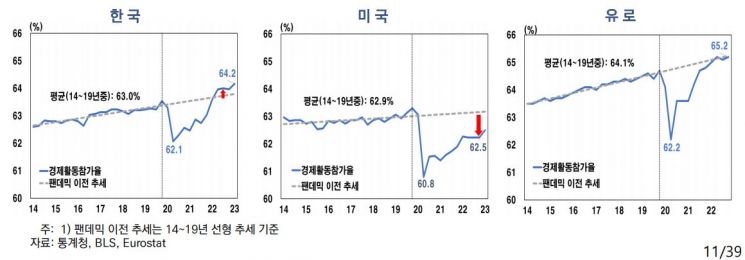
In fact, the number of employed persons in South Korea increased from 300,000 before the spread of COVID-19 to 570,000 year-on-year, and during the same period, the employment rate and economic participation rate also rose from 60.7% to 61.4% and from 63% to 63.4%, respectively.
Seo explained that although South Korea's quantitative labor market indicators have relatively expanded compared to the United States, the low labor market tightness is due to the lack of qualitative improvement.
First, in South Korea, employment among the elderly increased as the timing of the COVID-19 pandemic coincided with the retirement of the baby boomer generation. The employment increase effect (670,000) considering both the aging and employment rate rise of the first baby boomer group (ages 60-65) over the past five years accounted for 49% of the total employment increase.
This contrasts with the United States, where the economic participation rate of the elderly declined due to high COVID-19 fatality rates and early retirement.
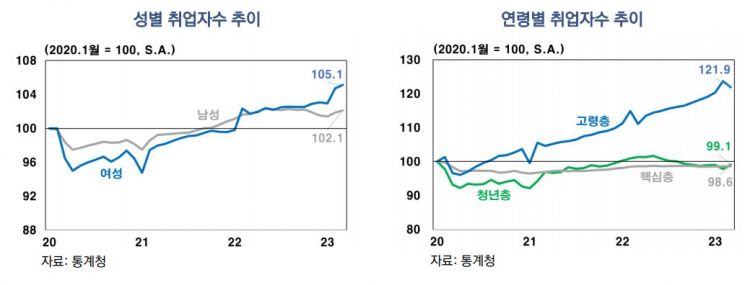
Additionally, after COVID-19, female employment expanded among both young and elderly groups due to delayed marriage, intensified low birth rates, and the expansion of marketization of household labor.
As incomplete employment such as part-time workers or irregular workers increased mainly among the elderly and women, total working hours remained similar to pre-COVID-19 levels despite the increase in the number of employed persons.
Seo stated, "Despite the quantitative increase in employment, the qualitative improvement has been limited, so the macroeconomic impact of the labor market is not significant," adding, "South Korea has a lower correlation between growth and employment compared to the United States, and unlike the U.S., labor productivity has declined since the pandemic."
She continued, "Although the direct relationship between traditional quantitative employment indicators and inflation is not high, labor market tightness and core inflation are estimated to be closely related," noting, "Tightness and core service prices have been declining together since the third quarter and October of last year."
Seo predicted that this year, as demand slows and supply expands in the labor market, tightness will ease, which will act as a factor reducing inflationary pressure.
She emphasized that if the decline in labor productivity continues, a return to a low growth-low inflation regime will be inevitable, increasing the burden on monetary policy, thus requiring proactive responses.
Seo said, "It is necessary to consistently pursue genuine structural improvements in the labor market," and added, "Since traditional indicators such as unemployment and employment rates have limitations in reflecting employment and economic conditions, it is important to continuously develop employment indicators with high practical relevance."
© The Asia Business Daily(www.asiae.co.kr). All rights reserved.
![A Woman Who Jumps Holding a Stolen Dior Bag... The Mind-Shaking, Bizarre Con of a "Human Knockoff" [Slate]](https://cwcontent.asiae.co.kr/asiaresize/183/2026021902243444107_1771435474.jpg)


















