The three major mobile carriers are targeting the robotics business as a new growth engine and are accelerating their efforts. They are rapidly launching service robots enhanced with artificial intelligence (AI) to aggressively capture the market.
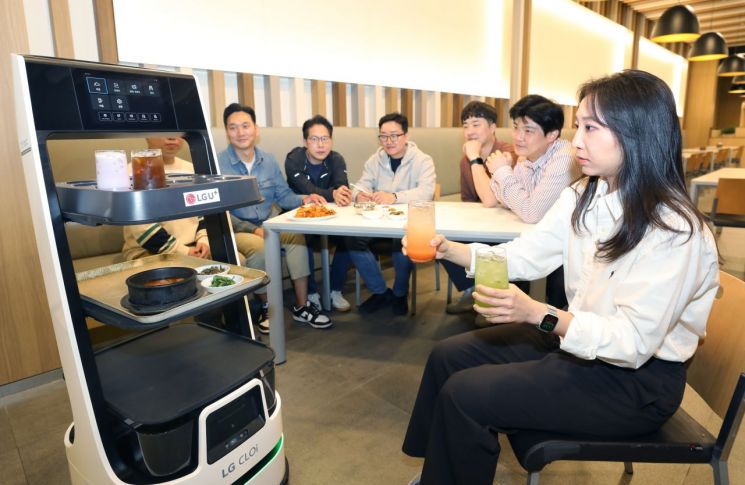
LG Uplus announced on the 25th that it will launch a renewed 'U+ Serving Robot' service using the new serving robot 'LG CLOi ServeBot.'
The U+ Serving Robot is equipped with six independent suspensions, LiDAR sensors, and 3D cameras, allowing it to safely carry items weighing up to 40kg on a wider tray (400×500mm → 444×532mm) compared to previous models. This enables safer serving of liquid-containing foods such as gukbap (soup with rice), ramen, and beverages in restaurants.
The tray for loading items can be adjusted in height and number according to the items being served and the store environment, improving usability. It can run continuously for 11 hours on a full charge, and with direct communication between robots, more than 10 robots can operate in the same space.
LG Uplus also plans to introduce the U+ Serving Robot mobile app. While the existing serving robot service only allowed users to check basic information such as battery level and activity, the U+ Serving Robot app enables remote control to send the robot to specific tables, dish return areas, waiting areas, and charging stations as needed.
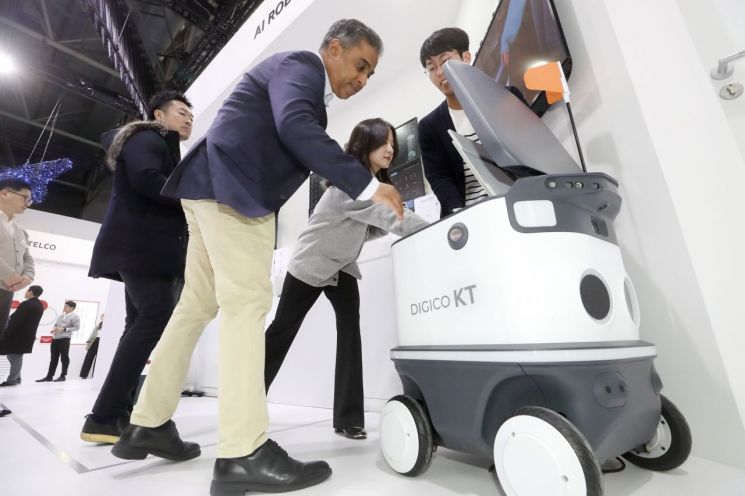
KT also showcased its 'Robot Makers' platform and autonomous delivery robots at events such as Mobile World Congress (MWC) 2023 and World IT Show (WIS) 2023, accelerating the commercialization of delivery robots.
'Robot Makers' is a cloud-based integrated robot control platform that connects not only different types of robots but also infrastructure necessary for robot use, such as elevators, ordering and payment applications, doors, intercoms, and cold chain systems. It features an open architecture that allows various robots to be applied across multiple businesses and provides SDK (Software Development Kit) and API (Application Programming Interface) to integrate robots with systems.
KT’s delivery robot incorporates a cold chain system that controls temperature and humidity. It manages not only the temperature but also the humidity inside the cargo compartment, maximizing the freshness of food during delivery. This robot was piloted last year at Jeju Shinhwa World and recently received great feedback from customers, becoming an 'official staff member' at Jeju Shinhwa World.
SK Telecom has also begun commercializing patrol robot services that integrate AI technology. Recently, it signed a business agreement with Newility and SK Shieldus for the joint development of an 'autonomous driving AI patrol robot.' The autonomous driving AI patrol robot service involves autonomous robots patrolling designated areas for monitoring and dispatching security personnel from the control center upon detecting unusual situations, providing security and guarding services.
SKT plans to apply AI video recognition and transmission technology to Newility’s autonomous driving robot technology and remote control solutions, while utilizing SK Shieldus’s security solutions and sales infrastructure. They are considering the patrol robot market targeting schools, factories, and public institutions that require 24-hour monitoring and have CCTV blind spots.
© The Asia Business Daily(www.asiae.co.kr). All rights reserved.


















