Next-Generation Antenna Technology Study Held
LG Uplus has successfully demonstrated next-generation network technology that expands frequency coverage in the ultra-high frequency band, which has a short reach and low diffraction. This can eliminate shadow areas, improving communication quality and investment efficiency. It is a proactive preparation for the upcoming 6G era.
On the 24th, LG Uplus held a next-generation antenna technology study session and introduced Reconfigurable Intelligent Surface (RIS) technology.
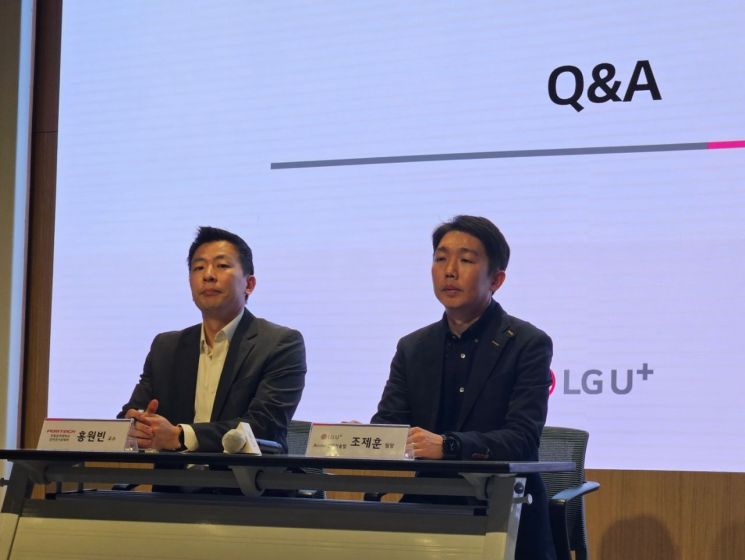 Professor Hong Won-bin of Pohang University of Science and Technology (left) and Jo Je-hoon, Head of LG Uplus Access Advanced Technology Team, are answering reporters' questions at the next-generation antenna technology study held on the 24th.
 [Photo by Oh Su-yeon]
LG Uplus, in collaboration with Pohang University of Science and Technology (POSTECH), developed frequency coverage expansion technology, a core element for implementing 6G mobile communication services, and successfully demonstrated it in a commercial environment. The ‘Reconfigurable Intelligent Surface (RIS)’ developed by LG Uplus and Professor Hong Wonbin’s research team at POSTECH is a technology that expands frequency coverage in the terahertz band, a candidate frequency band for 6G. Since last year, LG Uplus and Professor Hong’s team have been conducting industry-academic cooperation research on 6G RIS technology. They developed technology that reflects, transmits, and absorbs frequencies and confirmed that it operates without power consumption in the terahertz band above 100 GHz, which is similar to actual usage environments.
Although 6G technology standards have not yet been established, the terahertz band is considered a key candidate band. Jo Jehoon, head of LG Uplus’s Access Advanced Technology Team, said, "We are currently researching various frequencies. Many frequencies are mentioned as candidates for 6G, and the band demonstrated today is also widely discussed."
In the 6G era, terahertz (THz) bands, which offer wide available bandwidth and ultra-high-speed, large-capacity data transmission, are attracting attention as candidate frequencies for specialized services such as holograms and XR (Extended Reality). However, despite these advantages, terahertz frequencies have very short wavelengths. Signal loss occurs in environments with obstacles within the signal reach or when signals enter indoors from outdoor base stations, resulting in degraded communication quality.
LG Uplus, Professor Hong Wonbin’s team, and measurement instrument manufacturer Keysight Technologies developed a novel radio wave surface that can artificially reflect, absorb, and transmit terahertz band radio waves in specific directions. In nature, radio waves exhibit characteristics such as reflection, diffraction, refraction, and interference when encountering media. This technology artificially adjusts these characteristics and is the world’s first of its kind. It can be used to minimize terahertz band radio wave loss and extend the radio wave reach.
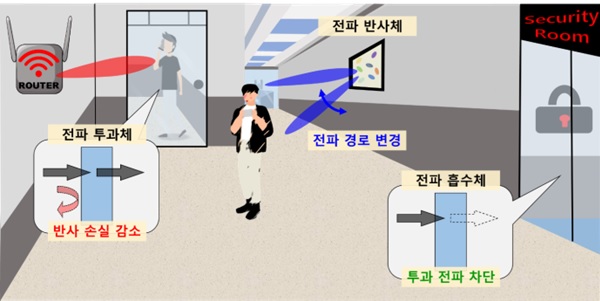
The newly developed three types of radio wave surfaces respectively reflect, transmit, and absorb frequencies. They look like tiles commonly seen in everyday life rather than repeaters. They can be harmoniously installed in the surrounding environment, such as on walls or picture frames. The reflective type forms a new path for radio waves in a different direction, delivering radio waves to areas where they normally cannot reach, thereby extending the radio wave reach. The transmissive type reduces reflection loss that occurs when passing through glass, supporting radio wave reach. The absorptive type converts electromagnetic wave energy into heat energy to dissipate it, preventing radio waves from reaching secure facilities.
Introducing this technology can reduce costs when building 6G wireless communication infrastructure using the terahertz band. It can also be applied to existing 5G communication bands and various 6G candidate frequencies to improve service quality. However, since there is no commercial terahertz band network yet, the extent to which communication quality can be improved has not been confirmed. Professor Hong Wonbin said, "There is no commercial terahertz band network yet, so there is a lack of reference to measure how much improvement has been made," adding, "We confirmed that the signal increased about 110 times when reflective RIS was present compared to when RIS was absent."
The three major telecom companies are struggling to utilize the ultra-high frequency 5G 28 GHz band. KT and LG Uplus had their allocations canceled for failing to meet base station construction targets, and SK Telecom is expected to follow. Regarding this, Team Leader Jo said, "Technically, it can be used at 28 GHz. However, this demonstration verified technical feasibility, and it is inappropriate to say whether commercialization is possible," adding, "Even if technically feasible, it is still at the prototype stage, so there are many considerations before commercialization. It is difficult to say that 28 GHz coverage can be 100% solved."
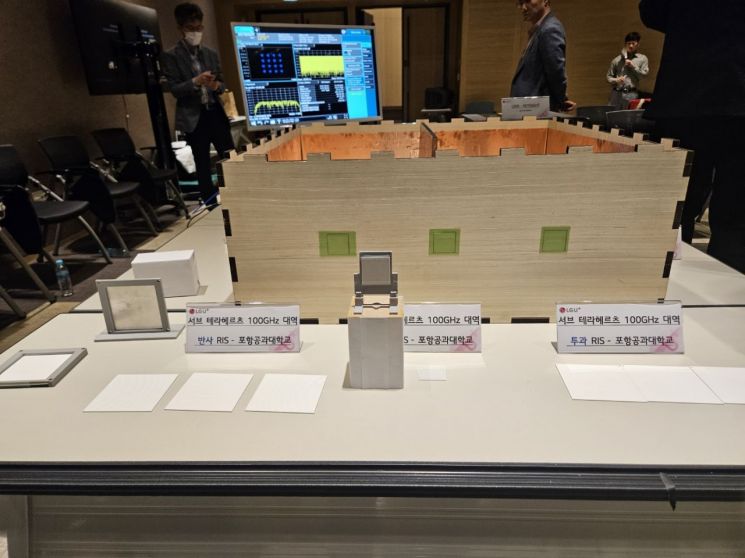
Meanwhile, the three major telecom companies are early developing RIS technology for candidate frequencies to secure leadership in the 6G era. SK Telecom developed transparent antenna equipment and RIS technology with chemical materials company Dongwoo Fine-Chem. KT exhibited RIS technology jointly developed with Seoul National University at Mobile World Congress (MWC) 2023 held last February.
Professor Hong Wonbin of POSTECH said, “The newly developed 6G RIS technology is significant as it is the world’s first to control the wireless communication radio wave environment, enabling efficient communication system configuration,” adding, “We will continue to secure technological superiority through various research and development.”
Lee Sangheon, head of LG Uplus’s Network Advanced Development, said, “Through this industry-academic cooperation research with POSTECH, we have secured core technology for expanding 6G coverage,” adding, “We will continue to strive to ensure customers can experience improved service quality through the development of core network technologies preparing for the future.”
© The Asia Business Daily(www.asiae.co.kr). All rights reserved.



















