15 Years Since the Enforcement of the Non-Regular Worker Protection Act
Non-Regular Worker Ratio at 38.4%... Highest Ever
Sharp Increase in Non-Regular Workers After the In-gukgong Incident
Since the enactment of the Non-Regular Workers Protection Act, the rate at which non-regular workers have transitioned to regular positions has nearly halved over the past 15 years. Although the law mandates the conversion of non-regular workers who have worked for more than two years into regular employees, about 14% of these non-regular workers became unemployed after one year, indicating a lack of career continuity.
According to the paper "Analysis of Job Mobility of Non-Regular Workers," co-authored by Yook Kyung-jun, a member of the People Power Party, and Kwon Tae-gu, an assistant professor in the Department of Human Resource Development at Korea University of Technology and Education, the probability that a non-regular worker in August 2020 remained a non-regular worker one year later in August 2021 was 71.4%, and the proportion of workers who transitioned from non-regular to regular employment was 10.1%. This is nearly half the 18.9% transition rate from non-regular to regular employment observed between 2006 and 2007.
Notably, 14.3% of non-regular workers in August 2020 transitioned to economically inactive status one year later, which is significantly higher than the 5.6% for regular workers and 4.8% for non-wage workers. The paper explains, "It can be seen that the proportion of non-regular workers whose careers are continuously accumulated is particularly low," adding, "This means that 14.3% of employed non-regular workers either prepare for re-employment, engage in childcare, or give up job-seeking activities."
Furthermore, the transition from non-regular to regular employment was more often due to job changes rather than tenure. The rate of conversion to regular employment through tenure decreased from 22.3% in 2006-2007 to 10.9% in 2020-2021, a drop of 11.4 percentage points. In contrast, the rate of transition to regular employment through job changes decreased less, from 24.5% to 14.1%, a 10.4 percentage point decline.
The Non-Regular Workers Protection Act was enacted and implemented on July 1, 2007, in response to the rapid increase in non-regular workers following the 1997 financial crisis, which exceeded one-third of all wage workers, and the deepening social polarization caused by discriminatory treatment of non-regular workers.
However, according to this paper, over the past 15 years, the number of non-regular workers increased by 47.6% (2.601 million), from 5.465 million to 8.066 million, while regular workers increased by 29.8%. Considering that the total number of employed persons increased by approximately 4.39 million during this period, non-regular job growth accounted for 59.2% of the total job increase over the past 15 years.
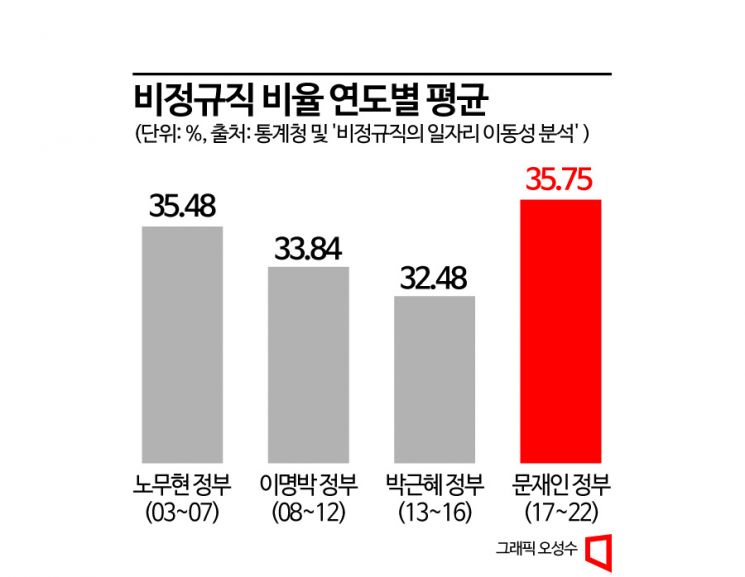
In particular, the proportion of non-regular workers, which accounted for 35.4% of wage workers in 2006, reached its lowest point at 32.2% in 2014 but has since steadily increased, reaching a record high of 38.4% in 2021. The share of non-regular workers, which remained at 32.9% in 2017, surged to 33.0% in 2018 and 36.4% in 2019.
During the early years of the Moon Jae-in administration, the so-called "Incheon International Airport Corporation (In-guk-gong) incident," involving the conversion of non-regular workers to regular positions at Incheon International Airport Corporation, sparked public backlash against the conversion of public sector workers to regular employment, leading to an increase in non-regular workers instead. Kim Yoo-sun, director of the Korea Labor and Society Institute, stated, "The Moon Jae-in government saw a reduction of about 200,000 non-regular workers in 2017 and 2018, but since then, the numbers have either stagnated or slightly increased," adding, "Because the regularization was limited to about 200,000 workers from the start, the government's momentum weakened significantly afterward." She further explained, "Without a strong government push, large corporations stopped paying attention, and as uncertainty grew due to the COVID-19 pandemic, companies expanded hiring in non-regular employment forms."
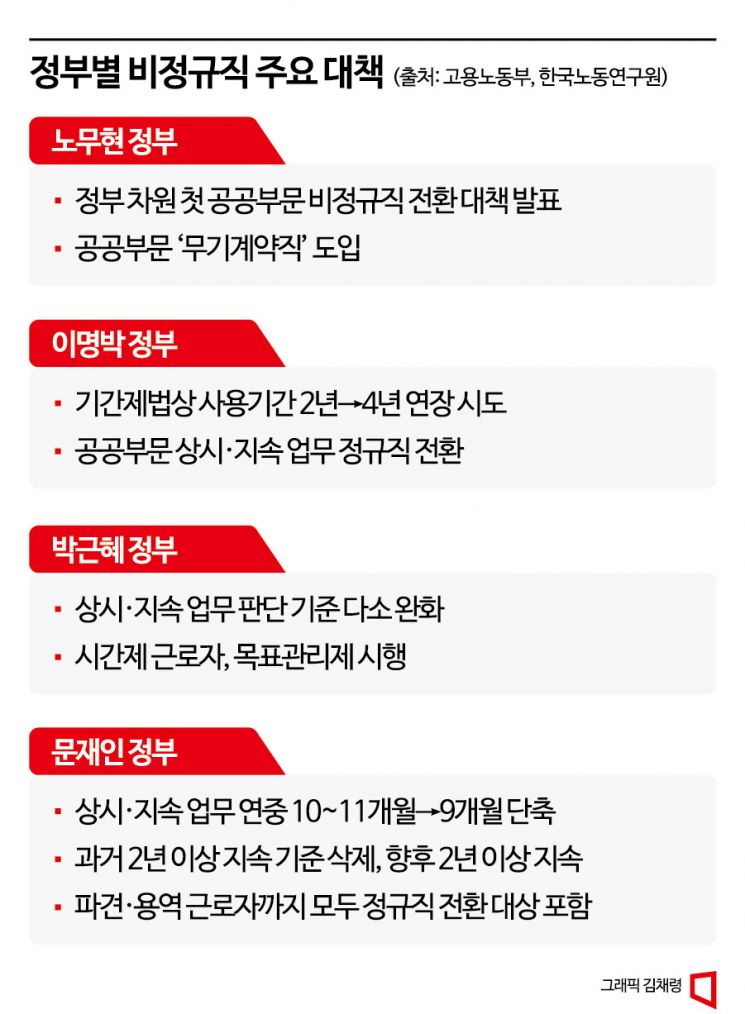
Considering that the proportion of non-regular workers among OECD member countries is in the 10% range, South Korea's non-regular worker ratio is relatively high. Experts suggest that to reduce the proportion of non-regular workers, the actual differences between regular and non-regular workers must be narrowed.
Kim Sang-kwang, a professor at the Graduate School of Public Policy at Chungnam National University, pointed out the persistent wage gap between regular and non-regular workers in the public sector, stating, "The issue of non-regular workers cannot be resolved simply by converting them to regular positions," and added, "It is necessary to effectively address additional problems arising from the financial burden of regularization, equity issues with existing regular worker unions, and the reduction of new youth jobs."
Seong Tae-yoon, a professor in the Department of Economics at Yonsei University, said, "Efforts are needed to resolve polarization between regular and non-regular workers, but this work is difficult without addressing the overprotection of regular workers," and cautioned, "Simply expanding regular employment imposes a burden on companies and ultimately makes it difficult to achieve regularization."
© The Asia Business Daily(www.asiae.co.kr). All rights reserved.


















