KAIST Develops Implantable Device for Real-Time Cardiovascular Monitoring
Domestic researchers have developed a technology that can be implanted in the body without a battery to monitor real-time cardiovascular conditions such as blood pressure.
KAIST announced on the 24th that Professor Kwon Kyungha of the Department of Electrical Engineering has developed a wireless cardiovascular implant that diagnoses cardiovascular function by measuring pressure, flow, and temperature inside the cardiovascular system in real time without a battery.
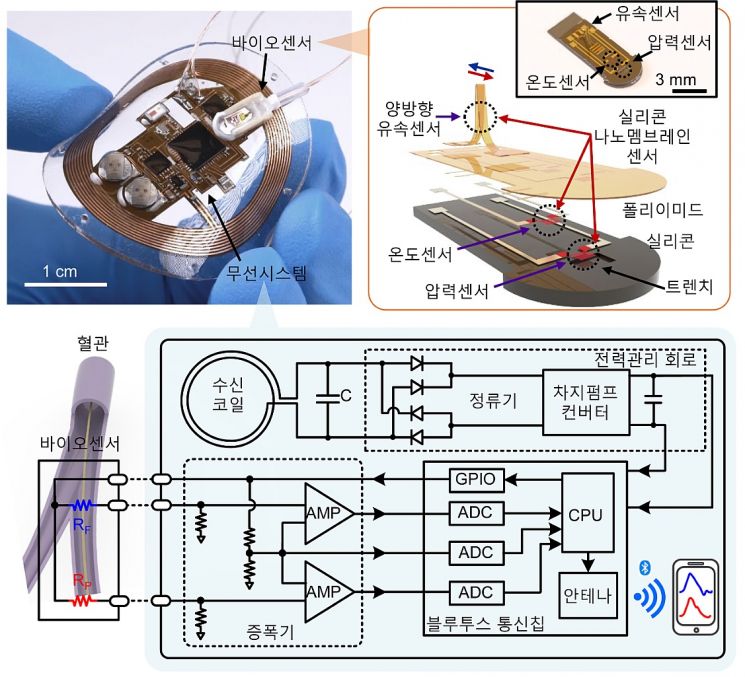 Schematic diagram of a bio sensor that can be wirelessly implanted in the human body without a battery to remotely measure blood pressure. Image courtesy of KAIST
Hemodynamic monitoring helps manage patients with cardiovascular diseases before and after surgery. Accordingly, there is increasing demand for wireless implantable medical technology that can provide real-time measurements of pressure, flow, and temperature inside the cardiovascular system in daily life.
The technology, developed through joint research with Dr. Kim Jongwook of Northwestern University in the United States, was published on the 11th of this month in the international journal Nature Biomedical Engineering.
Currently, sensors are inserted into arteries with wired tethers connected to bedside monitors to measure arterial pressure and blood flow velocity. However, wired interfaces can lead to cardiovascular damage, infection, or reduced measurement accuracy, so they are limited to temporary use for patients who do not move in hospitals. Developing a battery-free wireless implant system is a key challenge to support postoperative monitoring of patients anytime and anywhere without access to specialized medical facilities.
The research team developed an implantable wireless measurement system that can measure pressure, flow velocity, and temperature inside the cardiovascular system in real time without a battery by using wireless communication and wireless power transfer technology. They actually fabricated an implant device that operates wirelessly without a battery to measure pressure, flow velocity, and temperature. It succeeded in demonstrating performance similar to existing clinical devices in the pulmonary artery of pigs, as well as the aorta and left ventricle of sheep. This technology has the potential to objectively and accurately measure hemodynamic functions, improving treatment and quality of life for heart patients, and enables mobile monitoring anytime without restricting patient movement at home or in hospitals.
Professor Kwon said, “It is expected to be used in various clinical fields such as slope and other outflow tests after transcatheter aortic valve implantation (TAVI), pressure and flow measurements inside flow diverters for cerebral aneurysms, thoracic endovascular aortic repair (TEVAR), abdominal endovascular aneurysm repair (EVAR), and endoluminal surveillance.”
© The Asia Business Daily(www.asiae.co.kr). All rights reserved.
![User Who Sold Erroneously Deposited Bitcoins to Repay Debt and Fund Entertainment... What Did the Supreme Court Decide in 2021? [Legal Issue Check]](https://cwcontent.asiae.co.kr/asiaresize/183/2026020910431234020_1770601391.png)
















