Resolution on Partial Amendment to the Enforcement Decree of the Social Security Benefits Act
Range of Financial Overdue Amounts, 10 Million Won → 20 Million Won
If Actual Residence Differs, Fact-Finding for Identifying At-Risk Households
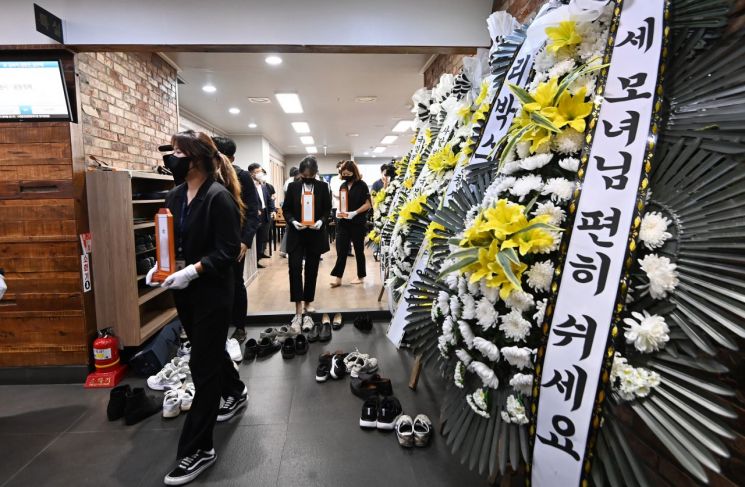 The funeral procession for the 'Suwon Three Sisters' held on the morning of August 26 last year at Suwon Central Hospital Funeral Hall in Gwonseon-gu, Suwon-si, Gyeonggi-do.
 [Image source=Yonhap News]
The government is expanding the types of crisis household detection information from 39 to 44 to eliminate welfare blind spots among vulnerable groups. The scope of financial delinquency amounts previously collected and reviewed will be increased from 10 million KRW to 20 million KRW.
On the 24th, the Cabinet meeting passed the partial amendment to the Enforcement Decree of the Social Security Benefits Act, which centers on these changes. The amendment is a follow-up measure to the "Welfare Blind Spot Discovery and Support System Improvement Plan" announced on November 24 last year.
The Ministry of Health and Welfare currently utilizes 39 types of information, such as power outages, national pension premium arrears, and business suspensions or closures, to detect households in crisis who are struggling financially in advance. Added to this will be overdue water and gas bill information. Although water and gas cut-off information is already in use, this aims to detect crisis situations more quickly. Employment crisis information will also be reviewed. To this end, the Ministry will newly acquire information on individuals without employment insurance enrollment history in the past year. Information on recipients of catastrophic medical expense support and those under debt adjustment suspension has also been included.
Additionally, to prevent missing crisis households, the scope of financial delinquency amounts being collected has been adjusted. Previously, only those with arrears between 1 million KRW and 10 million KRW over the past two years (including first, second, and third financial sectors, credit cards, and microloans) were managed. However, with the amendment's passage, the management target has expanded to those with arrears between 1 million KRW and 20 million KRW.
If Actual Residence Differs, Fact-Finding Investigation Will Be Conducted to Discover Crisis Households
If the actual residence differs from the registered address, a resident registration fact-finding investigation will be conducted to discover crisis households. When announcing the improvement plan last November, the Ministry of Health and Welfare stated that if death is suspected during visits to vulnerable groups, officials would forcibly open the household’s door and compensate for any damages from the budget. This was prompted by an incident where a government official visited the home of a woman in her 40s, a defector who died alone in October last year, multiple times but could not forcibly open the door, resulting in her being found only after a year.
This measure was prepared after a case in August last year in Gwonseon-gu, Suwon-si, Gyeonggi Province, where a mother in her 60s and her two daughters in their 40s suffered from cancer and rare diseases and endured financial hardship but did not receive welfare services and died. The root cause was that the three women had not registered their move, placing them in a welfare blind spot. Three months later, in Seodaemun-gu, a similar incident occurred where a mother in her 60s and her daughter in their 30s, living under different registered addresses, committed suicide due to financial difficulties. Subsequently, the government and local governments rushed to propose welfare system improvement measures.
Meanwhile, the Ministry of Health and Welfare has decided to utilize sexually transmitted infection medical records to find child sexual abuse victims. Previously, only information on 'injuries and mental illnesses' was received, but from now on, 'sexually transmitted infections' will also be monitored. Since these diseases are only transmitted through sexual abuse or molestation, this will help identify abused children and take necessary actions.
Kim Ki-nam, Welfare Administration Officer at the Ministry of Health and Welfare, explained, "This amendment to the enforcement decree expands the range of information that can be used to detect crisis households," adding, "The focus is on preventing welfare blind spots." He also stated, "We will promptly implement other tasks of the Welfare Blind Spot Discovery and Support System Improvement Plan, such as strengthening the public-private cooperative discovery system."
© The Asia Business Daily(www.asiae.co.kr). All rights reserved.

















