Satisfaction of Annual Average Air Quality Standards for All Items, Except Ozone; Decreasing Trend in All Items
Annual Average (Second) Fine Dust Concentration... Found to Be the Lowest Among the 7 Major Special and Metropolitan Cities
Busan Metropolitan City Health and Environment Research Institute (hereinafter referred to as the ‘Institute’) announced the results of the 2022 air pollution survey based on the operation results of the air quality monitoring network.
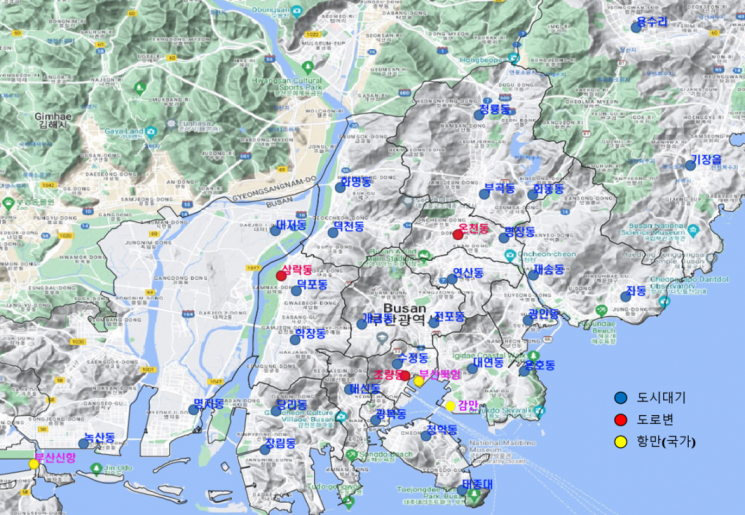
The Institute operates a total of 31 air quality monitoring stations, including 28 urban air stations and 3 roadside stations, to monitor the actual state of air pollution for six air quality standards items (sulfur dioxide, carbon monoxide, nitrogen dioxide, ozone, particulate matter (PM10), and fine particulate matter (PM2.5)).
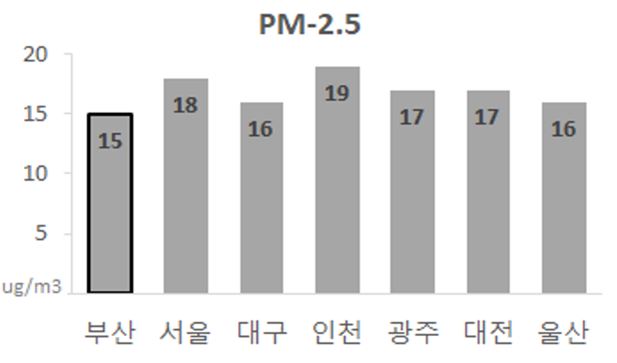
According to the annual average concentration survey results for the Busan area (urban air), sulfur dioxide was 0.003 ppm (standard: 0.02 or less), carbon monoxide was 0.3 ppm (8-hour standard: 9 or less), nitrogen dioxide was 0.015 ppm (standard: 0.03 or less), ozone was 0.033 ppm (8-hour standard: 0.06 or less), particulate matter was 27 μg/m3 (standard: 50 or less), and fine particulate matter was 15 μg/m3 (standard: 15 or less). All met the annual average air quality standards under the Enforcement Decree of the Framework Act on Environmental Policy, and all items except ozone showed a decreasing trend. In particular, (fine) particulate matter was the lowest among the seven metropolitan cities and provinces.
(Fine) particulate matter is classified into PM-10 and PM-2.5 according to diameter. The main sources of particulate matter are combustion at workplaces, vehicle fuel, and yellow dust (mineral particles), while the main sources of fine particulate matter are secondarily generated through reactions of sulfur oxides, nitrogen oxides, ammonia, and others.
High concentration exposure can cause respiratory diseases such as asthma, and PM-2.5 is known to penetrate directly into the alveoli.
According to regional survey results, (fine) particulate matter was higher in the western area with a high density of workplaces, ozone was higher in coastal adjacent areas and the eastern area, and nitrogen dioxide was higher in central Busan areas such as ports and roadsides with heavy vehicle traffic.
Regarding the integrated air quality index (CAI) evaluation results, compared to the previous year, the frequency of ‘Good’ CAI increased by 12.6%, and ‘Bad or worse’ decreased by 8.6%, confirming an improvement in air quality. On the other hand, fine particulate matter was identified as the main pollutant causing ‘Bad or worse’ occurrences, highlighting the need for related management policies.
The integrated air quality index (CAI) is an air pollution expression method (Good, Moderate, Bad, Very Bad) developed to allow the public to easily understand air pollution levels and to provide behavioral guidelines to prevent harm from air pollution by considering the human health effects and perceived pollution levels according to air pollution measurements.
Yoo Eun-cheol, head of the Air Environment Department at the Busan Health and Environment Research Institute, said, “Since the factors worsening air quality vary by region and time, our city must establish region-specific reduction measures. In particular, in the western Busan area where fine particulate matter concentrations are high, emission management at workplaces is required, and in urban areas, air pollution management caused by vehicles is necessary. We will continuously monitor Busan’s air quality and do our best to protect citizens’ health.”
© The Asia Business Daily(www.asiae.co.kr). All rights reserved.
![Clutching a Stolen Dior Bag, Saying "I Hate Being Poor but Real"... The Grotesque Con of a "Human Knockoff" [Slate]](https://cwcontent.asiae.co.kr/asiaresize/183/2026021902243444107_1771435474.jpg)

















