South Korea's Leading Economist... Strength in Simple Speech (S)
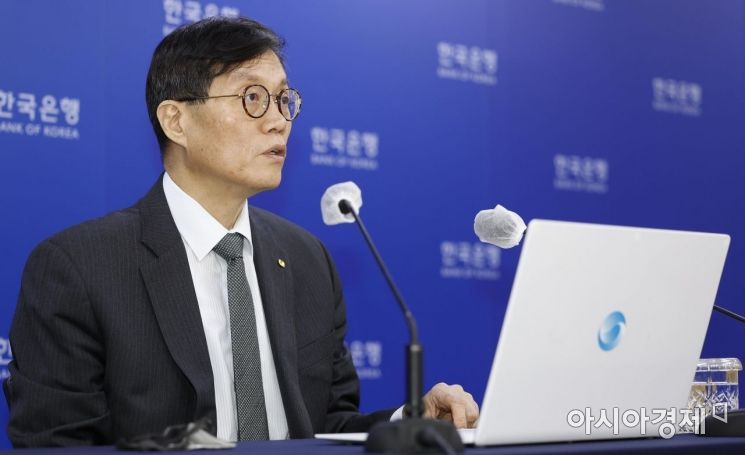
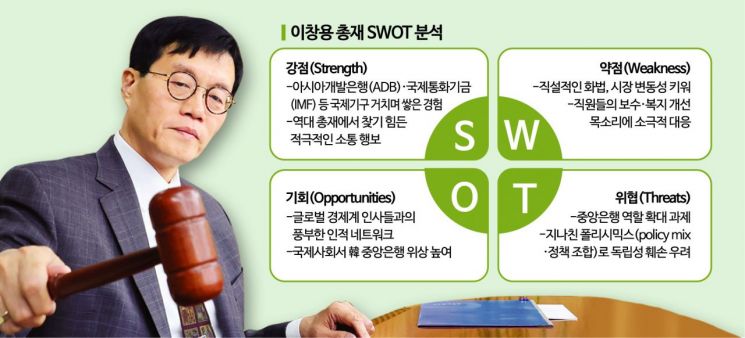
As Lee Chang-yong, Governor of the Bank of Korea (BOK), marks his first anniversary in office on the 21st, his foremost strength is undoubtedly the experience and capabilities he accumulated through his work at the Asian Development Bank (ADB) and the International Monetary Fund (IMF). Amid the global inflation that has persisted since last year, he has led the BOK's fastest and largest base rate hikes in its history, and so far, he is evaluated to have relatively successfully defended against the crisis. In March, he sparked controversy for being the first among major countries to freeze interest rates, which was seen as a 'judgment error,' but soon after, as global financial instability spread following the collapse of Silicon Valley Bank (SVB), analyses emerged that his decision was ultimately correct. In a recent survey conducted by the BOK labor union among 1,002 employees, 84% evaluated that Governor Lee's efforts to stabilize prices were timely.
His reformative communication style, rarely seen among previous BOK governors, is also a strength. At a New Year's meeting with reporters earlier this year, when asked if he would continue to strengthen communication this year, he smiled and said, "It might be quicker to block your ears than to block my mouth." Indeed, Governor Lee has attracted attention among the general public with his straightforward and simple speech. In October last year, he warned 'Seohak Gaemi' (Korean investors in U.S. stocks) about the risks of overseas investment, and in July, he advised young people considering buying a home to "think about the risks of high interest rates," earning him the nickname "Chang-yong Shin." Notably, he was the first to introduce 'forward guidance,' which signals the BOK's monetary policy direction, significantly reducing market uncertainty. Since January this year, he has also disclosed the opinions of all Monetary Policy Committee members on the final interest rate, earning praise from experts as 'innovative.'
Market Turmoil... Internal Management 'Weakness' (W)
However, Governor Lee's strengths sometimes act as 'weaknesses,' like two sides of the same coin. His direct speech occasionally contributes to increased market volatility. Given the enormous influence a central bank governor holds, some believe it is necessary to minimize market intervention and maintain gravitas, and thus, Governor Lee's communication approach can be viewed negatively. For example, in October last year, although he announced a policy of 'gradual rate hikes,' the Monetary Policy Committee implemented a 'big step' (a 0.50 percentage point base rate hike), leading to criticism that he had 'changed his words.' Governor Lee explained that "it is natural for monetary policy to change if the underlying conditions change," but there are also concerns that his forward guidance may exacerbate market herding behavior and cause shocks.
Despite being an outstanding economist, Governor Lee's internal management of the BOK is also cited as a weakness. In the BOK labor union survey, 46% of employees rated his internal management as 'poor' or 'very poor.' Governor Lee has focused on breaking hierarchical order to change the BOK's conservative organizational culture, often called the 'BOK temple,' but many employees complain that "work has increased, but conservatism and welfare remain the same." There are strong calls to improve low salaries and treatment relative to workload, but since there have been no significant changes since Governor Lee took office, morale among younger employees is particularly low. A BOK official lamented, "Even after the survey results were announced, there has been little reaction from the top, including the governor," adding, "Employees have significant dissatisfaction with their salaries."
"Catalyst for Elevating BOK's Status"... Opportunity (O)
Inside the BOK, Governor Lee is credited with raising the institution's status. By engaging in discussions with world-renowned macroeconomists and actively voicing opinions at major international meetings, the BOK's presence has naturally grown. After attending the recent G20 Finance Ministers and Central Bank Governors meeting in Washington, D.C., Governor Lee was invited as a high-level panelist at an IMF-hosted discussion, engaging in lively debates with economic gurus such as Olivier Blanchard, Professor Emeritus at MIT, and Mohamed El-Erian. Such participation in high-level panel discussions by a BOK governor is unprecedented. His eight years as IMF Asia-Pacific Director before assuming the governorship are seen as the driving force behind his experience and network. His impressive connections are also a valuable asset. Having formed ties with former U.S. Treasury Secretary Larry Summers at Harvard, he is known as Summers' prot?g? and maintains close relationships with former IMF Chief Economist Olivier and Christine Lagarde, President of the European Central Bank (ECB).
Governor Lee's abilities reportedly shine during crises. When the global financial market was shaken by the recent collapse of Silicon Valley Bank (SVB), he promptly analyzed the causes and focused on assessing the impact on the domestic financial market. A BOK employee who attended a related department meeting right after the SVB incident recalled, "When anxiety was spreading in the market due to the SVB incident, the governor personally led the department meeting and coordinated efforts to understand the situation efficiently, which increased trust." When the won-dollar exchange rate surged to 1,442.5 won on October 14 last year amid the global king dollar, Governor Lee stayed up late to monitor the global situation, identify causes, and devise responses. He immediately formed a task force (TF) and actively responded by signing foreign exchange swap agreements with the National Pension Service, successfully overcoming the difficult moment. Although he was criticized for a somewhat delayed initial response to the Legoland Asset-Backed Commercial Paper (ABCP) crisis last year, he later coordinated with the government to expand eligible collateral securities and purchase repurchase agreements (RP), thereby resolving the crisis.
Close Ties with Government... Threat to Independence (T)
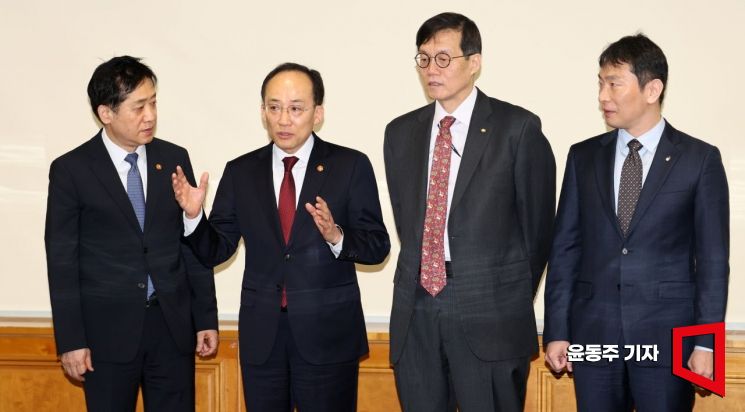
Since taking office, Governor Lee has particularly emphasized policy mix with the government, leading to concerns that the BOK's independence could be compromised. He holds regular meetings every Sunday with Deputy Prime Minister and Minister of Economy and Finance Choo Kyung-ho, Financial Services Commission Chairman Kim Ju-hyun, and Financial Supervisory Service Governor Lee Bok-hyun. Such frequent meetings raise worries that when interests such as inflation and the economy conflict, they could become a tool for government pressure. In February, when the BOK halted its interest rate hikes and froze rates, the financial authorities pressured commercial banks to lower rates, sparking controversy over the weakening of monetary policy. Governor Lee dismissed criticism by emphasizing the necessity of government intervention in interest rates. A similar situation occurred this month, raising suspicions of a divergence between the central bank and financial authorities, but Governor Lee actively denied this and sided with the government.
Some say, "While policy mix is important, an appropriate tension between the central bank and government is necessary," adding, "With next year's general election approaching, the government may try to advance the timing of rate cuts in the second half of this year due to economic concerns, but it remains to be seen whether the central bank governor, prioritizing price stability, can operate monetary policy with conviction." Accordingly, Governor Lee's leadership is expected to face another test in the second half of this year. In his inaugural speech a year ago, he expressed concern about South Korea's long-term low-growth trap and called for the central bank to expand its role beyond monetary policy to support fiscal policy and structural reforms. However, there are criticisms that he has yet to raise his voice on full-scale structural reforms. Kim Jeong-sik, Professor Emeritus of Economics at Yonsei University, emphasized, "As the end of the tightening cycle approaches, the BOK, which has maintained a neutral stance so far, now faces the task of raising its voice as the 'nation's top think tank' for the development of the Korean economy."
© The Asia Business Daily(www.asiae.co.kr). All rights reserved.
![From Bar Hostess to Organ Seller to High Society... The Grotesque Con of a "Human Counterfeit" [Slate]](https://cwcontent.asiae.co.kr/asiaresize/183/2026021902243444107_1771435474.jpg)


















