Announcement of Secondary Battery National Strategy at the 16th Emergency Economic Assembly
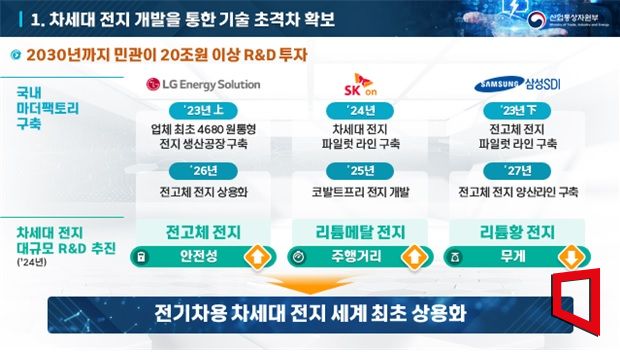
The government and private sector will invest 20 trillion won by 2030 to achieve the world's first commercialization of all-solid-state batteries, which are attracting attention as next-generation batteries. LG Energy Solution will establish a production plant for '4680 cylindrical' batteries, while Samsung SDI and SK On will each build pilot lines for all-solid-state and next-generation batteries.
The government will expand tax credits for mineral processing technologies and establish a secondary battery recycling system to activate domestic investment by secondary battery material companies.
 National Strategy to Strengthen Competitiveness in the Secondary Battery Industry (Source: Ministry of Trade, Industry and Energy)
On the 20th, Lee Chang-yang, Minister of Trade, Industry and Energy, announced a national strategy to strengthen the competitiveness of the secondary battery industry at the 16th Emergency Economic and Livelihood Meeting, which included these measures.
First, the three domestic battery companies will establish mother factories in Korea. A mother factory refers to a factory that serves as the center for product development and manufacturing. They plan to build a prototype production plant for all-solid-state batteries, and start domestic production of cobalt-free batteries including the cylindrical 4680 batteries, with plans for mass production overseas.
The government will promote large-scale research and development (R&D) for next-generation battery development. R&D will be conducted on promising batteries such as all-solid-state, lithium metal, and lithium-sulfur batteries, with a strategy to secure the world's first mass production technology for vehicle-use all-solid-state batteries.
Material, parts, and equipment companies will also receive focused support. Currently, more than half of the materials and over 90% of the equipment used in the factories of the three battery companies under construction are sourced from domestic companies. As battery companies expand overseas, domestic material, parts, and equipment companies are expected to gain global top competitiveness.
Furthermore, to activate domestic investment by material companies, the government recently raised the investment tax credit rate from 8% to 15% for large companies and from 16% to 25% for small and medium enterprises, expanded the scope of tax credit recognition to include mineral processing technologies, and is promoting measures to extend the application period (sunset in 2024).
To foster equipment companies, key equipment technologies will be newly designated as core technologies under the 'Special Support Act for Core Competitiveness of Materials, Parts, and Equipment,' with concentrated support for R&D and a policy fund of 500 billion won. A new preliminary feasibility study for R&D to develop equipment for smart factory construction is also planned.
 National Strategy to Strengthen Competitiveness in the Secondary Battery Industry (Source: Ministry of Trade, Industry and Energy)
The government and industry predict that through these efforts, domestic cathode material production capacity will quadruple and equipment exports will more than triple within the next five years.
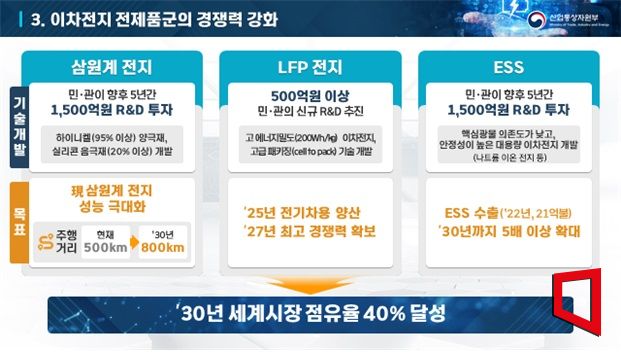
Additionally, more than 350 billion won will be invested in technology development for ternary batteries, lithium iron phosphate (LFP) batteries, and energy storage systems (ESS). The driving range of ternary batteries will increase from the current 500 km to over 800 km by 2030, and LFP batteries will secure top technological competitiveness by 2027. ESS export scale will also expand more than fivefold by 2030.
A system for 100% recycling of domestic secondary batteries will also be established. A used battery management system will be prepared centered on the Battery Association to allow the private sector to freely trade used batteries and utilize them in new industries.
Minister Lee said, "Since the pace of change in the global market and technology for secondary batteries is very fast, more bold innovation and investment are necessary to maintain global competitiveness. We will unite the power of the public and private sectors to firmly establish ourselves as the strongest nation in technology and market share by 2030."
© The Asia Business Daily(www.asiae.co.kr). All rights reserved.


















