Survey of 6,517 Domestic Tourists
As the number of tourists visiting Jeju Island has increased since the COVID-19 endemic, a survey found that the most common complaint about traveling in Jeju is that "prices are expensive."
On the 20th, the Jeju Tourism Organization announced the "2022 Jeju Special Self-Governing Province Visitor Survey," which investigated the travel behavior, consumption patterns, and evaluations of tourists who visited Jeju throughout 2022.
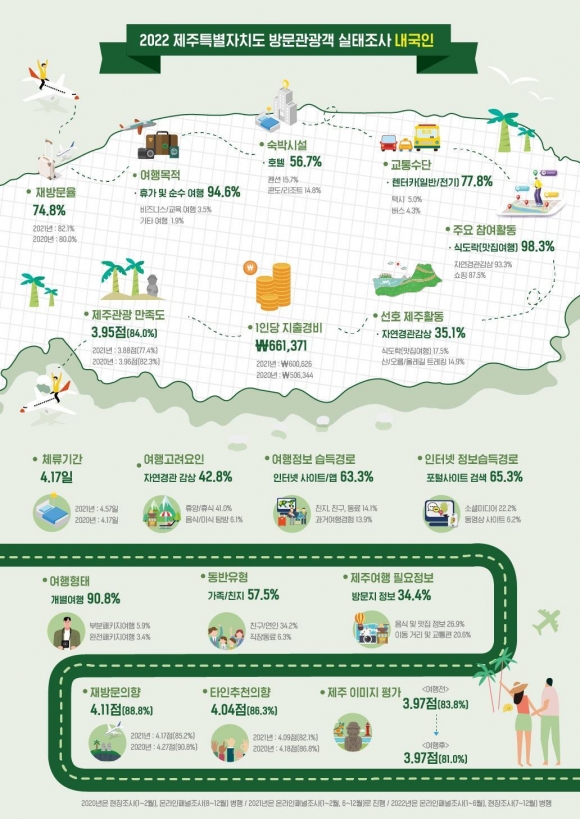
This survey was conducted over the course of 2022 using ▲online methods (January to June) and ▲face-to-face surveys (July to December), targeting 6,517 domestic tourists. The average satisfaction score for domestic tourists' travel experience in Jeju was 3.95 out of 5.
This score is 0.07 points higher than the 3.88 points recorded in 2021 but 0.01 points lower than the 3.96 points in 2020. Looking at satisfaction by category, attractions, accommodation facilities, food taste and service, and convenience of tourist sites all received generally high ratings above 4 points.
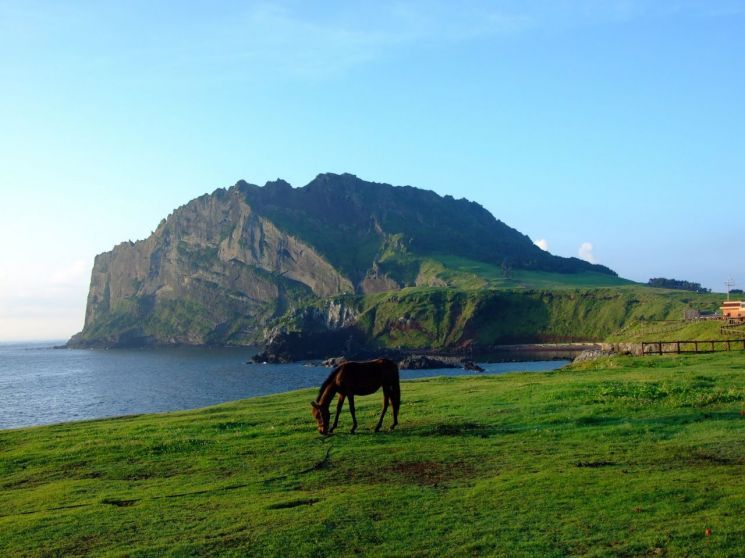
 As the number of tourists visiting Jeju Island has increased since the COVID-19 endemic, the most common complaint about traveling in Jeju was that "prices are expensive."
 [Photo by Jeju Tourism Organization]
However, satisfaction with travel expenses was the lowest at 3.16 points. In a multiple-response survey on dissatisfaction with Jeju travel, 53.4% of respondents cited "prices are expensive," making it the highest complaint.
Following that, the next most common complaints were inconvenience of public transportation (12.1%), lack of variety in shopping items (11.1%), unfriendliness of tourism staff (5.8%), and inaccurate tourist information (5.7%).
The average expenditure per person was 661,371 KRW, an increase of 60,745 KRW compared to 2021 (600,626 KRW). Regarding travel types, individual travelers accounted for 90.8% of the total, partial package tours 5.9%, and full package tours 3.4%.
Additionally, when asked about the intention to revisit Jeju for tourism purposes, 88.8% of respondents expressed willingness to revisit.
A representative from the Jeju Tourism Organization stated, "Among complaints about traveling in Jeju, dissatisfaction with prices has been the highest every year, but fortunately, satisfaction with the taste and service of food, as well as the convenience and service of accommodation facilities, is increasing. We are putting more thought into improving the quality of services to match the value of the amount tourists pay when they visit Jeju."
Jeju Province to Introduce 8,000 KRW 'Entry Tax' per Tourist
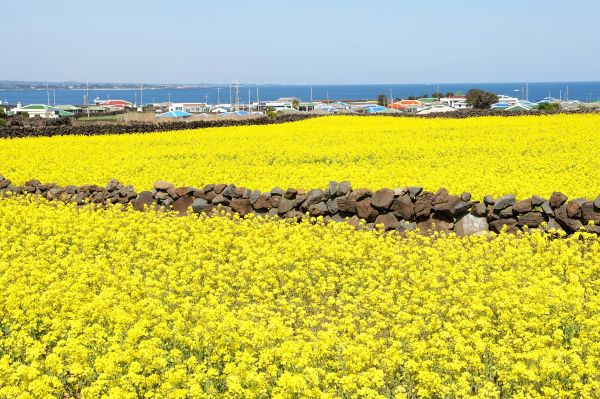
Meanwhile, on the 16th, Jeju Province announced plans to introduce an "entry tax" levied on tourists under the name of an environmental conservation contribution fee (environmental conservation charge) due to environmental pollution caused by tourism. The expected average charge per tourist is 8,170 KRW.
Jeju Province believes that national consensus and government persuasion are necessary to introduce the environmental conservation charge. In fact, Jeju attempted to introduce the "Environmental Asset Conservation Cooperation Fee" through a five-step system improvement task in 2012, but the plan was scrapped due to controversy over the "entry tax."
Therefore, in the ongoing feasibility study for implementation, the focus will be on legislation based on the results of the environmental conservation charge feasibility study. The plan is to supplement the legal basis and rationale, highlighting differentiation through comparative analysis with existing systems.
© The Asia Business Daily(www.asiae.co.kr). All rights reserved.
![User Who Sold Erroneously Deposited Bitcoins to Repay Debt and Fund Entertainment... What Did the Supreme Court Decide in 2021? [Legal Issue Check]](https://cwcontent.asiae.co.kr/asiaresize/183/2026020910431234020_1770601391.png)

















