Hyundai Motor Group Launches Development of Lunar Exploration Mobility
Hyundai Motor Group announced on the 20th that it has begun producing a development model of a "lunar exploration dedicated rover" in collaboration with domestic research institutions in the space sector.
In July last year, Hyundai Motor Group signed a multilateral joint research agreement (MOU) with six domestic space-related research institutions, including the Korea Astronomy and Space Science Institute (KASI), Electronics and Telecommunications Research Institute (ETRI), Korea Institute of Civil Engineering and Building Technology (KICT), Korea Aerospace Research Institute (KARI), Korea Atomic Energy Research Institute (KAERI), and Korea Automotive Technology Institute (KATECH), to develop a lunar exploration rover.
After discussions with the research institutions, the direction for producing the initial model of the lunar exploration rover was concretized. The goal was set to land on the lunar south pole and carry out various scientific missions such as mineral collection and environmental analysis.
The concept of this development model is a small autonomous mobility dedicated to lunar surface exploration, equipped with a self-charging system using solar power and Hyundai Motor Group’s cutting-edge autonomous driving technology. Additionally, advanced technologies such as thermal management and radiation shielding devices to withstand the extreme lunar surface environment?where the temperature difference between day and night exceeds 300 degrees Celsius?and metal drive wheels will be jointly developed with top domestic research institutions.
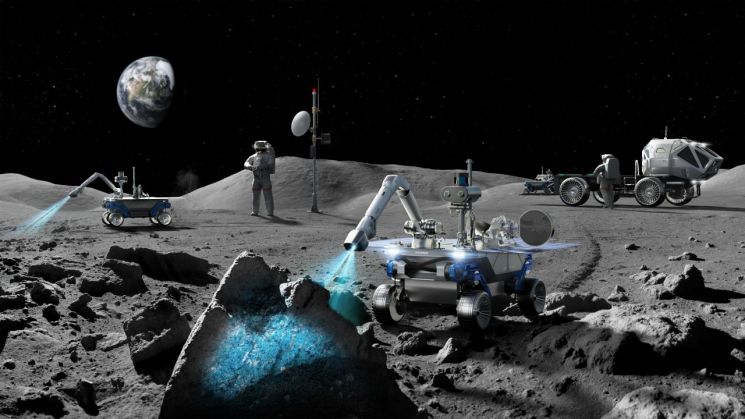 This is a vision image of Hyundai Motor Group's 'dedicated lunar exploration rover' conducting lunar exploration.
 [Photo provided by Hyundai Motor Group]
The development model aims for a maximum weight of 70kg and is largely divided into upper and lower parts. The upper part will mainly perform lunar surface exploration functions, while the lower part serves as the drive system.
The lower part of the development model is designed as a platform that can freely move across the lunar surface, allowing the same lower platform to be used even if the upper functions are added or changed in the future.
Hyundai Motor Group expects that the production of the lunar exploration rover development model could be completed as early as the second half of next year. They plan to continuously upgrade its functions while conducting driving and mission performance research in environments similar to the actual lunar surface, aiming to present a product capable of actual lunar surface exploration by 2027.
A Hyundai Motor Group official stated, “Hyundai Motor Group has consistently expressed its goal to expand the realm of human mobility experiences and contribute to human progress,” adding, “We will continue to take bold challenges to realize future visions such as ‘Metamobility,’ which was unveiled at last year’s CES.”
© The Asia Business Daily(www.asiae.co.kr). All rights reserved.

















