[At a Crossroads for Korean AI] ②
AI Workforce Doubled in 3 Years but... Labor Shortage Worsens
Last year, the number of workers in the artificial intelligence (AI) field nearly reached 40,000. This is almost double the size compared to three years ago. However, the shortage of personnel has worsened as demand outpaces supply. There is a growing consensus that the chronic workforce issue must be resolved for the domestic AI industry to grow.
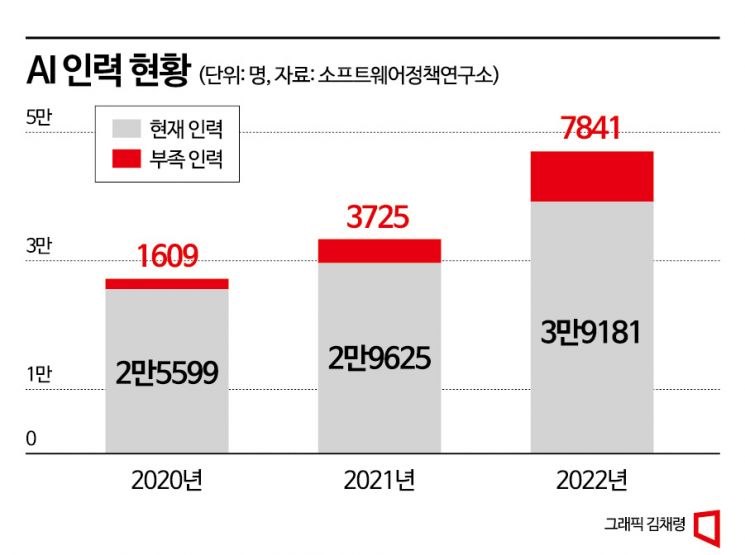
According to the "2022 AI Industry Survey" released by the Software Policy Research Institute on the 20th, the number of AI workers last year was 39,181. This is about 10,000 more than in 2021 (29,625) and nearly double the number from 2019 (21,583).
Despite the increase in personnel, the labor shortage has deepened. The shortage last year was 7,841, up from 1,609 in 2020 and 3,725 in 2021. The field with the greatest need for workers was AI developers (5,224), with shortages also seen across software (SW) and hardware (HW) developers, service developers, and architecture designers and analysts.
81.7% of companies cited workforce issues as the biggest challenge in business operations. This was considered more serious than other problems such as data acquisition difficulties, regulatory barriers, or lack of AI infrastructure.
The reason for the shortage is simply that the supply itself is low. Although departments for data science or AI graduate schools have recently been established at universities, they have yet to produce a significant number of professionals. Companies report that while there are more entry-level AI developers, the "immediately effective" talent they seek is still lacking.
The limited workforce tends to prefer overseas companies. This is because the development environment is better, such as having access to big data or unlimited cloud services. Salaries are also 4 to 5 times higher than those at domestic companies. Although there have been large-scale layoffs at overseas big tech companies recently, AI personnel have remained unaffected.
A recruiter from a major corporation said, "AI personnel are needed not only in IT but across all industrial sectors, so even military service exemption personnel are hired at salaries exceeding 100 million won," adding, "Regular attendance at overseas conferences is also to secure talent." This implies that companies are not hesitating to engage in so-called overseas headhunting.
The situation is even worse for startups, which are being outpaced by domestic and international big tech companies. Riding the ChatGPT wave, they have set aggressive hiring plans this year but find it difficult to recruit people. Regardless of company size, there is a preference for candidates with a master's degree or higher or those with experience, leading to fierce competition for talent.
Generative AI startup Lytton Technologies is currently hiring across all positions. They are looking for SW engineers, machine learning engineers, and business developers. For prompt engineer positions, they have offered annual salaries of 100 million won. Prompt engineers are a newly emerging role gaining attention with generative AI, responsible for inputting commands so that AI can provide appropriate answers to specific problems. AI search platform Liner plans to hire about 20 people this year, significantly expanding its current staff of 29. They post job openings 365 days a year and conduct developer interviews once or twice daily.
Kim Jin-woo, CEO of Liner, lamented, "Since ultra-large AI models have only been around for 2 to 3 years, there are very few experienced personnel. Saying that we want to hire but cannot find people is not an exaggeration."
© The Asia Business Daily(www.asiae.co.kr). All rights reserved.

















