Park Sang-hyuk, a member of the Democratic Party of Korea representing the Gimpo district, criticized alternatives such as amphibious buses and River Bus, which were mentioned as countermeasures for the 'Gimpo Gold Line' crush incident, calling them "unrealistic measures."
On the 19th, on BBS's 'Jeon Young-shin's Morning Journal,' Park said, "Because of these unrealistic measures, the current problem is rather being trivialized," adding, "Citizens are even saying things like 'Now it seems like we might as well ride a hot air balloon.'"
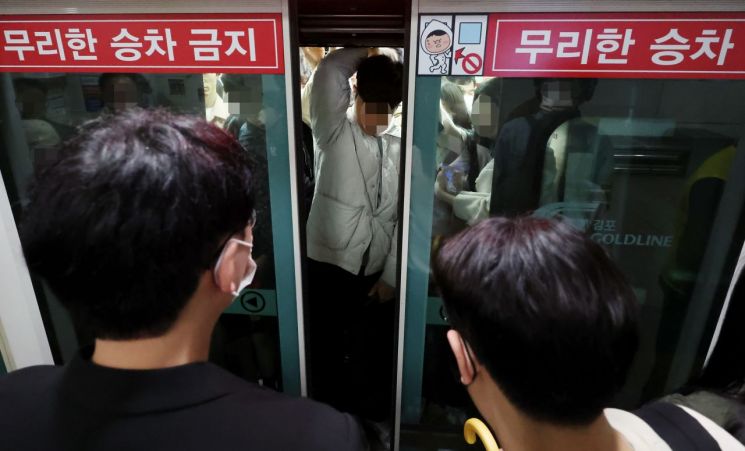
Park said, "Because of these unrealistic talks, the citizens of Gimpo are actually hurt," and questioned, "While there are some low-speed amphibious buses used for tourism in certain areas, how can so many Gimpo citizens commute using these unverified amphibious buses as a countermeasure?"
Park also raised doubts about the 'River Bus' that Seoul City announced it would promote. He said, "The Han River itself is slow for amphibious buses, and in winter it freezes, while in summer there are heavy rains," adding, "Seoul Mayor Oh Se-hoon mentioned the 'River Bus,' but it's all the same story." Seoul City has started work on establishing a water transportation network by introducing the River Bus on the Han River section between Seoul and Gimpo.
Park questioned, "How would it even reach the Han River, and even if you take an amphibious bus or the 'River Bus' on the Han River and arrive at Yeouido in Han River, when would you take the subway again?" He pointed out, "In the past, water taxis failed because accessibility was blocked by Olympic Road and Gangbyeonbuk-ro."
The Gimpo Gold Line is a light rail with only two cars, which is far from sufficient to transport the population of 500,000 in Gimpo City. Park said, "The government designated the 2nd phase new town, originally planned on a large scale, and intended to promote and build a heavy rail system like Seoul as a transportation measure," but added, "the new town scale was reduced to some extent due to opposition from the Ministry of National Defense, resulting in the cancellation of the heavy rail, yet the new town continued to progress without transportation measures."
He continued, "When the elected mayors made campaign promises, they promised heavy rail, but since the Ministry of Land, Infrastructure and Transport and government authorities opposed it, they decided to proceed independently and introduced light rail. When preliminary feasibility studies showed no economic viability, LH transportation contributions and Gimpo City's finances were used independently, resulting in this two-car light rail," calling it a typical example of desk-bound administration.
Park criticized, "It is a desk-bound administration that failed to foresee the future," pointing out, "When Gimpo became a city in 1998, the population was 100,000, but now it is 500,000. This is a typical example of desk-bound administration that completely failed to anticipate how rapidly the population would grow and how their announced new town policies would proceed."
© The Asia Business Daily(www.asiae.co.kr). All rights reserved.

















