4th Generation Lung Cancer Targeted Therapy Candidate
Aiming to Start Clinical Trials with Patients Within the Year
Bridge Biotherapeutics announced on the 19th that it presented preclinical research results of its 4th-generation non-small cell lung cancer (NSCLC) treatment candidate 'BBT-207' in poster form at the 2023 American Association for Cancer Research (AACR) Annual Meeting held in Orlando, Florida, USA, from the 14th to the 19th (local time).
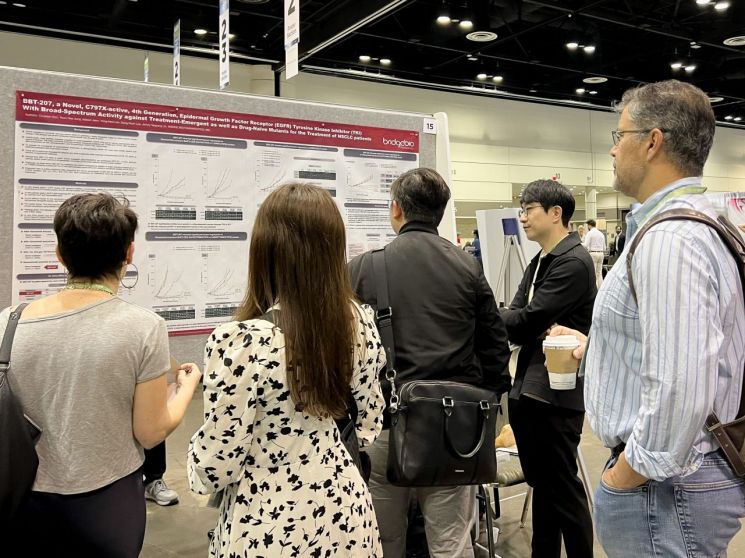 At the poster presentation of the 2023 American Association for Cancer Research Annual Meeting (AACR 2023), a representative from Bridge Biotherapeutics is introducing the preclinical data of BBT-207.
 [Photo by Bridge Biotherapeutics]
BBT-207, Bridge Biotherapeutics' first internally discovered candidate, is being developed as a targeted lung cancer therapy capable of addressing mutation cases such as the C797S-positive double mutation that arises as resistance after treatment with 3rd-generation EGFR (epidermal growth factor receptor) inhibitors in NSCLC patients. On the 18th, through a local poster session, the company introduced preclinical research results focusing on BBT-207's ▲antitumor efficacy ▲brain metastasis inhibition ▲improved survival rates in brain metastasis animal models against various resistance mutations.
The study results showed that in the 'DC (Del19/C797S)' model, which harbors double mutations including C797S that develop resistance after first-line treatment with the 3rd-generation EGFR inhibitor osimertinib (brand name Tagrisso), tumor regression was observed in all test subjects with tumor size reduction. Compared to baseline, tumor size decreased by approximately 88.6% or more. This tumor suppression efficacy was also confirmed in the 'LC (L858R/C797S)' model, which is known to be difficult to treat. Additionally, the company explained that in animal models implanted with patient-derived tumors, BBT-207 demonstrated superior efficacy compared to osimertinib in a dose-dependent manner, reaffirming its effectiveness.
Alongside this, new data on BBT-207's brain metastasis inhibition effect was also presented. In experiments using animal models based on patient-derived lung cancer cells, analysis of visualized metastatic states showed that the BBT-207 treatment group exhibited reduced levels of metastasis compared to the control group, confirming the drug's brain metastasis inhibition effect. At the 3-week mark of administration, the survival rate of the control group was only about 25%, whereas the low-dose and high-dose BBT-207 groups showed excellent survival rates of 75% and 100%, respectively.
Jimmy Jin, Vice President in charge of Discovery Biology at Bridge Biotherapeutics, said, "We are pleased to showcase the antitumor efficacy results of BBT-207, which was internally discovered and is being developed as a 4th-generation lung cancer targeted therapy, as well as the improved survival results in brain metastasis models at this conference. Based on the clinical development capabilities accumulated in the lung cancer treatment field, we will do our best to quickly enter clinical trials involving patients and provide better treatment options to terminal resistant patients who currently have no available therapies."
Meanwhile, Bridge Biotherapeutics submitted an Investigational New Drug (IND) application to the U.S. Food and Drug Administration (FDA) on the 24th of last month to enter Phase 1/2 clinical trials for BBT-207. The company is continuing development with the goal of completing clinical trial applications domestically within the first half of the year and rapidly entering patient clinical trials within this year.
© The Asia Business Daily(www.asiae.co.kr). All rights reserved.
!["The Woman Who Threw Herself into the Water Clutching a Stolen Dior Bag"...A Grotesque Success Story That Shakes the Korean Psyche [Slate]](https://cwcontent.asiae.co.kr/asiaresize/183/2026021902243444107_1771435474.jpg)
















