The U.S. Department of Commerce has announced a preliminary countervailing duty determination requiring a 1.1% countervailing duty on steel products exported from Korea to the United States.
According to the Ministry of Trade, Industry and Energy on the 18th, the U.S. Department of Commerce stated in February that a 1.1% countervailing duty should be imposed on hot-rolled steel plates that Hyundai Steel attempted to export to the U.S., pointing out that "Korea's cheap industrial electricity rates effectively act as subsidies to the steel industry."
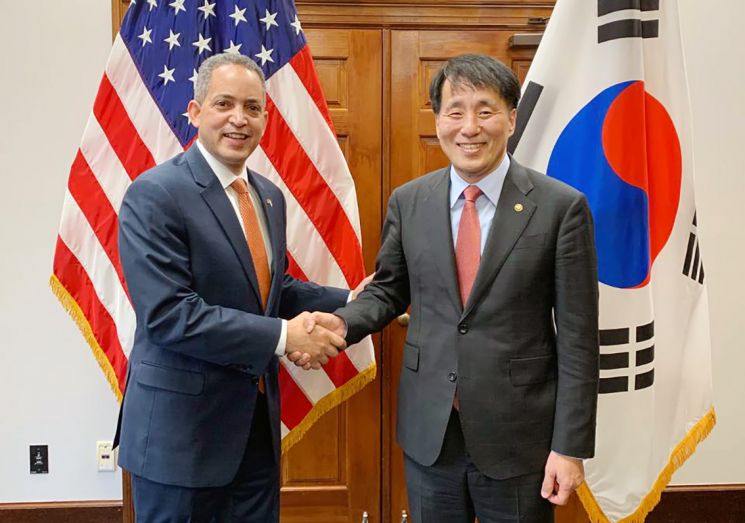 Jang Young-jin, First Vice Minister of the Ministry of Trade, Industry and Energy, is taking a commemorative photo after a meeting with Don Graves, Deputy Secretary of the U.S. Department of Commerce, on the 16th (local time) in Washington D.C., USA.
 [Photo by Ministry of Trade, Industry and Energy] [Image source=Yonhap News]
Countervailing duties are measures imposed by the importing country to protect its domestic industry by levying tariffs on imported goods when the exporting country provides direct or indirect subsidies that cause material injury to the importing country's industry. Since Korean steel products produced with cheap electricity rates may have an advantage over domestic industries, the intention is to impose additional tariffs as a protective measure.
However, controversy is expected as the 1.1% countervailing duty differs significantly from the 0.5% estimated by the industry. Since this is a preliminary determination, the Ministry of Trade, Industry and Energy plans to prepare response measures to minimize damage to domestic companies until the final determination, which will be made in 3 to 6 months.
An official from the ministry said, "Electricity rates have been an issue previously raised by the U.S.," adding, "We have responded well so far, so we will wait and see until the final determination."
In fact, in 2020, the U.S. government ruled that cheap electricity rates did not constitute a subsidy and decided not to impose countervailing duties on galvanized steel sheets exported by Hyundai Steel.
© The Asia Business Daily(www.asiae.co.kr). All rights reserved.

![Clutching a Stolen Dior Bag, Saying "I Hate Being Poor but Real"... The Grotesque Con of a "Human Knockoff" [Slate]](https://cwcontent.asiae.co.kr/asiaresize/183/2026021902243444107_1771435474.jpg)















