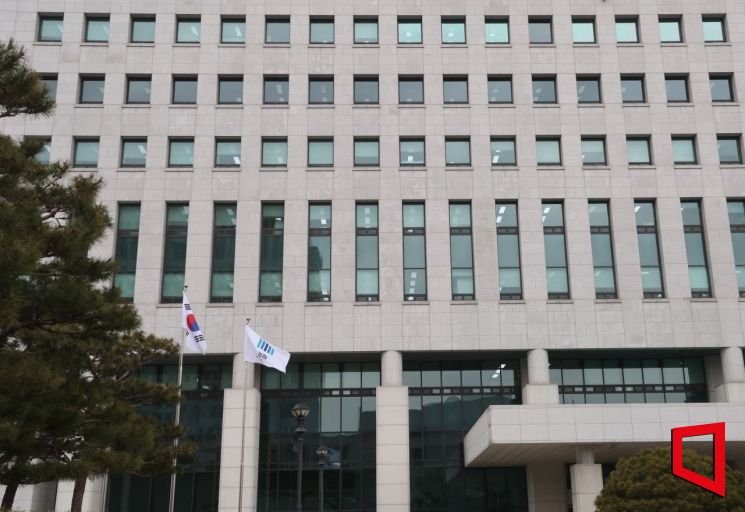
The prosecution plans to respond strictly to crimes against persons with disabilities and strengthen support to protect the rights of persons with disabilities in criminal procedures.
On the 18th, the Supreme Prosecutors' Office announced that it will strictly respond to crimes against persons with disabilities and enhance activities to protect and support the rights of socially vulnerable groups who have difficulties in rights protection, such as persons with disabilities, foster children, and the elderly.
An official from the Supreme Prosecutors' Office stated, "Persons with disabilities, as socially vulnerable individuals, are easily exposed to crimes and vulnerable to criminal acts. However, due to difficulties in communication or lack of information, they often face challenges in legal responses or victim recovery, sometimes falling into blind spots of legal protection. Therefore, it is necessary to organize material and human support systems so that persons with disabilities can participate smoothly in criminal procedures, actively perform necessary roles for human rights protection as 'representatives of public interest,' and strictly punish crimes against persons with disabilities," explaining the background.
According to the Supreme Prosecutors' Office, 440 cases of violations of the Act on Welfare of Persons with Disabilities were reported last year, a 33% increase compared to the previous year.
In the past three years, among 'sexual violence prosecutions against persons with disabilities,' the rate of trials without detention was 99.7%, and the rate of prosecution with detention was 23.3%, which is much higher than the 70.2% and 11.2% respectively for 'general sexual violence prosecutions,' and the 32.6% and 3.4% respectively for 'all prosecution cases.'
The Supreme Prosecutors' Office has assigned 85 dedicated prosecutors for developmental disabilities nationwide as of February this year to handle investigations related to persons with developmental disabilities.
These prosecutors collect sentencing materials and appropriately dispose of cases when persons with developmental disabilities are suspects, and establish individual support plans to assist when they are victims.
The prosecution is strictly responding to crimes against persons with disabilities through specialized investigations tailored to the types of victimization, based on education to enhance expertise and understanding of disabilities.
In particular, for 'serious crime types' such as sexual violence against persons with disabilities, abuse crimes within facilities for persons with disabilities, and labor exploitation crimes targeting persons with disabilities, strict measures such as detention investigations will be taken considering the nature of the crime, the manner of the act, and the extent of the damage.
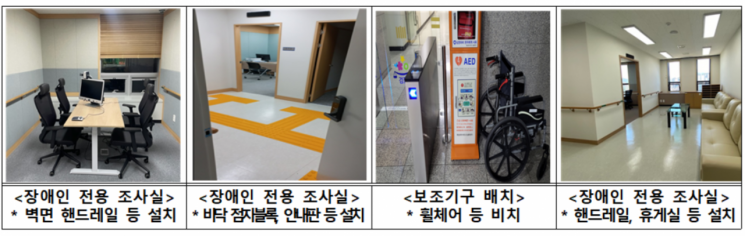 Disabled support facilities within the Prosecutor's Office.
 [Photo by the Supreme Prosecutors' Office]
The Supreme Prosecutors' Office has established and implemented the 'Sign Language Interpreter Operation Regulation' since June last year to facilitate smooth communication for persons with hearing disabilities, and frontline prosecutors' offices cooperate with the Korea Association of the Deaf to select and operate sign language interpreters.
Also, since June last year, after inspecting the mobility and usage environment for persons with disabilities within nationwide prosecution offices, dedicated investigation rooms for persons with disabilities have been installed in 10 prosecution offices, and assistive devices such as wheelchairs have been provided in 30 prosecution offices. Additionally, a disability-friendly investigation environment is being established, including the installation of braille blocks.
The prosecution also operates a system where 'dedicated prosecutors for persons with developmental disabilities' coordinate with probation offices and developmental disability support centers to handle suspect dispositions and support victims. In particular, for victims of sexual violence or abuse cases against persons with disabilities, public defenders are appointed, and support is provided to ensure victims' opinions are reflected through accompaniment by trusted persons and participation of statement assistants.
Furthermore, the prosecution plans to strengthen legal support activities as representatives of public interest for socially vulnerable groups who have difficulties in rights protection, such as persons with disabilities, foster children, and the elderly, not only in criminal law areas such as investigation, prosecution, and maintenance of prosecution but also in civil and administrative areas.
Since September 2021, the Seoul Southern District Prosecutors' Office, Daegu District Prosecutors' Office, Busan District Prosecutors' Office, and Gwangju District Prosecutors' Office have established 'Public Interest Representative Teams' to actively carry out legal support activities for socially marginalized groups, including ▲requests for loss of parental rights ▲appointment of minor guardians and commencement of adult guardianship ▲ex officio birth registration ▲cancellation of missing person declarations ▲appointment of inheritance property managers ▲filing various public interest lawsuits.
An official from the Supreme Prosecutors' Office said, "The prosecution will continue to strictly punish crimes against socially vulnerable persons with disabilities and make relentless efforts to prepare human and material support measures so that persons with disabilities are not marginalized in criminal procedures and their fundamental rights are fully guaranteed. Additionally, we will cooperate with related organizations such as developmental disability support centers to provide comprehensive victim protection and support so that victims with disabilities can restore their daily lives. As 'representatives of public interest,' we will faithfully carry out legal support activities for human rights protection and continue to fulfill necessary roles so that everyone can live together in a safe society," he added.
© The Asia Business Daily(www.asiae.co.kr). All rights reserved.
![A Woman Who Jumps Holding a Stolen Dior Bag... The Mind-Shaking, Bizarre Con of a "Human Knockoff" [Slate]](https://cwcontent.asiae.co.kr/asiaresize/183/2026021902243444107_1771435474.jpg)

















