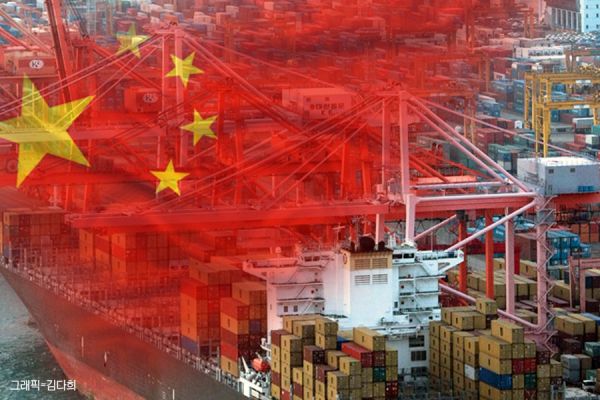
The United States and its allies are striving to maintain extensive trade and investment relations with China, the world's second-largest economy, while seeking to reduce dependence on China, particularly in strategic materials. Beyond the overt US-China hegemonic rivalry, the case of Russia weaponizing energy exports immediately after the Ukraine war last year is seen as a lesson that has changed perspectives on China as well.
The Wall Street Journal (WSJ) reported on the 17th (local time) that among the Group of Seven (G7) countries and major US allies, concerns are growing that if geopolitical tensions escalate or another pandemic spreads, China might halt exports of key strategic materials and critical resources, similar to Russia. Western senior economic officials are also wary that if restrictions are not placed on domestic investments and specialized technologies, it could aid China's military buildup, which is increasingly revealing its military ambitions.
These concerns were also discussed at the International Monetary Fund (IMF) and World Bank (WB) Spring Meetings held last week in Washington DC. The G7 countries, including the US, Canada, France, Germany, Italy, the UK, and Japan, agreed on a new initiative to strengthen supply chains. They decided to provide financial support to secure key minerals used in electric vehicle motors and batteries stably and to reduce dependence on China.

In particular, Russia's invasion of Ukraine last year served as a catalyst that heightened Western vigilance not only toward Russia but also toward China. Russia, the world's second-largest gas producer, disrupted the global energy market by restricting natural gas exports to Europe in response to Western sanctions. Russia's actions fueled fears that resource-rich countries, including China, might weaponize resources, especially as the need for 'supply chain restructuring' has emerged globally after the pandemic. In other words, resources have literally become instruments of international politics.
Russia and China hold significant shares in the resource markets, including minerals. China dominates the rare earth market used in advanced products and fighter jets. The same applies to key materials for electric vehicle batteries such as lithium, cobalt, and manganese. Russia is ranked among the top three producers of nickel, a primary raw material for batteries.
Jeremy Hunt, the UK Chancellor of the Exchequer, said, "Our greatest strategic choice is to strengthen supply chain resilience," adding, "To do this, we must cooperate with fellow democratic countries." Nils Annen, Germany's Foreign Minister, pointed out Europe's dependence on Russian energy exports and emphasized, "We must not repeat the misjudgments and mistakes made regarding Russia with other major powers." However, Minister Annen also added, "We do not want to implement a decoupling policy." Especially for major countries, concrete policy measures to reduce dependence on China inevitably carry the burden of potentially hindering global growth or creating overt conflict dynamics.
Some voices express concern about the global economy being divided into explicit trade blocs, such as the West led by the US versus China and Russia. Kristalina Georgieva, IMF Managing Director, said at a press conference on the 13th, "I do not want to see a repeat of the Cold War," and pointedly asked, "The question is whether we can strengthen supply chain security without pushing the world into a new Cold War." In response, Janet Yellen, US Treasury Secretary, mentioned 'friend-shoring,' the relocation of supply chains centered on allies and partners, and argued, "The benefits of open trade, such as the efficient allocation of global resources, will be maintained through friend-shoring."
So far, the US has shown moves to explicitly exclude China by reorganizing global supply chains centered on itself. The passage last year of the Inflation Reduction Act (IRA), which provides tax credit benefits only for North American-made electric vehicles, and the Chips and Science Act (CSA) are part of this effort. The US, which is considering ways to restrict investments in China, is reportedly expecting other Western allies to join this effort. WSJ cited sources saying that US authorities have been weighing ways to limit investments in China, focusing on sectors related to military buildup, and that the measures could include banning investments by US private equity and venture capital in quantum computing and advanced semiconductors.
© The Asia Business Daily(www.asiae.co.kr). All rights reserved.
![Clutching a Stolen Dior Bag, Saying "I Hate Being Poor but Real"... The Grotesque Con of a "Human Knockoff" [Slate]](https://cwcontent.asiae.co.kr/asiaresize/183/2026021902243444107_1771435474.jpg)

















