The research team led by Professor Jongwon Lee from the Department of Electrical and Electronic Engineering at Ulsan National Institute of Science and Technology (UNIST) has developed an ‘active metasurface in the mid-infrared region’ that possesses optical properties and functions by electrically controlling the intensity and phase of light.
A metasurface consists of structures smaller than the wavelength arranged in a two-dimensional array, resulting in an extremely thin thickness. It can also partially control the phase, intensity, and polarization of light.
However, most previously reported metasurfaces are passive devices, and once fabricated, their optical properties and functions cannot be altered, limiting their application in various ways.
Professor Lee’s research team developed an ‘active metasurface in the mid-infrared region’ that can independently control the intensity and phase of light electrically, thereby adjusting the wavefront and polarization state.
Through this research, the team implemented a metasurface that can modulate linearly polarized light into circularly polarized light as a waveplate and control the propagation direction of light depending on the voltage within a single device.
The active metasurface in the mid-infrared region is voltage-controllable and can independently adjust the local intensity and phase of light. Therefore, it can be utilized in various ways even after fabrication. In other words, a single optical device can simultaneously realize multiple functions such as lenses, polarizers, and beam steerers.
Additionally, the developed metasurface is thinner and lighter compared to conventional optical devices like polarizers and waveplates that change the polarization of light. In particular, unlike waveplates that operate at a single wavelength, this metasurface has the advantage of functioning over a broad range of wavelengths.
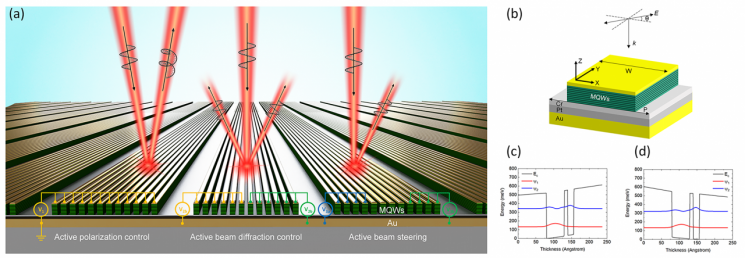 Operating principle of the developed phase modulation metasurface and the core structure, the multiple quantum well structure.
Jung Hyeongju and Hwang Inyong, researchers in the Department of Electrical and Electronic Engineering and co-first authors, explained, “The developed metasurface is determined by the plasmonic resonance structure and the heterojunction semiconductor layer, specifically the multiple quantum well structure.”
They added, “By utilizing this and changing the structure, it is possible to develop an active metasurface that can control the phase and intensity of light at various frequencies in the mid-infrared region.”
Professor Jongwon Lee said, “The metasurface-based optical device developed this time can be applied to active waveplates that freely modulate the polarization state of light, active metalenses with variable focal lengths, and further to moving hologram technology that requires real-time control of not only light intensity but also phase.”
The results of this research were published online on April 7 in Advanced Science, a world-renowned academic journal published by Wiley.
© The Asia Business Daily(www.asiae.co.kr). All rights reserved.

![Clutching a Stolen Dior Bag, Saying "I Hate Being Poor but Real"... The Grotesque Con of a "Human Knockoff" [Slate]](https://cwcontent.asiae.co.kr/asiaresize/183/2026021902243444107_1771435474.jpg)















