G7 Issues Statement Welcoming Japan's Efforts on Contaminated Water... Korea Says Must Meet International Standards
The South Korean government has taken an unusual stance to check the joint declaration by the Group of Seven (G7) climate, energy, and environment ministers, which included a phrase welcoming Japan's efforts to address contaminated water.
On the 17th, the Prime Minister's Office issued a press reference stating, "The content related to Fukushima contaminated water included in the G7 ministers' joint statement is separate from the final conclusions of the International Atomic Energy Agency (IAEA) monitoring." The joint declaration contains a passage that "welcomes Japan's transparent efforts with the IAEA based on scientific evidence."
In response, the South Korean government emphasized that this is unrelated to the ongoing IAEA monitoring task force's final conclusions and that the safety of ocean discharge should be observed until the investigation results are available. The Prime Minister's Office added that the joint statement "emphasizes the importance of the IAEA's independent verification activities to ensure that contaminated water treatment complies with international standards." It also stated, "The South Korean government will continue to stress its existing position that nuclear power plant contaminated water treatment must be scientific, objective, safe, and comply with international standards."
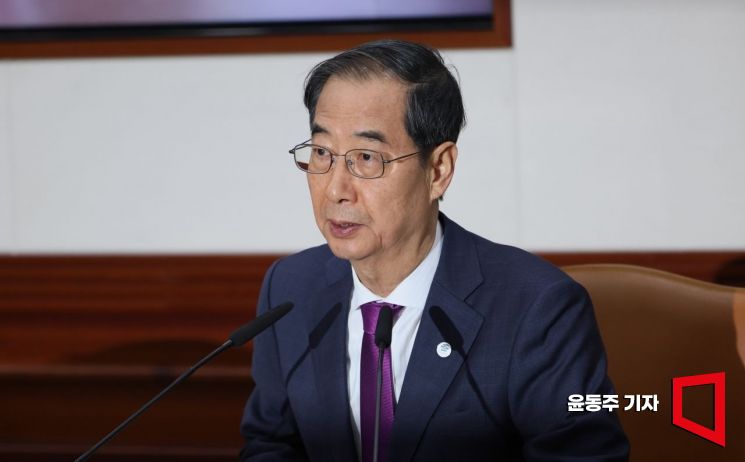 Prime Minister Han Duck-soo is attending the Ministerial Meeting on State Affairs held at the Government Seoul Office in Jongno-gu, Seoul on the 6th, delivering opening remarks. Photo by Yoon Dong-joo doso7@
An official from the Prime Minister's Office's Office for Government Policy Coordination said, "There was information that Japan was trying to gain support for the discharge of contaminated water at the G7 meeting, and we were on high alert in preparation for this," adding, "Fortunately, the initially feared G7 support declaration did not materialize, but it was necessary to express the government's position at the level of explanatory materials, so we released the statement."
Initially, Japan was reportedly expecting a statement at the G7 climate, energy, and environment ministers' meeting held in Sapporo, Hokkaido, that would "welcome" the IAEA's investigation into the discharge of contaminated water. The aim was to use G7 support as a stepping stone to create a favorable atmosphere in the international community to smoothly proceed with the ocean discharge of Fukushima contaminated water. However, due to opposition from some countries including Germany, the joint declaration did not include the phrase "welcome (the discharge)." In fact, Japan's Minister of Economy, Trade and Industry, Yasutoshi Nishimura, said at a joint press conference with ministers from Germany and Italy that the G7 "expressed a welcoming stance toward steady progress in decommissioning, including the ocean discharge of treated water from Fukushima, and Japan's transparent response based on scientific evidence." However, German Environment Minister Steffi Lemke countered, "We respect the efforts made by Tokyo Electric Power Company and the Japanese government after the nuclear accident. However, we cannot welcome the (ocean) discharge of contaminated water."
Meanwhile, the Japanese government plans to discharge Fukushima nuclear power plant contaminated water into the ocean around this summer. Neighboring countries such as South Korea and China have expressed concerns about the discharge. On the 5th, the IAEA released its fourth report evaluating the contaminated water discharge program as reliable. However, the fifth and sixth reports, which include analysis results of marine water samples collected on-site, are still pending.
© The Asia Business Daily(www.asiae.co.kr). All rights reserved.

















