When meeting someone for the first time, people usually exchange a piece of paper measuring 85mm by 54mm. This is a business card. Even the heads of the largest corporate groups in Korea present business cards when meeting someone for the first time. These cards often only include the name, title, and office phone number, with personal mobile phone numbers frequently omitted. Recently, mobile phone numbers have gradually disappeared even from the business cards of top executives of large corporations and high-ranking government officials such as ministers. This can be interpreted as a way to disclose workplace information while protecting personal information.
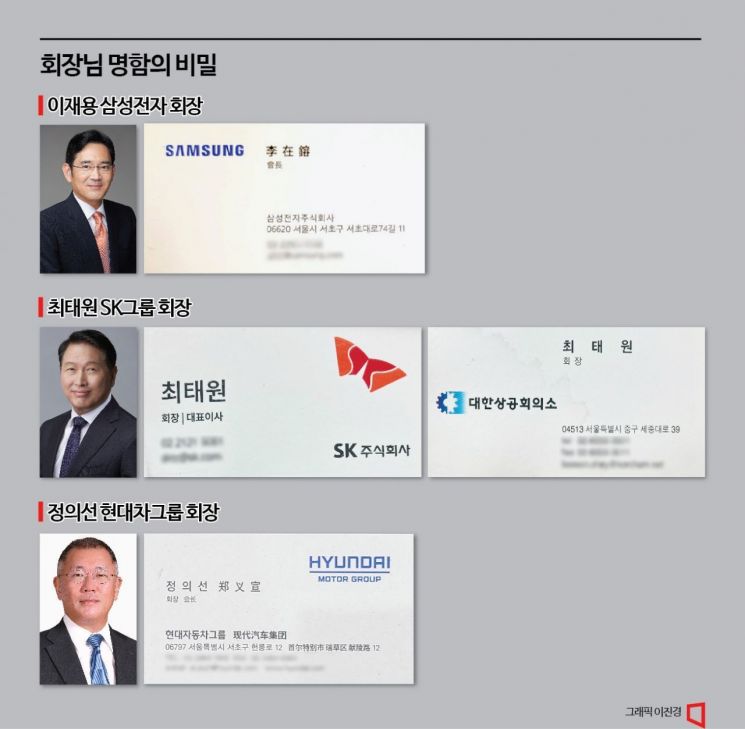
Lee Jae-yong, chairman of Samsung Electronics and ranked number one in South Korea’s business hierarchy, is known as having a "face that is a business card." He also has an actual company business card that he uses. After being promoted from vice chairman to chairman of Samsung Electronics at the end of October last year, Lee created a new business card. The front side features his name and title in Chinese characters: '李在鎔 會長 (Lee Jae-yong Chairman)'. It is a straightforward business card that clearly indicates he is the chairman of Samsung Electronics Co., Ltd. The address listed on the card is the Samsung headquarters building located in Seocho-gu, Seoul. Although his office is on the 41st floor, the card does not specify the detailed floor number or his mobile phone number. Instead, it includes the secretary office number, where his secretary answers calls, and an email address created with his English name under the Samsung domain. In fact, for several years now, mobile phone numbers have disappeared from the business cards of chairmen and CEOs of major Korean corporations as if by agreement. This reflects a reluctance to reveal personal information on business cards that are handed out like flyers at official events.
Lee’s new business card differs slightly from the one he used as vice chairman until last year. First, the blue oval mark surrounding the word SAMSUNG, which had been a symbol introduced in 1993, is no longer present. This oval mark was a Samsung emblem starting with Samsung Electronics but has been removed across all affiliates. The logo engraved on Samsung products is now used to emphasize brand unity and visually highlight a younger and more flexible image of Samsung. The previous card included his English name 'Jay Y. Lee' next to the Chinese characters '李在鎔', but the new card moves the English notation to the back, adding a cleaner look. Generally, Koreans do not use middle names, but Lee, who studied abroad, added a period after the 'Y' to indicate a middle name. Therefore, overseas, he is often called simply 'Jay.' Samsung’s expansion of horizontal titles also allows people to call him 'Jay,' which aligns with this context.
Choi Tae-won, chairman of SK Group and ranked second in the business hierarchy, who sits next to Lee when meeting important foreign dignitaries, officially uses two types of business cards. One is an SK Corporation card stating 'Choi Tae-won Chairman/CEO,' and the other is a Korea Chamber of Commerce and Industry card simply stating 'Choi Tae-won Chairman.' Of course, neither card includes his mobile phone number.
Choi’s email addresses clearly reflect his name and affiliation. The email address 'sktc' on the SK card is derived from his kingdom, SK, and the initials of his name. Both his English name (Tony Choi) and the English-style representation of his Korean name (Tae-won Choi) can be abbreviated as 'tc.' When SK Telecom was the flagship face of SK, 'SK Telecom (SKT) + Choi (C)' was also a common interpretation. The Korea Chamber of Commerce and Industry card uses 'taewon.chey' as the email address.
A notable point here is that Koreans usually spell the surname 'Choi' as 'Choi,' but Choi’s family uses 'Chey' instead. This spelling tradition started with the late Choi Jong-hyun, the former chairman of SK and father of Choi Tae-won. Before studying abroad, Choi Jong-hyun worked as an interpreter at a U.S. military base in Suwon to learn English. He asked a U.S. Army captain which spelling would most closely approximate the pronunciation of '최' (Choi), and the conclusion was 'Chey.' This careful attention to detail was passed down from father to son as the family’s English surname spelling.
The business card of Chung Eui-sun, chairman of Hyundai Motor Group and ranked third in the business hierarchy, sitting next to Choi, reveals his affection for the Chinese market. The card features the blue 'HYUNDAI MOTOR GROUP' logo and includes his name and title written not in Chinese characters but in simplified Chinese characters that Chinese people can read. The company name Hyundai Motor and the address in Seocho-gu are also written in simplified Chinese. China is considered a market of both love and hate for Hyundai Motor. In 2016, Hyundai sold 1.14 million vehicles in China, achieving a market share of 7.35%, but last year sales plummeted to 380,000 vehicles, dropping the market share to the 1% range. However, it remains an important market that cannot be abandoned. China is the world’s largest automobile market, and the growth rate forecast for electric vehicles, which Hyundai is targeting, reaches 30%. This is why Chairman Chung often needs to take out this business card with Chinese characters.
© The Asia Business Daily(www.asiae.co.kr). All rights reserved.

















