As Hallyu has grown more than 40 times over the past 20 years, positively impacting South Korea's national prestige and economy, voices have emerged calling for government efforts such as easing content regulations and diversifying export markets to follow suit.
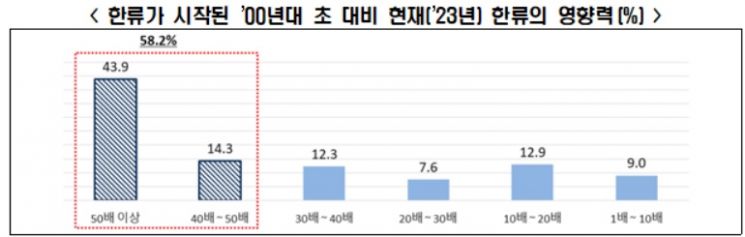
On the 17th, the Federation of Korean Industries commissioned market research firm Mono Research to survey 1,011 South Korean citizens aged 18 and older nationwide on their perceptions of the spread of Hallyu. The results showed that over half of respondents (58.2%) believe that Hallyu's global standing and influence have grown more than 40 times compared to the early 2000s when Hallyu began. Among them, 43.9% said it has increased more than 50 times, and 14.3% said between 40 and 50 times. Responses indicating a 30 to 40 times increase accounted for 12.3%, followed by 20 to 30 times (7.6%), 10 to 20 times (12.9%), and 1 to 10 times (9.0%).
The main factors contributing to the worldwide spread of Hallyu were the development and diversification of distribution platforms such as YouTube and Netflix (34.2%). This was followed by a well-developed cultural content industry system and active investment and promotion by companies (28.2%), fresh and interesting ideas and high-quality content utilizing them (21.0%), and increased global interest in Korean culture (12.2%).
As for content that can be called the "national representative of Hallyu," K-pop and artists such as BTS dominated with 65.9%. Next were ▲movies and dramas (26.4%), ▲food and cosmetics (3.4%), ▲webtoons and variety shows (2.6%), and ▲games (1.7%).
The public believed that domestic companies play a significant role in fostering Hallyu. When asked about companies' contributions to Hallyu, 25.1% responded "contribute very greatly," and 38.2% said "contribute considerably." Additionally, about 9 out of 10 people (89.5%) judged that Hallyu has elevated the global status of Korea and Koreans. Regarding whether Hallyu contributes to the national economy, more than 8 out of 10 respondents answered positively, with 63.1% saying "definitely yes" and 24.0% saying "mostly yes."
For the sustainable development of Hallyu, the tasks the government should pursue were identified as ▲easing regulations on the cultural content industry and distribution platforms (31.6%), ▲promoting cultural diplomacy using Hallyu and diversifying content export markets (26.5%), and ▲enhancing companies' content production capabilities through expanded R&D support and tax incentives (21.4%). Other policy tasks included ▲establishing a system to protect intellectual property rights such as copyrights for overseas export content (10.8%) and ▲developing Hallyu-derived products and services such as home appliances, medical services, and tourism (9.7%).
Choo Kwang-ho, head of the Economic and Industrial Headquarters at the Federation of Korean Industries, stated, “Behind the globalization achievements of K-Culture lies the persistent challenges and efforts of domestic companies and content creators toward the development of the cultural industry and the global spread of Hallyu.” He added, “In addition to preparing systematic Hallyu development strategies such as deregulation and R&D support, it is necessary to foster an atmosphere that boosts morale so that content companies and distribution platforms can enthusiastically devote themselves to management and creation.”
© The Asia Business Daily(www.asiae.co.kr). All rights reserved.
![Clutching a Stolen Dior Bag, Saying "I Hate Being Poor but Real"... The Grotesque Con of a "Human Knockoff" [Slate]](https://cwcontent.asiae.co.kr/asiaresize/183/2026021902243444107_1771435474.jpg)

















