"Domestic companies are preparing to promote Carbon Capture, Utilization, and Storage (CCUS) technology for carbon neutrality, but the cost of applying the technology is more than twice as expensive compared to optimal conditions where carbon storage sites are secured, such as in the United States and Australia. The government needs to actively support domestic companies' carbon neutrality efforts through measures like the carbon price difference contract system and expanded tax incentives," said Professor Yoo Jong-min of Hongik University.
There is a call for active government support for CCUS, a core technology for achieving carbon neutrality.
The Korea Chamber of Commerce and Industry explained in its report "Current Status and Challenges of Domestic CCUS," released on the 17th, that "major countries worldwide are currently focusing on CCUS as a key technology for achieving carbon neutrality," and emphasized that "urgent policy support is needed to secure overseas carbon storage sites and foster related industries."
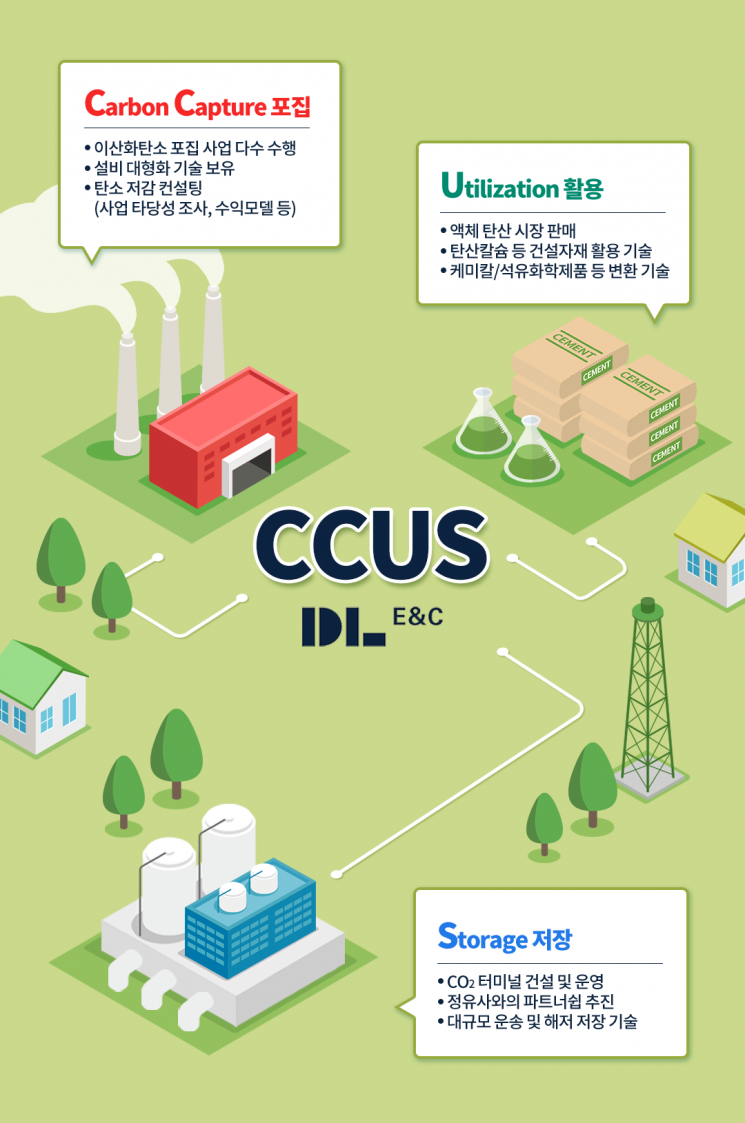
CCUS is a technology that captures carbon emitted during the use of fossil fuels and either stores or utilizes it. It encompasses CCS, which stores captured carbon, and CCU, which utilizes the captured carbon beneficially.
The Intergovernmental Panel on Climate Change (IPCC) forecasted in its Sixth Assessment Report last month that the global average temperature will increase by 1.5°C before 2040. The issue is that to keep the increase within 1.5°C, up to 12.18 billion tons of carbon must be processed through CCUS by 2100.
According to South Korea's National Carbon Neutrality and Green Growth Basic Plan, the 2030 reduction target for CCUS has been expanded by 800,000 tons from the previous 10.4 million tons to 11.2 million tons. Cumulatively, 16.8 million tons must be reduced by 2030, making CCUS technology development and project implementation urgent tasks.
However, CCS is managed by the Ministry of Trade, Industry and Energy, while CCUS falls under the Ministry of Science and ICT, and a clear responsible ministry overseeing CCUS-related policy support has yet to be designated.
Nonetheless, domestic companies have entered the race to secure overseas carbon storage sites. SK E&S is promoting a CCS project with an annual scale of 3 million tons by 2030 in Australia and East Timor. Samsung Engineering is collaborating with six companies to advance a project in Malaysia with an annual scale of 2 million tons starting in 2027.
Countries like South Korea, which lack carbon storage sites, must first establish intergovernmental agreements to transport captured carbon under the London Protocol (Convention on the Prevention of Marine Pollution by Dumping of Wastes and Other Matter). Both countries must also promptly deposit their acceptance of the London Protocol amendment with the International Maritime Organization (IMO).
Kwon Yi-gyun, head of the Korea CCUS Promotion Team, stated, "Intense competition among countries is expected to secure gas fields scheduled for production termination that can be converted into carbon storage sites," adding, "Since South Korea deposited its acceptance of the London Protocol amendment with the IMO in April 2022, it is necessary to negotiate for the counterpart countries that have secured carbon storage sites to promptly deposit their acceptance as well."
High CCUS costs are also a problem. Due to the lack of domestic storage sites, considering transportation costs for exporting carbon, the economic feasibility is significantly lacking. Currently, South Korea's CCUS cost is about $150 per ton of carbon.
To reduce the burden of CCUS costs, the carbon price difference contract system guarantees companies a fixed carbon price for a certain period, reducing uncertainty in investment in carbon neutrality technologies. The Ministry of Environment plans to introduce this system this year in connection with the emissions trading scheme.
Cho Young-jun, Director of the Sustainable Management Institute at the Korea Chamber of Commerce and Industry, said, "With national goals and plans finalized, we must now move into the full implementation phase through the development and commercialization of carbon neutrality measures," adding, "Like Europe and the United States, we need to clearly designate carbon neutrality technologies and industries and provide full support to solve the two national challenges of carbon neutrality and economic growth."
© The Asia Business Daily(www.asiae.co.kr). All rights reserved.

















