Ministry of Education and KDCA Announce Results of 'Student Health Checkup and Youth Health Behavior Survey'
Increase in Students Experiencing Depression and Stress... Youth Alcohol Consumption Rate Rises by Over 2%
It has been revealed that the number of students experiencing depression and stress is steadily increasing. There are also calls for a national-level response as the drinking rate among adolescents has risen. Additionally, while the consumption rate of fast food has increased, the intake of milk and fruits and vegetables has decreased.
The Ministry of Education and the Korea Disease Control and Prevention Agency jointly announced the results of the “Student Health Examination and Youth Health Behavior Survey” conducted last year on the 14th.
The student health examination analyzed physical development status and health checkup results from a sample of 1,062 elementary, middle, and high schools nationwide. The youth health behavior survey collected data on health behaviors such as smoking, drinking, and physical activity from about 60,000 middle and high school students at 800 sampled schools.

◆Elementary Students Grow Taller but Weigh Less=Looking at the physical development status conducted on students from 1st grade elementary to 3rd grade high school to check their growth levels, height slightly increased for 6th grade elementary and 3rd grade high school students compared to the previous year, but for 3rd grade middle school students, boys were 1.2 cm shorter and girls were 0.1 cm shorter.
Weight showed no significant change compared to 2021, but for 6th grade elementary boys and girls and 3rd grade high school girls, height increased while weight decreased by 0.4 to 0.7 kg. The proportion of overweight students remained unchanged, but the proportion of obese students decreased by 0.3 percentage points compared to the previous year.
◆Decrease in Students with Cavities and Vision Problems=Health checkup results for 1st and 4th grade elementary, 1st grade middle, and 1st grade high school students showed that the prevalence of cavities was 18.51%, a decrease of 1.73 percentage points from the previous year.
The proportion of students with vision problems also decreased by 2.85 percentage points to 55.17% from 58.02% the previous year, and the proportion of students undergoing vision correction among those with vision problems dropped by 1.11 percentage points to 30.06%.
Blood tests additionally conducted since 2021 on students diagnosed as overweight or obese showed that abnormalities in high-density lipoprotein (HDL) cholesterol decreased by 1.83 percentage points, and triglycerides decreased by 1.56 percentage points, while abnormalities in low-density lipoprotein (LDL) cholesterol increased by 6.57 percentage points.
◆Youth Smoking Rate Stable, Drinking Amount Increased=Last year, smoking behavior among students from 1st grade middle to 3rd grade high school showed little change, but drinking behavior worsened. The youth smoking rate was 6.2% for boys and 2.7% for girls, similar to the previous year. However, the use of electronic cigarettes increased significantly. The usage rate of liquid-type electronic cigarettes was 4.5% for boys and 2.2% for girls, increasing by 0.8 and 0.3 percentage points respectively, while the usage rate of heated tobacco products was 3.2% for boys and 1.3% for girls, increasing by 1.4 and 0.5 percentage points respectively.
The current drinking rate was 15.0% for boys and 10.9% for girls, up 2.6 and 2.0 percentage points respectively from the previous year. The rate of risky drinking, defined as moderate or higher average drinking per session (5 shots of soju for boys, 3 shots for girls), also increased to 6.1% for boys and 5.1% for girls.
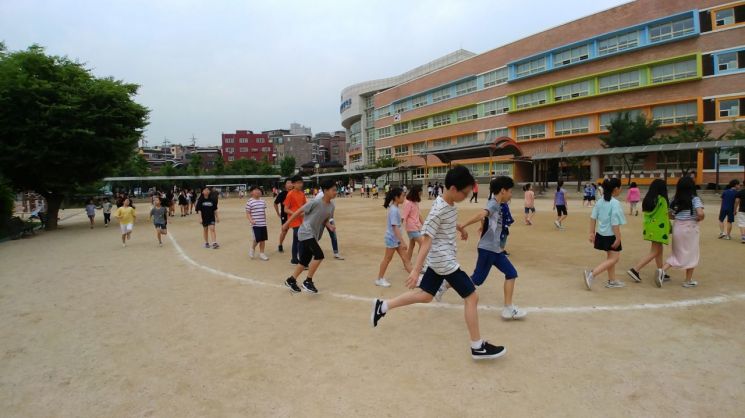
◆Increase in Physical Activity as COVID-19 Eases=The rate of practicing physical activity for 60 minutes a day at least 5 days a week was 23.4% for boys and 8.8% for girls, increasing by 2.7 and 0.7 percentage points respectively compared to the previous year. The rate of practicing high-intensity physical activity at least 3 days a week was 46.6% for boys and 25.8% for girls, increasing by 5.8 and 7.4 percentage points respectively. Notably, middle school students (45.5%) showed an increase of 10.4 percentage points, which was larger than the 2.3 percentage points increase among high school students. The most common reasons for exercising or engaging in physical activity were “because it is fun (33.3%),” followed by “for health (20.6%)” and “for weight loss (16.4%).”
The time spent sitting for study purposes on weekdays was 457 minutes, similar to the previous year’s 459 minutes, but sitting time for non-study purposes decreased on both weekdays (210 minutes to 186 minutes) and weekends (316 minutes to 293 minutes). The regular participation rate in school sports teams (at least one team) was 49.4%, and the rate of directly practicing exercise during school physical education classes (at least twice a week) was 64.0%, both slightly down compared to the previous survey in 2019.
◆Increasing Number of Students Skipping Breakfast=The breakfast skipping rate (percentage of students who did not eat breakfast at least 5 days in the past 7 days) was 39.0%, up 1.0 percentage point from the previous year. The most common reason for skipping breakfast was “lack of time (35.1%),” followed by “lack of appetite (21.4%)” and “stomachache or indigestion (14.0%).”
The fast food consumption rate (3 or more times per week) also increased by 1.1 percentage points to 27.3%, while the fruit consumption rate (at least once daily) decreased by 0.9 percentage points to 17.2%. Vegetable consumption rate (at least 3 times daily) and milk consumption rate (at least once daily) also declined by 2.6 and 4.8 percentage points respectively to 8.3% and 18.0% compared to the 2019 survey.
◆Increase in Student Depression and Stress=Looking at mental health indicators among adolescents, the experience rate of depression was 24.2% for boys and 33.5% for girls, rising by 1.8 and 2.1 percentage points respectively from the previous year. The stress recognition rate also increased by 3.7 and 1.4 percentage points to 36.0% for boys and 47.0% for girls respectively.
The number of students feeling lonely also increased. The loneliness experience rate was 13.9% for boys and 21.6% for girls, up 1.6 and 1.7 percentage points respectively, and the experience rate of generalized anxiety disorder also showed a slight increase to 9.7% for boys and 15.9% for girls.
Meanwhile, the 2022 student health examination sample statistics analysis report will be available on the Ministry of Education Student Health Information Center website (http://www.schoolhealth.kr), and the detailed report of the 18th Youth Health Behavior Survey will be published on the Korea Disease Control and Prevention Agency Youth Health Behavior Survey website (http://www.kdca.go.kr/yhs/).
© The Asia Business Daily(www.asiae.co.kr). All rights reserved.
![User Who Sold Erroneously Deposited Bitcoins to Repay Debt and Fund Entertainment... What Did the Supreme Court Decide in 2021? [Legal Issue Check]](https://cwcontent.asiae.co.kr/asiaresize/183/2026020910431234020_1770601391.png)















