Chairman Kim Jin-pyo "Expect to Complete Electoral System Reform by May"
Working Group Formation Underway
Plan to Gather Public Opinion Through Deliberative Survey
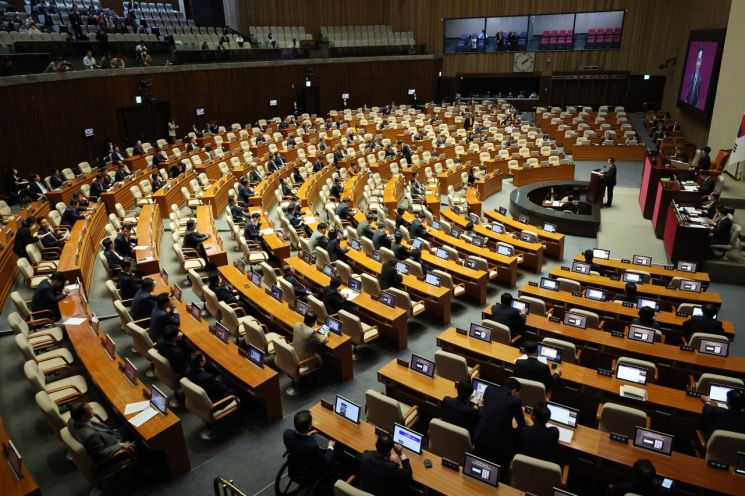
After the four-day schedule of the National Assembly's plenary committee for electoral system reform ended, the National Assembly will begin follow-up work to prepare a bipartisan agreement. A subcommittee within the plenary committee will be established to derive a bipartisan agreement, while simultaneously conducting a public opinion survey to reflect the views of the people through a public deliberation process. Attention is focused on whether the tangled electoral system reform, including the controversy over reducing the number of lawmakers, can be pushed forward.
On the 14th, Speaker of the National Assembly Kim Jin-pyo appeared on SBS Radio's "Kim Tae-hyun's Political Show" and said, "The past four days were a time for free discussion, and now the goal is to gather the various opinions from the forum well and create a unified proposal on constituency elections and proportional representation by the plenary committee with members from both parties." He added, "If possible, we aim to create the unified proposal within April, or at the latest by mid-May, have it voted on in the plenary session, and then send it back to the Special Committee on Political Reform to coordinate with the National Election Commission for electoral district delineation according to that election law." Speaker Kim said, "I think it could be finalized as early as May."
For now, the National Assembly is expected to begin forming a subcommittee within the plenary committee. The day before, Speaker Kim requested in the plenary session regarding the plenary committee, "Chairman Kim Young-joo of the plenary committee (Democratic Party), Democratic Party secretary Jeon Jae-su, and People Power Party secretary Kim Sang-hoon should create a revised proposal that both parties can agree on by properly gathering the valuable opinions of the members that have attracted public attention from the plenary committee through methods such as forming a subcommittee." Following the Speaker's proposal to form a plenary committee subcommittee, both parties are expected to start discussions on subcommittee formation. Democratic Party lawmaker Jeon Jae-su appeared on BBS Radio's "Jeon Young-shin's Morning Journal" and expressed hope that the People Power Party would participate in the subcommittee formation. This indicated the Democratic Party's willingness to respond to the Speaker's proposal and engage in forming the plenary committee subcommittee.
The People Power Party emphasizes that this electoral system reform must be processed through consensus, separate from the subcommittee formation. People Power Party lawmaker Lee Jong-bae pointed out problems during the introduction of the semi-linked proportional representation system before the last general election and urged, "I hope this electoral system reform will be handled through consensus."
Separately from the formation of the plenary committee subcommittee, a public deliberation survey will also be conducted at the level of the Special Committee on Political Reform. The day before, the National Assembly's Special Committee on Political Reform announced through a press release that it had designated a contractor to conduct a "public deliberation survey" for the deliberation process on the National Assembly electoral system. According to the disclosed schedule of the public deliberation survey along with the contractor selection, the Special Committee on Political Reform plans to conduct a public opinion survey in April targeting 5,000 adult men and women nationwide aged 18 and over, followed by a second and third round of deliberative public surveys in May with 500 citizen participants proportionally recruited by region, gender, and age. The citizen participants will receive information about the National Assembly electoral system in advance through materials and video resources, then conduct the public deliberation survey through panel discussions, expert Q&A sessions, and group discussions.
Unlike simple public opinion polls conducted without proper information provision, this approach aims to provide sufficient information beforehand and seek an ideal electoral system through discussions and other processes. There is also high expectation for the public deliberation survey in the political sphere. Democratic Party lawmaker Song Gap-seok said at the plenary committee, "The National Public Deliberation Committee being prepared by the National Assembly's Special Committee on Political Reform is really important," adding, "We should wait for the results of the public deliberation and seriously reflect them in the revision of the election law."
Concerns about future follow-up responses after the plenary committee were voiced in the political sphere. Although the plenary committee was convened for the first time in 20 years and 100 lawmakers expressed their thoughts on electoral system reform and political reform, it has been criticized as a cacophony of voices and chaotic debate. People Power Party lawmaker Cho Eun-hee said, "Although the plenary committee was held for the first time in over 20 years, I fear it will end with just a flood of diverse opinions without fierce debate or sincere efforts to reach consensus," adding, "I am afraid that the public who had some hope will be disappointed as expected."
© The Asia Business Daily(www.asiae.co.kr). All rights reserved.

















