The three major indices of the U.S. New York stock market are all rising in early trading on the 13th (local time) as additional signals confirm that inflationary pressures are easing.
As of 10:17 a.m. at the New York Stock Exchange (NYSE), the Dow Jones Industrial Average is up 96.42 points (0.29%) from the previous close, trading around the 33,742 level. The large-cap S&P 500 index has risen 26.23 points (0.64%) to 4,118, while the tech-heavy Nasdaq index is up 161.39 points (1.35%) at 12,090.
Currently, communication, technology, and consumer discretionary stocks are showing notable gains within the S&P 500. In contrast, real estate and utilities sectors are declining. Leading tech stocks such as Apple, Tesla, Amazon, Alphabet, and Meta Platforms are each recording gains in the 2% range. Delta Air Lines fell more than 3% after releasing earnings that missed Wall Street expectations. Harley-Davidson is down over 4% following UBS's analysis that first-quarter retail sales could drop more than 20% year-over-year. Steven Madden rose more than 2% after Citi upgraded its investment rating to buy.
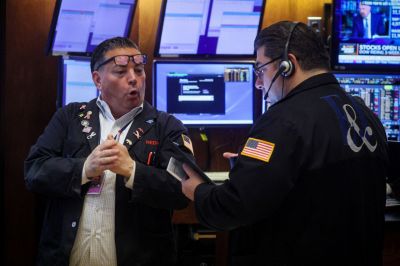
Investors are digesting the previously released Consumer Price Index (CPI) and the minutes from the March FOMC meeting, while also examining key indicators released today such as the Producer Price Index (PPI) and weekly initial jobless claims to gauge future economic outlook and the Federal Reserve's (Fed) policy path. Economic media outlet CNBC reported, "The market is rising on another report (PPI) showing cooling inflation," but added, "However, concerns about an imminent recession limit the gains in the Dow and S&P 500."
The U.S. March PPI, released before the market opened, fell 0.5% month-over-month, marking the largest decline since April 2020. This reversed Wall Street's initial forecast of a 0.1% increase. Compared to a year ago, the PPI increase narrowed to the high 2% range, below the Wall Street estimate of 3.0% and significantly slower than the previous month's 4.9% rise.
Considering that wholesale price increases typically pass through to consumer prices, these figures are interpreted as a signal that inflationary pressures have eased. The Wall Street Journal (WSJ) described it as "an encouraging sign that the Federal Reserve is making progress in its fight against inflation." CNN reported that "March wholesale prices showed a dramatic cooling." The previously released March CPI rose 5% year-over-year, the smallest increase since May 2021 (5.0%).
With the trend of easing inflationary pressures confirmed in both CPI and PPI, market expectations for the Fed's rate hike cycle nearing its end are gaining momentum. The Fed, which declared war on inflation, began raising rates in March last year and has since increased the U.S. benchmark interest rate to 4.75-5.0%. According to the Chicago Mercantile Exchange (CME) FedWatch tool, federal funds futures currently price in over a 60% chance of a 0.25 percentage point rate hike in May, followed by a pause in June and a potential rate cut in July.
Employment data suggesting cooling labor market overheating, a concern for the Fed, was also released. Weekly initial jobless claims reached the highest level since January last year. According to the U.S. Department of Labor, last week's initial claims totaled 239,000, an increase of 11,000 from the previous week. This slightly exceeded market expectations of 232,000. Continuing claims, which count those receiving unemployment benefits for at least two weeks, decreased by 13,000 to 1.81 million.
However, concerns about a recession persist. According to the minutes from the March FOMC meeting released the previous afternoon, Fed officials noted, "Considering the potential economic impact on the banking sector, a mild recession could begin by the end of this year," adding that "recovery is expected to take about two years." The rate decision at that time was made amid turmoil following the collapse of Silicon Valley Bank (SVB) and rising concerns about a banking crisis.
Large banks such as JPMorgan Chase, Citi, and Wells Fargo are scheduled to report earnings the following day. CNBC emphasized, "As earnings season kicks off, the U.S. economy and consumer health will be put to the test." Attention will also focus on any management messages regarding loan regulations and credit tightening stemming from the SVB incident.
In the New York bond market today, U.S. Treasury yields fell after the PPI release. The 10-year Treasury yield is trading around 3.39%, while the 2-year yield, which is sensitive to monetary policy, is near 3.93%. The dollar index, which measures the dollar's value against six major currencies, is down more than 0.5% from the previous close, trading at 100.9.
European stock markets are mixed. Germany's DAX index is down 0.14%, while the UK's FTSE and France's CAC indices are up 0.06% and 0.85%, respectively.
© The Asia Business Daily(www.asiae.co.kr). All rights reserved.

















