Songpa-gu Rises Again After 5 Weeks Since First Week of March
Dongjak-gu Up After 10 Months "Intermittent Demand Occurs"
Apartment prices in Songpa-gu, Seoul, turned to an increase for the first time in five weeks since the first week of March. Dongjak-gu also rose for the first time in about 10 months since the first week of June last year.
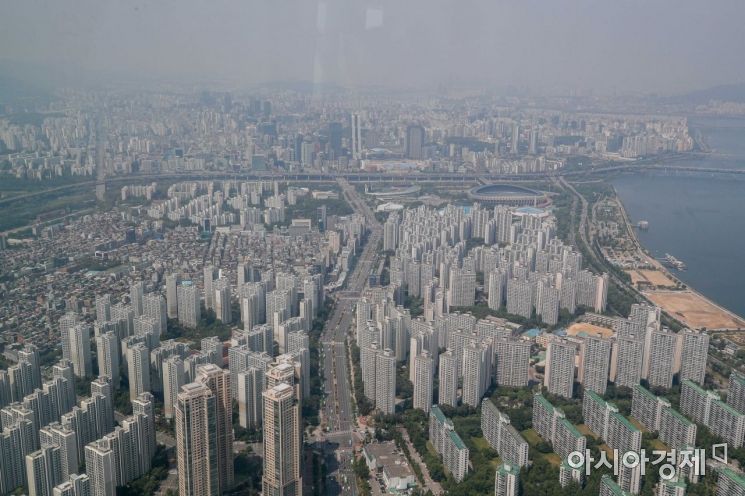 View of apartments from Lotte World Tower Seoul Sky in Songpa-gu, Seoul. / Photo by Jinhyung Kang aymsdream@
According to the weekly apartment price trend announced by the Korea Real Estate Board on the 13th, apartment prices in Seoul fell by 0.11% in the second week of April (as of the 10th), narrowing the decline compared to the previous week (-0.13%).
The Real Estate Board stated, "Despite a cautious stance among buyers, intermittent demand is occurring mainly for mid-to-low priced and small-sized apartments near subway stations," adding, "The decline has slightly eased due to some price increases in inquiries and certain listings." Last week, Seoul apartment prices had recorded no change, halting the eight-week streak of narrowing declines, but this week the rate of decline narrowed again after one week.
By district, apartment prices in Songpa-gu rose by 0.02%. According to the Ministry of Land, Infrastructure and Transport’s real transaction price disclosure system, all listings of Jamsil Els with a net area of 84.8㎡ in Songpa-gu, priced in the 1.9 billion KRW range, were sold out by February, and since March, transactions have been made around 2.15 billion KRW. On the 5th of this month, a 22nd-floor unit was sold for 2.15 billion KRW.
Apartment prices in Dongjak-gu increased by 0.01%, marking the first rise in about 10 months since the first week of June last year (0.01%). A Real Estate Board official explained, "In Dongjak-gu, amid mixed trends, prices rose mainly for small units in Sangdo-dong and Noryangjin-dong."
Elsewhere, the decline narrowed compared to the previous week in Gangnam-gu (-0.10% → -0.01%), Gangdong-gu (-0.07% → -0.05%), Yongsan-gu (-0.09% → -0.05%), and Yeongdeungpo-gu (-0.17% → -0.11%). On the other hand, the decline widened in Nowon-gu (-0.10% → -0.13%), Seodaemun (-0.15% → -0.18%), and Guro-gu (-0.14% → -0.18%) compared to a week ago.
In Gyeonggi Province, the decline notably narrowed from -0.33% to -0.22%. Buoyed by expectations of national industrial complex development, Cheoin-gu in Yongin-si (0.19%) continued its upward trend, and Yeongtong-gu in Suwon-si (0.05%) rose mainly around newly built large complexes in Maetan and Mangpo-dong. Conversely, Osan-si (-0.50%), Uijeongbu-si and Ilsanseo-gu in Goyang-si (each -0.45%), and Hanam-si (-0.38%) continued their downward trends.
Incheon (-0.07%) also significantly reduced its decline compared to last week (-0.20%). Seo-gu (0.12%) turned to an increase due to strong real demand mainly in new towns with favorable living conditions. However, overall, a backlog of listings continued due to a gap between buyers’ and sellers’ desired prices. In the provinces, the five major metropolitan cities showed a 0.24% decline, while Sejong (0.07%) was the only one among the 17 cities and provinces to rise, marking a four-week consecutive increase.
Regarding apartment jeonse (long-term lease) prices, Seoul saw a 0.20% decline, with the rate of decrease easing compared to the previous week (-0.24%). The decline continues due to an overall backlog of listings and scheduled move-in volumes by region, but some areas experienced relocation demand. Sejong (0.03%) was the only city/province to record a three-week consecutive rise in jeonse prices.
© The Asia Business Daily(www.asiae.co.kr). All rights reserved.
!["I'd Rather Live as a Glamorous Fake Than as a Poor Real Me"...A Grotesque Success Story Shaking the Korean Psyche [Slate]](https://cwcontent.asiae.co.kr/asiaresize/183/2026021902243444107_1771435474.jpg)
















