Since Yoon's Inauguration, a Total of 3.1227 Trillion Won Last Year
No Fiscal Rules, Parliament Eased Preliminary Feasibility Reviews
Concerns Over Flood of Election-Promoting Preliminary Feasibility Exemptions
"Even if the population is only 200,000, there would be 2 to 3 subway lines passing through, but our area has a population of 500,000 and has not received any government-funded projects. This is a factor that leads to the evaluation that elected officials lack capability." (Kim Ju-young, Democratic Party of Korea lawmaker, Gyeonggi Gimpo-gap)
"For neglected areas that cannot fall within the scope of preliminary feasibility studies (PFS) even after 10 or 20 years, shouldn't there be exceptional regulations? For example, in Changwon, high-speed rail goes to Daegu and Busan, but the railway to Changwon is an old line." (Kim Young-sun, People Power Party lawmaker, Gyeongnam Changwon-si Uichang-gu)
These remarks were made during the review of a revision bill to the National Finance Act that would significantly relax the exemption criteria for PFS at the Economic and Fiscal Subcommittee of the National Assembly's Planning and Finance Committee on December 5 last year. PFS is a system that assesses the economic efficiency when constructing roads, airports, railways, etc., and currently must be conducted if the total project cost exceeds 50 billion KRW.
At that time, the ruling and opposition parties clashed sharply over the 2023 budget, but they unanimously reached a tentative agreement to raise the PFS project threshold to 100 billion KRW to expedite local projects. This revision bill passed the subcommittee on the 12th, raising concerns that PFS exemption projects, which had slowed under the Yoon Seok-yeol administration, may surge again.
According to data received on the 13th from the Ministry of Economy and Finance by Jang Hye-young, Justice Party lawmaker of the National Assembly Planning and Finance Committee, a total of 3.1227 trillion KRW worth of projects have been exempted from PFS since President Yoon took office. This is the smallest scale of PFS exemption projects in the first year of any administration. The Lee Myung-bak administration exempted 13.759 trillion KRW worth of PFS projects, including the Four Major Rivers Project, in its first year; the Park Geun-hye administration exempted 5.183 trillion KRW; and the Moon Jae-in administration exempted 16.551 trillion KRW.
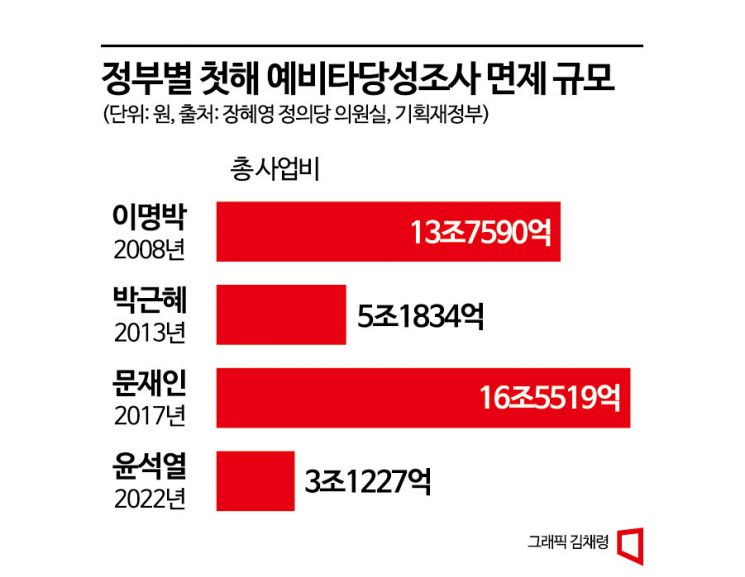
Yoon’s First Year: Reducing PFS Exemptions, Saying 'No to Blind Exemptions'
Since its launch last year, the Yoon Seok-yeol administration has criticized the Moon Jae-in administration for wasting taxpayers’ money by pushing forward 120 trillion KRW worth of government-funded projects exempted from PFS and proposed reforms to strengthen PFS exemption criteria. The scale of PFS exemption projects under the Moon administration jumped from 12.8798 trillion KRW in 2018 to 35.975 trillion KRW in 2019, including regional projects such as the Southern Inland Railway Project (4.6562 trillion KRW) promoted by Gyeongnam Governor Kim Kyung-soo and the Pyeongtaek-Osong double track project (3.0904 trillion KRW) ahead of the 2020 general election. In 2020, emergency disaster relief funds related to COVID-19 (9.663 trillion KRW) and other government-funded projects were exempted from PFS, bringing the total project scale to 30.0215 trillion KRW. Until just before his retirement last year, the government also approved PFS exemption for the Gadeokdo New Airport project, which amounted to 13.7584 trillion KRW.
The reform plan announced by the government in September last year to eliminate 'blind PFS exemptions' focuses on specifying PFS exemption criteria by sector and codifying them in the National Finance Act. Only projects with detailed calculation bases such as project scale and costs, as well as concrete plans for funding, operation, and policy effects, will be eligible for PFS exemption.
At that time, the government said that the PFS system, introduced in 1999, had not reflected the economic scale expansion over the past 23 years, and decided to raise the PFS exemption thresholds for social overhead capital (SOC) and research and development (R&D) projects from 'total project cost of 50 billion KRW or more with at least 30 billion KRW of national funding' to 'total project cost of 100 billion KRW or more with at least 50 billion KRW of national funding.' This was the content passed by the Planning and Finance Committee’s fiscal subcommittee.
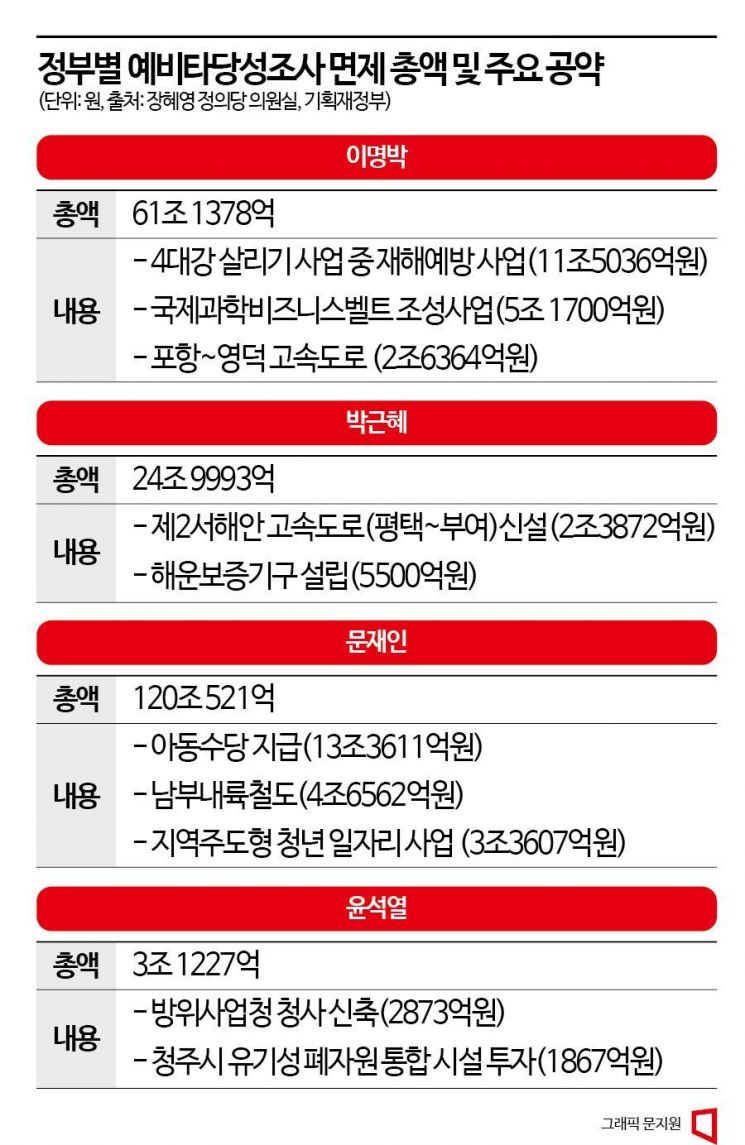
Because of this, the minutes of the tentative agreement between the ruling and opposition parties show that lawmakers expressed concerns about the clause specifying PFS exemption targets. Song Eon-seok, People Power Party lawmaker from Gyeongbuk Gimcheon-si, pointed out, "If it is specified as 'roads under Article 2, Clause 1 of the Road Act,' there may be suspicion that other metropolitan or local roads are excluded from PFS exemption." Shin Dong-geun, chairman of the fiscal subcommittee and Democratic Party lawmaker, said, "PFS exemptions were made for balanced national development, but I am not sure if this means making it stricter and more demanding or just organizing the details more precisely."
Fiscal Rules Neglected... 'Opaque Legislation' Targeting Local Votes
Although the government plans to strengthen PFS exemption criteria, concerns arise that only the exemption amount threshold may be relaxed during the National Assembly review process. Lawmaker Jang Hye-young said, "Since the Yoon administration announced plans last year to minimize PFS exemptions, it should not repeat the behavior of generously exempting large-scale PFS projects as a favor ahead of elections."
In fact, if this revision bill passes the plenary session of the National Assembly, there are concerns that vote-buying local fiscal projects may be recklessly unleashed ahead of next year’s general election. Moreover, bills related to 'fiscal rules' that guarantee fiscal soundness have been postponed due to disagreements between the ruling and opposition parties, drawing fierce criticism as 'collusive legislation' targeting local votes without a 'fiscal breakwater.' In fact, the ruling and opposition parties have already passed the Daegu-Gyeongbuk New Airport Special Act and the Gwangju Military Airport Special Act, each expected to require over 10 trillion KRW in fiscal input, in their respective standing committees.
Professor Lee Byung-tae of KAIST’s Department of Economics pointed out, "Politicians are tempted to allocate and spend budgets without considering economic feasibility. There should be a total cap regulation on how much debt the government can incur. Without this, politics will turn populist, leading to situations like those in Latin American and Southern European countries."
© The Asia Business Daily(www.asiae.co.kr). All rights reserved.
![Clutching a Stolen Dior Bag, Saying "I Hate Being Poor but Real"... The Grotesque Con of a "Human Knockoff" [Slate]](https://cwcontent.asiae.co.kr/asiaresize/183/2026021902243444107_1771435474.jpg)


















