Three Times More Than Before Ukraine Invasion
Imports Surge to Produce War Weapons
Criticism Over US Inability to Track Semiconductor Exports
It has been revealed that Russia circumvented U.S. government semiconductor export restrictions and imported U.S.-made semiconductors worth approximately 1 trillion won by routing through Hong Kong and China. Due to difficulties in procuring semiconductors amid Western sanctions, Russia appears to have employed a detour strategy via China to avoid disruptions in weapons production.
According to customs data from Indian intelligence research firm 'Export Genius,' obtained by the Nihon Keizai Shimbun on the 11th, Russia imported a total of $1.07756 billion (1.4245 trillion won) worth of semiconductors worldwide from February 24 to the end of December last year. This amount is three times higher than the total imports before the Ukraine invasion ($366.71 million).
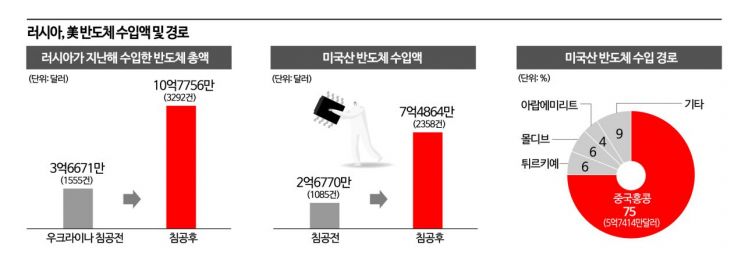
Of the total import value, U.S. semiconductors accounted for $748.64 million. This is 2.8 times more than the amount Russia imported before invading Ukraine.
When U.S. sanctions blocked imports of American semiconductors, Russia circumvented the export ban by routing through Hong Kong and China. According to customs data, Russia imported $574.14 million, which is 75% of its U.S. semiconductor imports, through these two countries. Among them, the volume imported via Hong Kong was larger. The remaining 25% was imported by circumventing through countries such as T?rkiye (6%), Maldives (6%), and the United Arab Emirates (4%).
Russia actively utilized newly established companies related to itself in Hong Kong and China to evade U.S. scrutiny. According to Nihon Keizai, between February and December last year, a Hong Kong company that sold more than 10,000 U.S.-made semiconductors to Russia in 13 shipments was founded by a Russian national. This company exported semiconductors to a firm owned by a Russian tycoon.
New companies in China and Hong Kong mainly sold microprocessors from U.S. semiconductor companies Intel and AMD, as well as Xilinx's FPGA (field-programmable gate arrays), to Russian firms. In addition, several other companies imported U.S.-made semiconductors into Russia, reportedly reestablishing companies if sanctioned to continue supplying semiconductors to Russia.
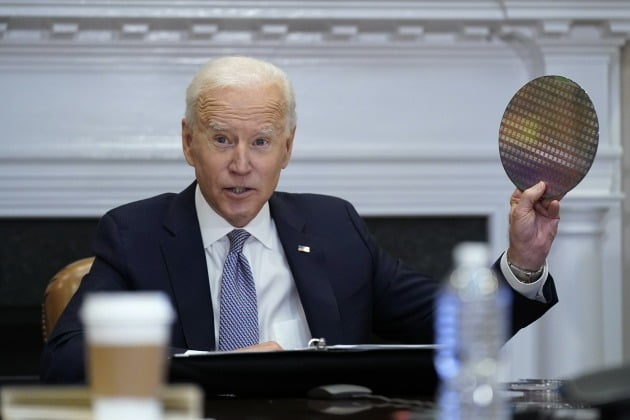
Russia appears to be intensifying efforts to export U.S.-made semiconductors for war weapon production. Advanced semiconductors with high computational processing power are required in large quantities to control missile trajectories and targets. Since the Soviet era, Russia has relied on Western technologies and components, including those from the U.S., to manufacture weapons. However, since February last year, the U.S. has imposed a complete ban on the export of military parts and semiconductors to Russia, leading to a shortage of advanced missiles in Russia's arsenals. In January, the Ukrainian local media outlet 'Kyiv Independent' reported that Russia, facing weapon shortages, has been employing tactics mixing Iranian drones, its own outdated missiles, and precision ballistic missiles.
Some critics argue that the U.S. is unable to accurately track the final destinations of semiconductors distributed worldwide. Dirk Kaps, a senior researcher at the Flanders Peace Institute in Belgium, explained, "It is difficult to identify and monitor the final export destinations of U.S. semiconductors sold through global supply chains."
U.S. semiconductor companies have strongly denied responsibility for exports to Russia, stating that such decisions are not theirs. Intel told Nihon Keizai, "We prohibit all shipments of products to Russian customers," adding, "We comply with export regulations and do not tolerate our products being used for human rights violations." AMD also emphasized, "Our authorized sales agents comply with all global export regulations," and reiterated, "(The export companies pointed out by Nihon Keizai) are not authorized dealers."
© The Asia Business Daily(www.asiae.co.kr). All rights reserved.
![Clutching a Stolen Dior Bag, Saying "I Hate Being Poor but Real"... The Grotesque Con of a "Human Knockoff" [Slate]](https://cwcontent.asiae.co.kr/asiaresize/183/2026021902243444107_1771435474.jpg)

















